Saint profile
Deborah
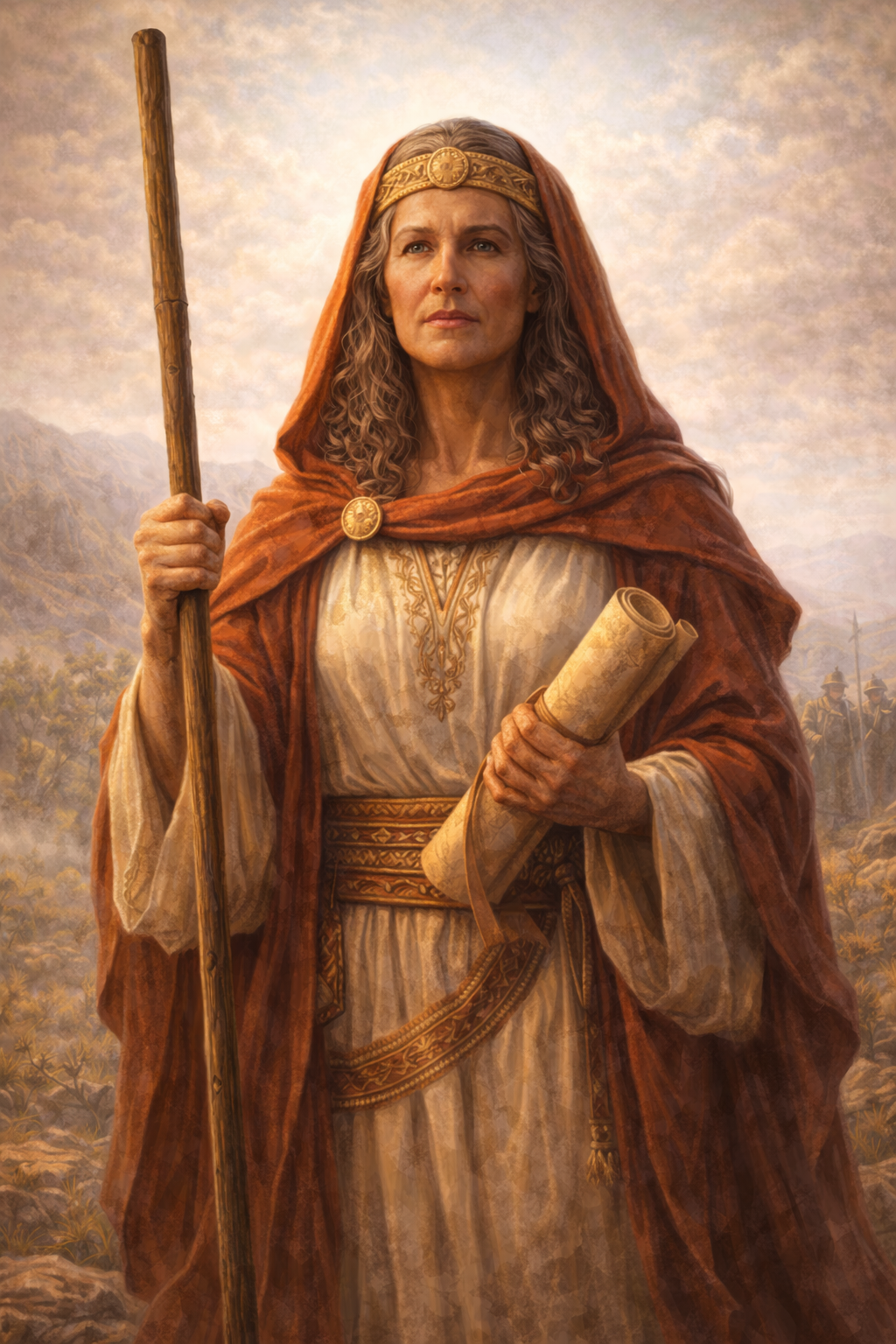
About Deborah
Deborah was a remarkable woman who served as both a prophetess and judge over Israel during a dark period when the Israelites had fallen into idolatry and were oppressed by Jabin, a Canaanite king, and his military commander Sisera. She is one of only a few women in Scripture explicitly called a prophetess and the only female judge mentioned in the Book of Judges.
Deborah held court under a palm tree between Ramah and Bethel in the hill country of Ephraim, known as the Palm of Deborah. There the Israelites came to her to have their disputes decided. She is also identified as the wife of Lappidoth, though little else is known about her husband or family life.
At that time, the Israelites had been cruelly oppressed for twenty years by King Jabin and his commander Sisera, who possessed nine hundred iron chariots and terrorized the people. The Israelites cried out to the Lord, and God raised up Deborah to deliver them.
As a prophetess, Deborah received direct revelation from God and summoned Barak son of Abinoam from Kedesh in Naphtali. She delivered God’s command that Barak was to gather ten thousand men from the tribes of Naphtali and Zebulun and lead them to Mount Tabor. God promised to draw Sisera and his chariots to the Kishon River and give them into Barak’s hands.
Barak, however, refused to go unless Deborah accompanied him. Deborah agreed but prophesied that because of his hesitation, the honor of the victory would not go to him but to a woman. Deborah then went with Barak as they mustered their forces at Mount Tabor.
When Sisera heard of Israel’s mobilization, he brought his chariots and troops to the Kishon River. At God’s command, Deborah told Barak to attack, declaring that the Lord had gone before him. God threw Sisera’s army into confusion, and Barak pursued them until every soldier was killed. Sisera himself fled on foot.
Sisera sought refuge in the tent of Jael, the wife of Heber the Kenite, believing he would be safe there. Jael welcomed him, gave him milk, and covered him with a blanket. While Sisera slept, exhausted, Jael took a tent peg and drove it through his temple, killing him. When Barak arrived in pursuit, Jael showed him Sisera’s body, fulfilling Deborah’s prophecy that a woman would receive the honor of the victory.
Following this deliverance, Deborah and Barak sang a victory hymn known as the Song of Deborah, recorded in Judges chapter five. This ancient poem recounts the battle, praises the tribes who answered the call, rebukes those who did not, and celebrates the Lord as Israel’s divine warrior. Jael is praised as “most blessed of women” for her decisive action.
After this victory, the land had peace for forty years. Deborah’s story is extraordinary because she fulfilled multiple roles—prophet, judge, leader, and worshiper—at a critical moment in Israel’s history. Her life demonstrates that God equips and calls people according to His purposes, regardless of gender, and that faithful leadership requires both listening to God’s voice and acting with courage.