Saint profile
Isidore of Seville
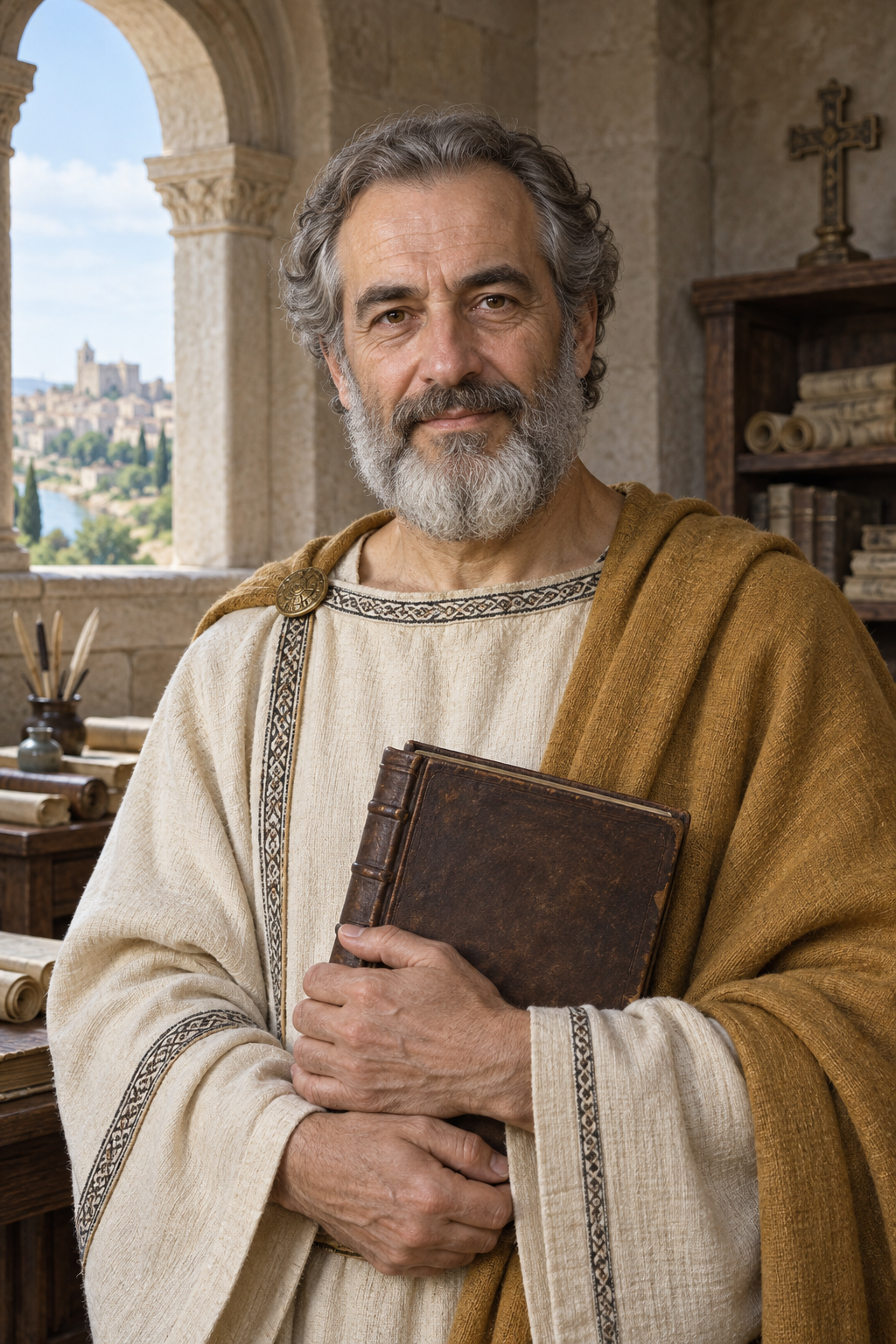
About Isidore of Seville
Isidore of Seville was the most learned man of his age and the last of the great Latin Fathers. Born in Cartagena to a noble Hispanic-Roman family (his siblings Leander, Fulgentius, and Florentina are also saints), Isidore was educated by his older brother Leander, who was bishop of Seville.
When Leander died around 600, Isidore succeeded him as Archbishop of Seville, serving for over 35 years. He presided over several councils, including the Council of Toledo (633), which decreed that every cathedral should establish schools—advancing education in Visigothic Spain.
Isidore's greatest achievement was his writing. His "Etymologiae" (Etymologies), a 20-volume encyclopedia, attempted to compile all human knowledge. It covered grammar, rhetoric, mathematics, medicine, history, theology, agriculture, warfare, and more—everything an educated person should know. While some of its etymologies and science seem naive today, it preserved classical and patristic learning and served as a standard textbook for nearly 1,000 years.
Isidore wrote numerous other works: "De Natura Rerum" (On the Nature of Things), histories of the Goths and the world, theological treatises, biblical commentaries, rules for monks, and liturgical works. His "Sentences" became a standard theology textbook. He compiled one of the first documented attempts at systematic Christian theology.
Isidore established a school in Seville that became a model for cathedral schools throughout medieval Europe. He required clergy to study arts and medicine, not just theology. His emphasis on education and preservation of knowledge helped bridge the ancient and medieval worlds.
Isidore's work converting Arian Visigoths to Catholicism (the Visigoths had converted to Arianism centuries earlier) was crucial to Spanish unity. His efforts culminated in the Visigothic King Reccared's conversion, reuniting Spanish Christians.
Isidore died in Seville in 636, after distributing his wealth to the poor. He was declared a Doctor of the Church in 1722. In 1999, he was proposed as patron saint of the Internet and computer users because his Etymologies represented the world's knowledge compiled in an organized, accessible format—a medieval analog to the Internet.