Saint profile
Gideon
About Gideon
Gideon, also called Jerubbaal, was a judge and military leader whom God raised up to deliver Israel from seven years of severe oppression by the Midianites and Amalekites. His story demonstrates how God uses unlikely people and displays His power through human weakness.
During Gideon’s time, Midianite raids were so devastating that the Israelites hid in mountain clefts, caves, and strongholds. Whenever they planted crops, the invaders swarmed the land with their camels, destroying everything and leaving Israel with nothing. The people were greatly impoverished and cried out to the Lord.
One day, the angel of the Lord appeared to Gideon while he was secretly threshing wheat in a winepress to hide it from the Midianites. The angel greeted him as a “mighty warrior,” but Gideon responded with doubt, questioning how the Lord could be with Israel amid such suffering. God then commissioned Gideon to deliver Israel, promising to be with him. Gideon protested his inadequacy, noting that his clan was the weakest in Manasseh and that he was the least in his family.
Still uncertain, Gideon asked for a sign and prepared an offering. The angel touched it with his staff, fire consumed it, and the angel disappeared. Fearing he would die after seeing the angel of the Lord, Gideon was reassured by God’s words of peace.
That same night, God commanded Gideon to tear down his father’s altar to Baal and the Asherah pole beside it, and to build an altar to the Lord in its place. Gideon obeyed, though he did so at night out of fear. When the townspeople demanded his death, his father Joash defended him, declaring that if Baal were truly a god, he could defend himself. From this event, Gideon received the name Jerubbaal, meaning “let Baal contend with him.”
When the Midianites and Amalekites gathered again for battle, the Spirit of the Lord came upon Gideon, and he blew a trumpet to summon Israel. Thirty-two thousand men answered the call, yet Gideon sought further confirmation from God through two signs involving a fleece. God graciously granted both signs.
As Gideon prepared for battle, God told him he had too many men, lest Israel boast that they had won by their own strength. Through two tests, God reduced Gideon’s army from thirty-two thousand to just three hundred men. God then strengthened Gideon’s faith by allowing him to overhear a Midianite’s dream predicting their defeat.
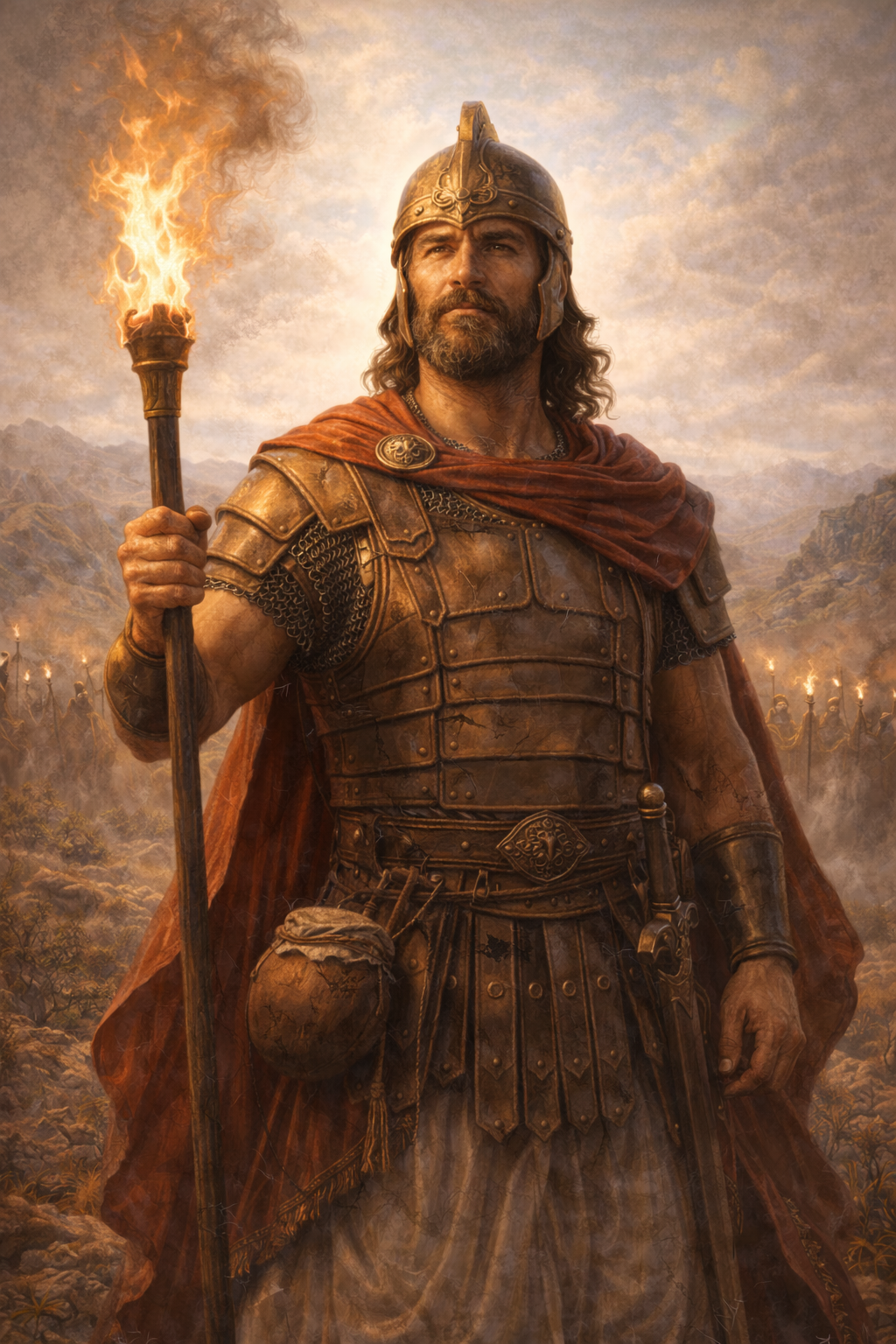
Gideon divided his three hundred men into three companies, giving each man a trumpet and a jar with a torch inside. In the middle of the night, they surrounded the Midianite camp and, at Gideon’s signal, blew their trumpets, broke the jars, raised their torches, and shouted, “A sword for the Lord and for Gideon!” The Midianites fell into panic, turned on one another, and fled.
Gideon pursued the enemy across the Jordan and, with help from other tribes, secured a complete victory. When the Israelites wanted to make him king, Gideon refused, insisting that the Lord would rule over them. However, he later made a gold ephod from the plunder, which became a snare as the people began to worship it.
Gideon had many wives and seventy sons, as well as a son named Abimelech through a concubine. After Gideon’s death, Israel once again turned to Baal worship. Gideon’s story illustrates God’s patience with doubt, His power to work through weakness, and the necessity of giving God alone the glory for victories He accomplishes.