Saint profile
David
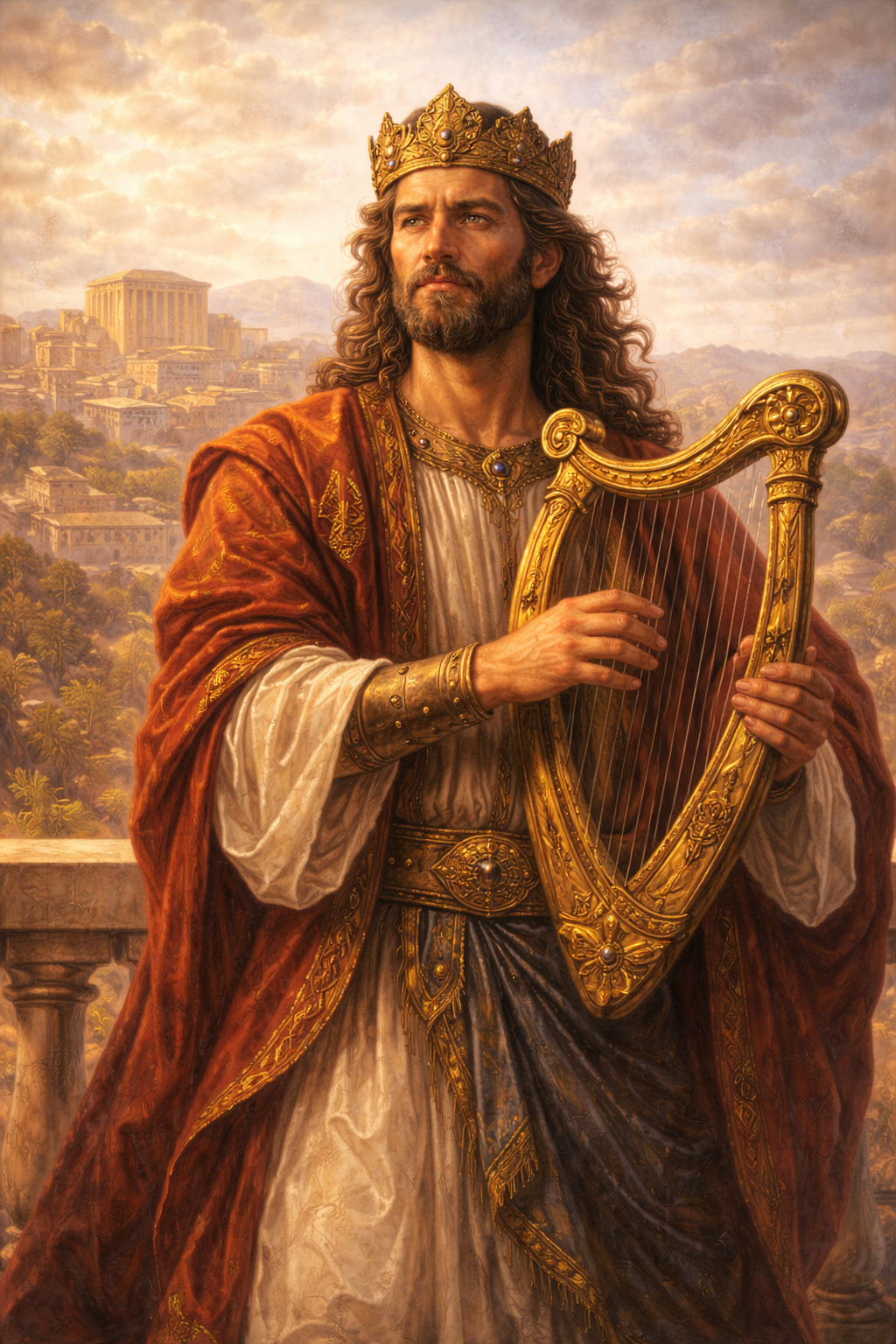
About David
David, the son of Jesse from Bethlehem, was Israel’s greatest king—a man described as being “after God’s own heart.” He was a mighty warrior, gifted musician, and prolific psalmist whose life embodied both great faithfulness and great failure. He was the youngest of eight sons and spent his youth tending his father’s sheep in the fields around Bethlehem, where he killed lions and bears that threatened the flock, developing courage and trust in God.
When the prophet Samuel came to Bethlehem to anoint a new king from among Jesse’s sons, God rejected each of David’s older and more impressive brothers, reminding Samuel that God looks at the heart rather than outward appearance. David was summoned from the fields, and though he was ruddy, with beautiful eyes and a handsome appearance, it was his heart that God had chosen. Samuel anointed him with oil, and the Spirit of the Lord came upon David from that day forward.
At the same time, King Saul was tormented by an evil spirit. His servants recommended a skilled harpist, and David was described as a brave warrior, prudent in speech, handsome, and favored by the Lord. David entered Saul’s service, and whenever Saul was troubled, David played the harp and brought him relief.
When the Philistines gathered for war, the giant Goliath of Gath challenged Israel for forty days, striking fear into the entire army. David arrived to bring food to his brothers and was outraged by Goliath’s defiance of the living God. Saul summoned David, who declared that the same God who delivered him from lions and bears would deliver him from the Philistine. Rejecting Saul’s armor, David chose five smooth stones and faced Goliath with a sling and staff.
David declared he came in the name of the Lord Almighty and struck Goliath in the forehead with a stone, killing him. He then used the giant’s own sword to cut off his head, sending the Philistines fleeing. This victory made David famous throughout Israel.
Saul appointed David as a military commander, and David succeeded in everything because the Lord was with him. The people sang, “Saul has slain his thousands, and David his tens of thousands,” which ignited Saul’s jealousy. Saul repeatedly attempted to kill David, even hurling spears at him while he played the harp.
Saul’s son Jonathan became David’s closest friend, making a covenant with him and protecting him from Saul’s rage. David married Saul’s daughter Michal, who helped him escape when Saul sought to kill him. David fled and became a fugitive, gathering about six hundred men and spending years hiding in the wilderness.
During this period, David had multiple opportunities to kill Saul but refused to harm “the Lord’s anointed,” sparing Saul’s life to demonstrate his loyalty. After Saul and Jonathan were killed in battle on Mount Gilboa, David mourned deeply, composing a moving lament.
David was anointed king over Judah in Hebron, but it took seven years of civil war before all the tribes accepted him as king. He then captured Jerusalem, made it his capital, and brought the Ark of the Covenant there with great celebration, dancing before the Lord with all his might.
God established a covenant with David, promising that his throne would endure forever and that one of his descendants would reign eternally—a promise ultimately fulfilled in Jesus Christ. Though David desired to build a temple for the Lord, God told him that his son would build it instead. David’s reign expanded Israel’s borders through many successful military campaigns.
Despite his devotion, David committed grievous sin. While his army was at war, he committed adultery with Bathsheba and arranged for her husband Uriah to be killed in battle. The prophet Nathan confronted David with a parable, declaring, “You are the man!” David repented deeply, composing Psalm 51, but God pronounced lasting consequences on his household.
The child born from the adulterous union died, though David and Bathsheba later had Solomon, who would succeed David. David’s family life was marked by tragedy—Amnon raped Tamar, Absalom murdered Amnon and later rebelled against David, forcing him to flee Jerusalem. Absalom was eventually killed, and David mourned him bitterly.
In his later years, David conducted a census against God’s will, bringing a devastating plague upon Israel. He purchased the threshing floor of Araunah to build an altar and stop the plague, a site that would later become the location of the Temple.
Before his death, David charged Solomon to walk in God’s ways, keep His commands, and be strong. David reigned forty years—seven in Hebron and thirty-three in Jerusalem—and was buried in the City of David. He authored roughly half of the Psalms, expressing the full range of human emotion before God. Despite his failures, David’s repentance, passion for God, and devotion to God’s house made him the standard by which Israel’s kings were judged, and through his lineage came the Messiah, Jesus Christ, the eternal King.