Saint profile
Solomon
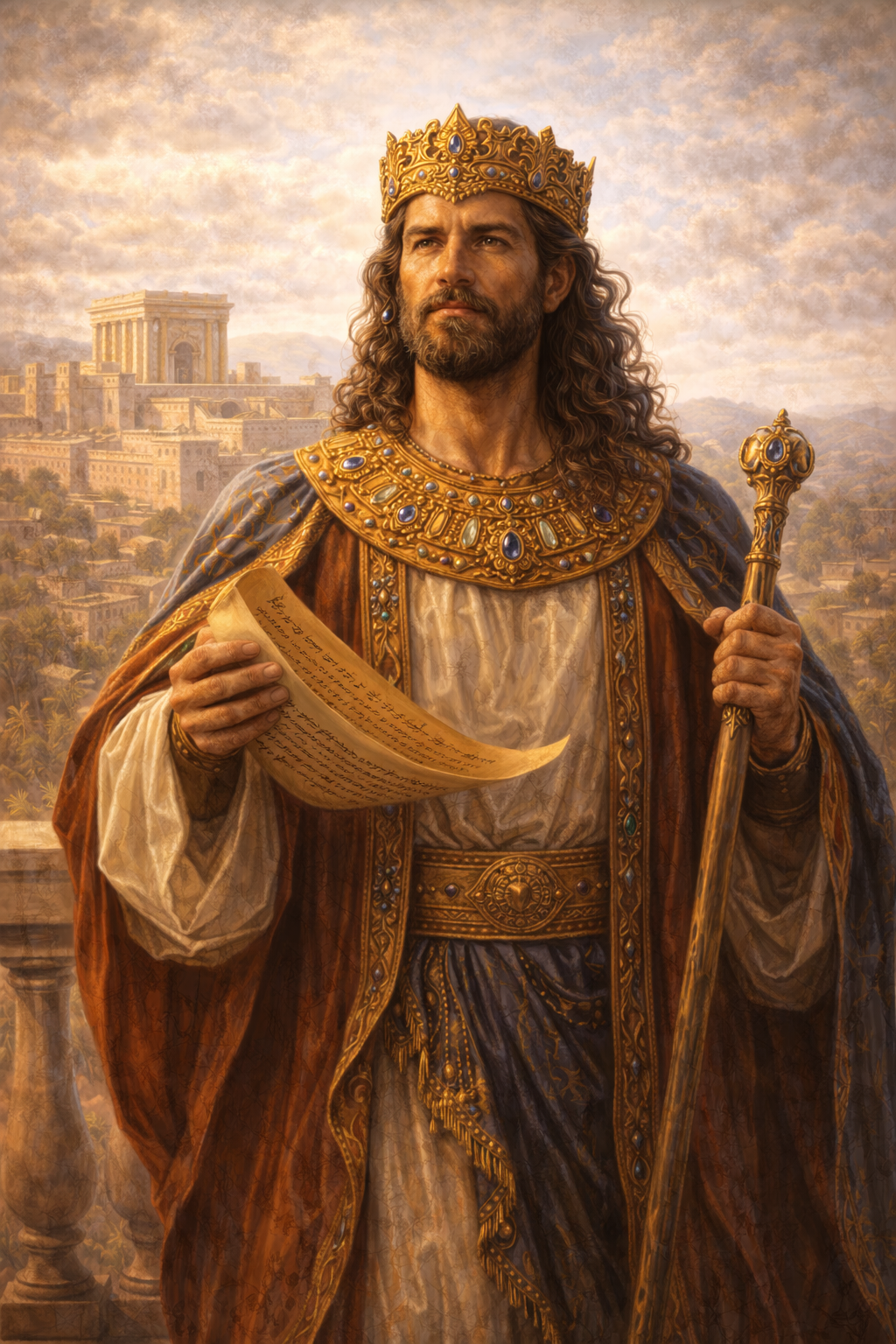
About Solomon
Solomon, whose name means “peaceful,” was the son of David and Bathsheba and became the third king of Israel, reigning during Israel’s golden age. He was renowned throughout the world for his wisdom, wealth, and for building the magnificent Temple in Jerusalem. The prophet Nathan also called him Jedidiah, meaning “beloved of the Lord.” Although Solomon was not David’s firstborn, his path to the throne was secured through the intervention of his mother Bathsheba and the support of Nathan.
As David lay dying, his son Adonijah attempted to seize the throne. Nathan and Bathsheba reminded David of his promise that Solomon would succeed him, prompting David to have Solomon anointed king at Gihon while he was still alive. This decisive action ensured a peaceful succession. After David’s death, Solomon consolidated his power by removing potential rivals, including Adonijah, who was executed after requesting to marry one of David’s former concubines, and Joab, David’s general who had committed murder.
Early in his reign, the Lord appeared to Solomon in a dream at Gibeon and offered him whatever he desired. Solomon did not ask for long life, wealth, or victory over enemies, but for a discerning heart to govern God’s people wisely. God was pleased with this request and granted Solomon extraordinary wisdom and understanding, along with unmatched riches and honor. God also promised Solomon a long life if he walked faithfully in obedience.
Solomon’s wisdom became legendary. A famous example is his judgment between two women claiming to be the mother of the same baby. By proposing to divide the child, Solomon revealed the true mother’s compassion and restored the baby to her. This display of wisdom caused all Israel to stand in awe of him.
People from many nations came to hear Solomon’s wisdom. He spoke thousands of proverbs, composed many songs, and demonstrated remarkable knowledge of plants and animals. Kings from across the known world sent envoys to learn from him, and his reputation spread far and wide.
The greatest achievement of Solomon’s reign was the construction of the Temple in Jerusalem on the threshing floor David had purchased. The Temple took seven years to build and was constructed with the finest materials. When it was completed, Solomon dedicated it with sacrifices and a profound prayer. As the Ark of the Covenant was placed in the Most Holy Place, the glory of the Lord filled the Temple.
God appeared to Solomon a second time, promising to establish his throne if he remained faithful, but warning that disobedience and idolatry would bring judgment on the nation and the Temple. Despite this warning, Solomon continued to expand Israel’s wealth and influence through trade, including shipping ventures and alliances with neighboring kings. His prosperity became so great that silver was said to be as common as stones in Jerusalem.
The Queen of Sheba came to test Solomon with difficult questions and was overwhelmed by his wisdom, wealth, and the splendor of his kingdom. She praised the Lord for placing Solomon on Israel’s throne and recognized God’s blessing upon him.
In his later years, however, Solomon’s heart turned away from the Lord. He loved many foreign women, and as he aged, they led him into the worship of other gods. Solomon built high places for these idols, provoking the Lord’s anger. God declared that the kingdom would be torn from Solomon’s house after his death, leaving only a portion for the sake of David.
God raised up adversaries against Solomon, and the prophet Ahijah foretold that Solomon’s servant Jeroboam would rule over ten tribes. Solomon attempted to kill Jeroboam, who fled to Egypt. Solomon reigned forty years over Israel, then died and was buried in the City of David. His son Rehoboam succeeded him, but his harsh leadership caused the kingdom to divide, just as God had warned.
Solomon’s legacy is complex. He built the Temple that became the center of Israel’s worship and authored enduring books of wisdom such as Proverbs, Ecclesiastes, and the Song of Songs. Yet his compromise with idolatry led to the division of the kingdom and planted seeds of future destruction. His life illustrates that great wisdom and blessing must be accompanied by obedience to God in order to endure.