Saint profile
Elijah
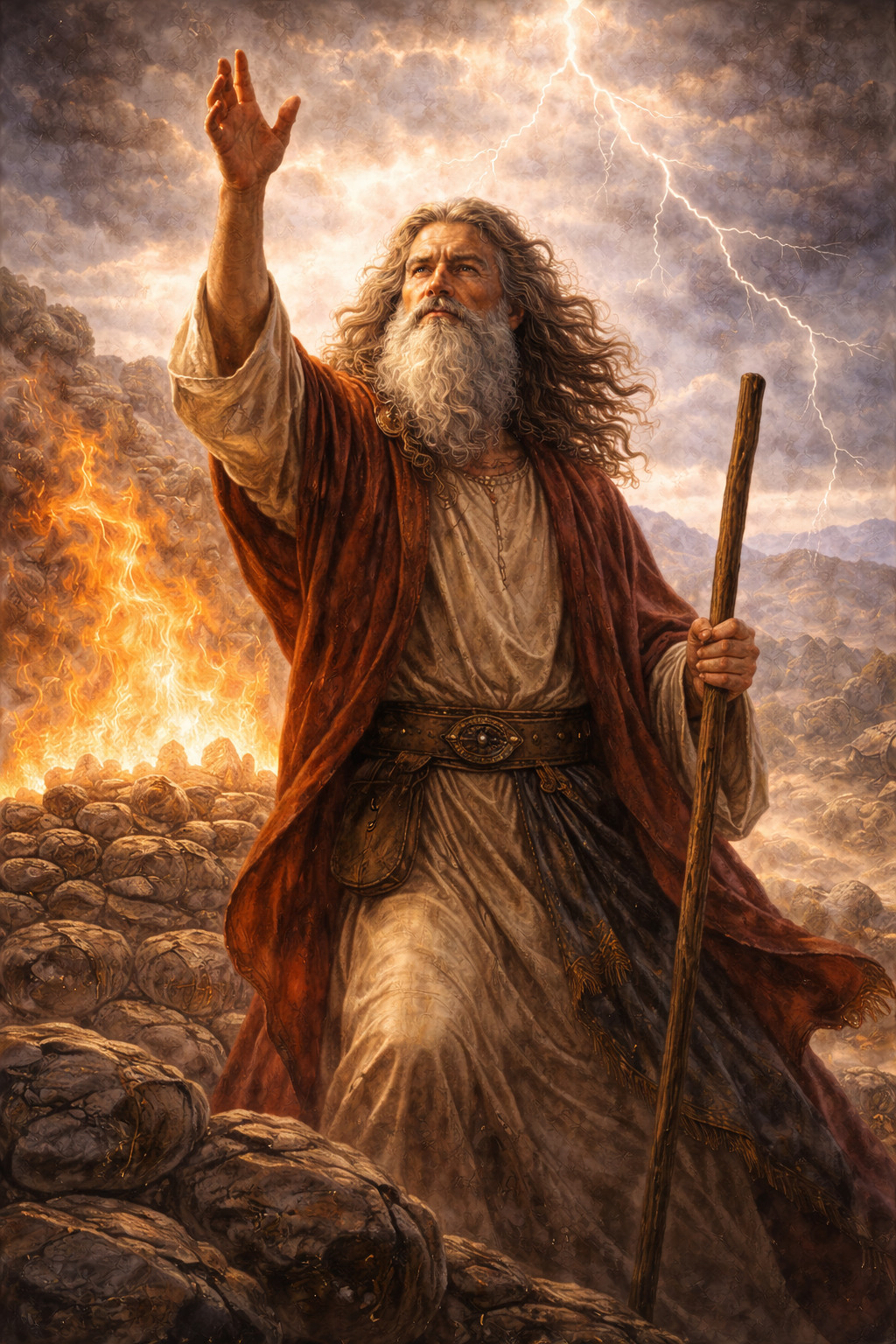
About Elijah
Elijah the Tishbite, from Tishbe in Gilead, was one of the greatest prophets of Israel, known for his zealous defense of true worship and his dramatic confrontations with idolatry during the reign of King Ahab and Queen Jezebel. His ministry took place during one of Israel’s darkest spiritual periods, when Jezebel promoted the worship of Baal and violently persecuted the prophets of the Lord.
Elijah burst onto the scene by appearing before King Ahab and declaring that there would be neither dew nor rain in Israel except at his word—a direct challenge to Baal, who was believed to control storms and fertility. God then instructed Elijah to hide by the Kerith Ravine east of the Jordan, where ravens miraculously brought him food and he drank from the brook.
When the brook dried up because of the drought, God sent Elijah to Zarephath in Sidon to a widow whom He had appointed to provide for him. Elijah found her preparing a final meal for herself and her son before they expected to die of starvation. Elijah told her not to be afraid and promised that her jar of flour and jug of oil would not run out until rain returned. She obeyed, and her household was sustained for many months.
During this time, the widow’s son became ill and died. Elijah prayed earnestly, stretching himself over the child three times, and the Lord restored the boy’s life. This was the first recorded resurrection in Scripture, confirming Elijah’s role as a powerful prophet of God.
After three years of drought, God commanded Elijah to present himself to Ahab and announce the coming rain. Elijah met Obadiah, Ahab’s palace administrator who secretly feared the Lord and had hidden a hundred prophets from Jezebel. When Elijah finally met Ahab, the king accused him of being the “troubler of Israel,” but Elijah replied that Ahab himself was responsible for abandoning the Lord.
Elijah challenged Ahab to gather all Israel, along with the prophets of Baal and Asherah, at Mount Carmel. There Elijah confronted the people, asking how long they would waver between two gods. He proposed a test: whichever god answered by fire would be the true God.
The prophets of Baal cried out from morning until evening, danced, cut themselves, and prophesied wildly, but no fire came. Elijah mocked them openly. When it was his turn, Elijah repaired the Lord’s altar with twelve stones, drenched the sacrifice with water, and prayed a simple prayer. Fire immediately fell from heaven, consuming the sacrifice, the stones, the soil, and even the water in the trench. The people fell facedown and declared that the Lord alone was God.
Elijah ordered the execution of the prophets of Baal in the Kishon Valley. He then announced the coming rain and prayed earnestly on Mount Carmel. After his servant reported a small cloud rising from the sea, heavy rain soon fell, ending the drought.
When Jezebel learned what Elijah had done, she threatened his life. Elijah fled in fear to Beersheba and then into the wilderness, where he collapsed in despair and prayed to die. An angel provided him with food and water, and strengthened by it, Elijah traveled forty days and nights to Horeb, the mountain of God.
At Horeb, God asked Elijah why he was there. Elijah lamented that he was alone and that Israel had abandoned the covenant. God revealed Himself not in wind, earthquake, or fire, but in a gentle whisper. The Lord then commissioned Elijah to anoint new kings and to appoint Elisha as his successor, assuring him that seven thousand in Israel had remained faithful.
Elijah found Elisha plowing and threw his cloak over him, calling him into prophetic service. Elijah continued to confront Ahab, including pronouncing judgment after Naboth was murdered for his vineyard. Though Ahab humbled himself temporarily, judgment was only delayed, not removed.
When the time came for Elijah’s departure, he traveled with Elisha from Gilgal to the Jordan River. Elijah struck the water with his cloak, and the river divided so they crossed on dry ground. Elijah asked Elisha what he desired, and Elisha requested a double portion of his spirit.
As they walked together, a chariot of fire with horses of fire separated them, and Elijah was taken up to heaven in a whirlwind. Elisha witnessed it, took up Elijah’s fallen cloak, and divided the Jordan again, confirming that Elijah’s spirit rested upon him.
Elijah’s life was marked by fearless devotion, divine power, deep human weakness, and extraordinary faith. His mysterious departure without dying elevated his significance in Israel’s memory. Later Scripture foretold Elijah’s return before the day of the Lord, a role fulfilled by John the Baptist, and Elijah appeared with Moses at the Transfiguration of Jesus, representing the prophets alongside the law.