Saint profile
Ruth
About Ruth
Ruth was a Moabite woman whose loyalty, faith, and moral character led her to become an ancestor of King David and ultimately of Jesus Christ, despite being from a nation traditionally hostile to Israel. Her story, recorded in the Book of Ruth, demonstrates God’s grace extending beyond Israel to include Gentiles in His redemptive plan.
During the time when judges ruled Israel, a severe famine struck the land of Judah. A man named Elimelech from Bethlehem took his wife Naomi and their two sons, Mahlon and Kilion, to live in the country of Moab. While there, Elimelech died, leaving Naomi a widow with two sons. The sons married Moabite women—one named Orpah and the other Ruth. After about ten years, both Mahlon and Kilion also died, leaving Naomi with her two daughters-in-law, all three women widowed and childless.
When Naomi heard that the Lord had come to the aid of His people by providing food in Judah, she prepared to return to Bethlehem. Her two daughters-in-law started to go with her, but Naomi urged them to return to their mothers’ homes, praying that the Lord would grant them rest in the home of new husbands. She explained that she had no more sons for them to marry according to the custom of levirate marriage. Orpah kissed Naomi goodbye and returned to her people and her gods, but Ruth clung to Naomi.
When Naomi urged Ruth to return as well, Ruth made one of the most beautiful declarations of loyalty in Scripture: “Where you go I will go, and where you stay I will stay. Your people will be my people and your God my God. Where you die I will die, and there I will be buried.” Seeing that Ruth was determined, Naomi stopped urging her, and the two women traveled together to Bethlehem.
Their arrival caused excitement in the town, with the women exclaiming, “Can this be Naomi?” Naomi told them not to call her Naomi (“pleasant”) but Mara (“bitter”), because the Almighty had dealt bitterly with her—she went away full but had returned empty. They arrived in Bethlehem at the beginning of the barley harvest.
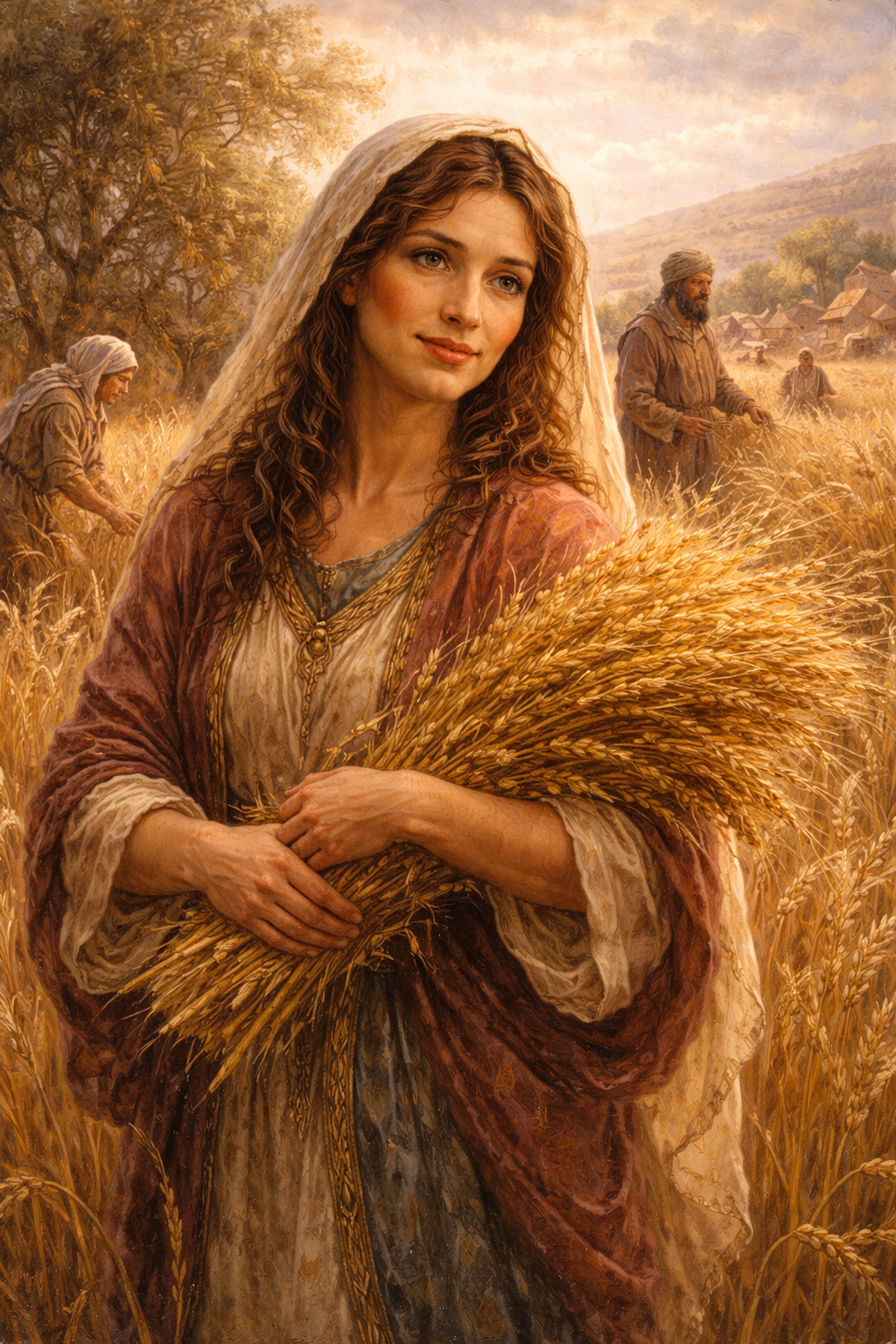
Ruth asked Naomi for permission to glean in the fields behind anyone who would allow her. This practice was provided for in the Law of Moses to care for the poor, widows, and foreigners. Ruth happened to glean in a field belonging to Boaz, a wealthy and honorable man from Elimelech’s clan.
When Boaz noticed Ruth and learned of her loyalty to Naomi, he treated her with kindness and protection, allowing her to glean freely and even providing her food and water. He prayed that the Lord would reward her for seeking refuge under His wings. Ruth worked until evening and returned to Naomi with an unusually large amount of barley, along with food she had saved from her meal.
When Naomi learned that Ruth had gleaned in Boaz’s field, she praised the Lord and explained that Boaz was a guardian-redeemer, a close relative who could preserve the family line. Naomi advised Ruth to remain in Boaz’s fields where she would be safe, and Ruth continued gleaning through the barley and wheat harvests.
After the harvest ended, Naomi devised a plan for Ruth to seek Boaz’s protection through marriage. Following Naomi’s instructions, Ruth approached Boaz at the threshing floor and symbolically requested that he redeem her. Boaz was moved by her loyalty and promised to act, noting that another redeemer had the first right but that he himself would redeem her if the other declined.
The next morning, Boaz went to the town gate and presented the matter before elders and witnesses. When the closer relative declined to redeem Ruth, Boaz formally accepted the responsibility. He declared that he had acquired Ruth as his wife to preserve the family line, and the people blessed their union.
Boaz married Ruth, and the Lord enabled her to conceive. She bore a son, Obed, and the women of Bethlehem rejoiced with Naomi, saying that the Lord had not left her without a redeemer. Naomi cared for the child, and the women proclaimed, “Naomi has a son.”
Obed became the father of Jesse, who was the father of David. Thus Ruth, a Gentile woman from Moab, became the great-grandmother of Israel’s greatest king and an ancestor of Jesus the Messiah. Her story beautifully illustrates that God’s grace transcends ethnic and national boundaries, that loyal love and faithfulness are honored by God, and that those who take refuge under His wings will be blessed.