Saint profile
Jonah
About Jonah
Jonah son of Amittai was a prophet from Gath Hepher in the territory of Zebulun in northern Israel, who lived during the reign of Jeroboam II in the eighth century BC. He is mentioned briefly in 2 Kings as prophesying that Jeroboam would restore Israel's boundaries, a prophecy that came true, showing Jonah was a recognized prophet in Israel. However, Jonah is primarily known for the book bearing his name, which records his attempt to flee from God's call, his experience in the belly of a great fish, and his mission to the great Assyrian city of Nineveh. The book of Jonah is unique among prophetic books in that it is primarily narrative rather than a collection of prophecies, and it focuses more on the prophet's character flaws than on his message.
The word of the Lord came to Jonah: “Go to the great city of Nineveh and preach against it, because its wickedness has come up before me.” Nineveh was the capital of Assyria, Israel's most brutal enemy, known for extreme cruelty in warfare. Rather than obeying, Jonah immediately ran in the opposite direction, going down to Joppa where he found a ship bound for Tarshish, likely in Spain, as far west as one could sail from Nineveh. He paid the fare and boarded, attempting to flee from the Lord.
The Lord sent a great wind on the sea, creating such a violent storm that the ship threatened to break up. The sailors were terrified and each cried out to his own god, throwing the cargo into the sea to lighten the ship. Meanwhile, Jonah had gone below deck, lay down, and fallen into a deep sleep, suggesting a troubling spiritual apathy. The captain found him and urged him to call on his god so they would not perish. The sailors cast lots to find who was responsible for the disaster, and the lot fell on Jonah.
Questioned about his identity, Jonah admitted he was a Hebrew who worshiped the Lord, the God who made the sea and dry land, and that he was running from Him. Terrified, the sailors asked what they should do to calm the sea. Jonah told them to throw him into the sea, acknowledging his guilt. The sailors tried to row to shore, but the storm worsened. Finally, they prayed to the Lord for mercy and threw Jonah overboard. Immediately, the sea became calm, and the sailors feared the Lord, offered sacrifices, and made vows to Him.
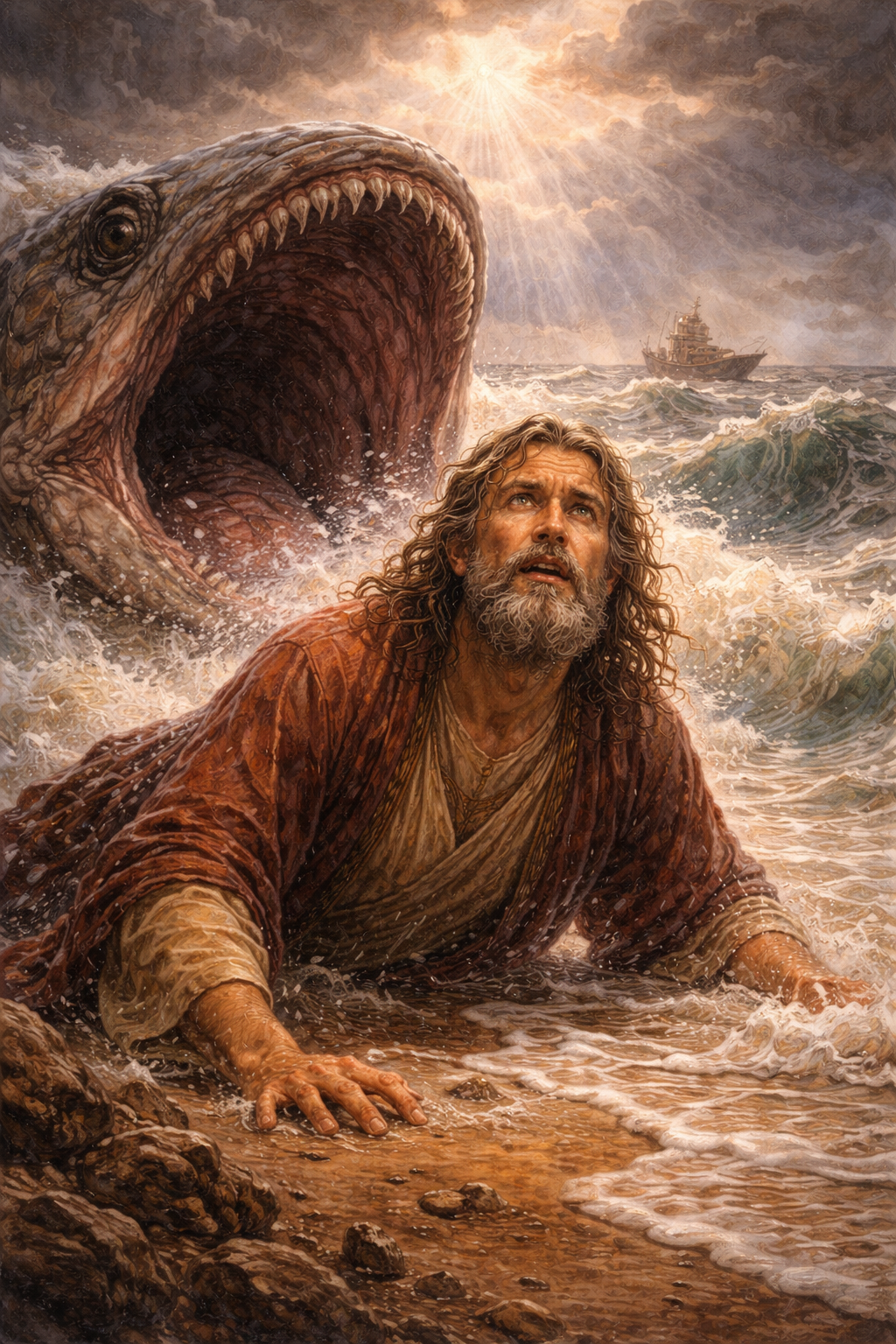
The Lord then provided a great fish to swallow Jonah, and he remained in its belly for three days and three nights. From inside the fish, Jonah prayed to the Lord, describing his distress and descent into the depths, entangled in seaweed and barred in by the earth. Yet he acknowledged that the Lord brought his life up from the pit. He vowed to worship and declared, “Salvation comes from the Lord.” At God’s command, the fish vomited Jonah onto dry land.
The word of the Lord came to Jonah a second time, commanding him again to go to Nineveh. This time Jonah obeyed. Nineveh was an enormous city, requiring three days to traverse. Jonah entered the city and proclaimed a stark message: “Forty more days and Nineveh will be overthrown.” Though brief and lacking an explicit call to repentance, the people believed God. They fasted, wore sackcloth, and turned from their evil ways. Even the king humbled himself, calling the people to repent in hopes that God might relent.
When God saw their repentance, He spared the city. This mercy enraged Jonah. He prayed angrily, admitting that he fled earlier because he knew God was gracious, compassionate, slow to anger, and abounding in love. He asked God to take his life. God questioned Jonah’s anger, but Jonah left the city and waited to see what would happen.
God provided a leafy plant to shade Jonah, bringing him comfort, but the next day a worm destroyed it. Then God sent a scorching east wind, and Jonah again wished for death. God asked if Jonah had the right to be angry about the plant. Jonah insisted that he did. God responded by pointing out Jonah’s concern for a plant he did not create, contrasting it with God’s compassion for Nineveh, a city of over 120,000 people—and even its animals.
The book ends with God’s unanswered question, forcing readers to confront their own attitudes toward divine mercy. Jonah’s story highlights God’s sovereignty over creation, His compassion for all people—including enemies—and the futility of fleeing from His will. Jesus later referenced Jonah’s three days in the fish as a sign foreshadowing His own burial and resurrection, noting that Nineveh’s repentance condemned those who rejected a greater message.
Jonah stands as both a remarkably effective prophet, whose preaching sparked one of history’s greatest revivals, and a cautionary example of a servant who understood God’s truth but resisted sharing God’s heart.