Saint profile
Melchizedek
About Melchizedek
Melchizedek is one of the most mysterious and significant figures in Scripture, appearing briefly in Genesis yet echoed throughout the Bible as a type that prefigures Christ’s eternal priesthood. His name means “king of righteousness,” and he served as both king of Salem (later Jerusalem) and priest of God Most High during the time of Abraham.
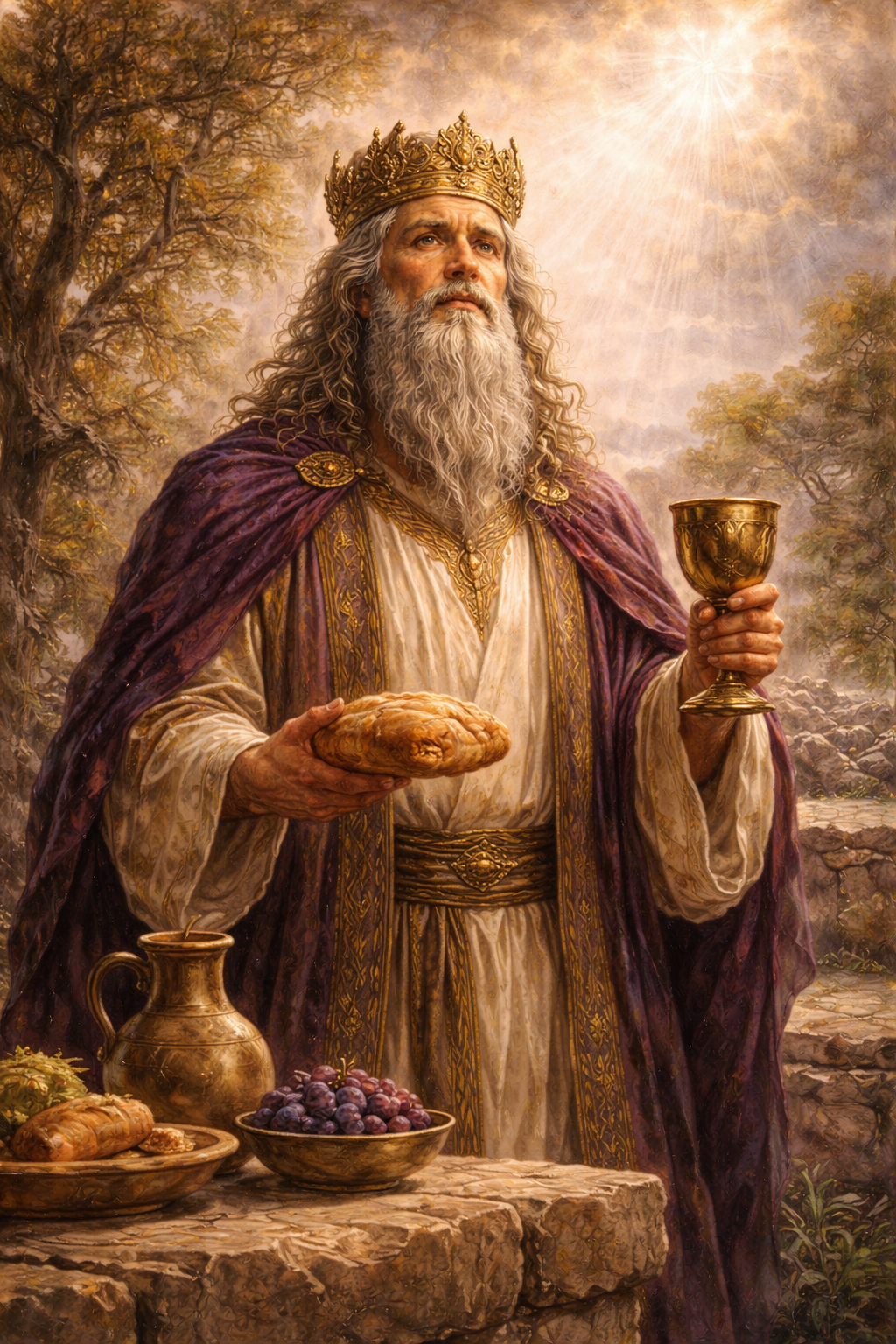
The first mention of Melchizedek occurs in Genesis 14, after Abraham returned from defeating the kings who had captured his nephew Lot. Melchizedek, king of Salem, brought out bread and wine and blessed Abraham, proclaiming blessing from God Most High, Creator of heaven and earth, and praising God for delivering Abraham’s enemies into his hand. Abraham responded by giving Melchizedek a tenth of everything, acknowledging his superior priestly status.
This encounter is remarkable for several reasons. Melchizedek appears without genealogy or introduction, implying an already established authority. He is called “priest of God Most High,” the same God Abraham worshiped, showing that true worship existed outside Abraham’s lineage. He blesses Abraham—demonstrating spiritual superiority—and receives tithes from him, something especially striking given Abraham’s role as the father of the faithful. The bread and wine he brings have long been understood by Christians as foreshadowing the Eucharist.
Melchizedek appears again in Psalm 110, a royal psalm attributed to David, where God swears an oath to the Messiah: “You are a priest forever, in the order of Melchizedek.” This psalm, one of the most quoted Old Testament passages in the New Testament, establishes that the coming Messianic king would also be a priest—distinct from the Levitical order descended from Aaron.
The Book of Hebrews provides the most extensive explanation of Melchizedek’s significance (chapters 5–7). The author argues that Jesus Christ is our high priest according to the order of Melchizedek, not Aaron. The Levitical priesthood depended on genealogy and was temporary, as priests died and were replaced. By contrast, Melchizedek appears in Scripture without recorded parents, genealogy, or death, making him a fitting type of an eternal priesthood.
Hebrews emphasizes that Melchizedek was greater than Abraham because he blessed him and received tithes from him. Since Levi was still within Abraham at that moment, even the Levitical line is said, in a sense, to have paid tithes to Melchizedek—demonstrating the superiority of this priesthood. The law-based Levitical system could not bring perfection, which is why Scripture foretold a different priesthood.
Jesus, though from the tribe of Judah rather than Levi, became a priest not by physical descent but by the power of an indestructible life. God appointed Him with an oath—“You are a priest forever”—granting Him a permanent priesthood. Unlike Levitical priests who offered repeated sacrifices, Jesus offered Himself once for all, a perfect and sufficient sacrifice, and now serves in the true heavenly sanctuary as mediator of a better covenant.
Melchizedek thus functions as a powerful type of Christ. Both are kings of righteousness and peace, priests of God Most High, and holders of an eternal priesthood superior to the Levitical order. Melchizedek’s lack of recorded genealogy and Jesus’ eternal divine nature further align the type and its fulfillment. Even the offering of bread and wine echoes forward to the Lord’s Supper.
Some Christian traditions have suggested that Melchizedek was a pre-incarnate appearance of Christ, though most interpreters understand him as a historical figure whose unique role made him an ideal foreshadowing of the Messiah. In either case, Melchizedek stands as a figure of profound theological significance, showing that God’s redemptive purposes predate Israel, that kingship and priesthood unite in the Messiah, and that an eternal priesthood—fulfilled in Jesus Christ—supersedes the temporary Levitical system.