Saint profile
Susanna
About Susanna
Susanna, whose name means “lily,” is the heroine of a deuterocanonical addition to the Book of Daniel, found in chapter 13 in Catholic and Orthodox Bibles. Her story is a dramatic account of faithfulness to God in the face of sexual harassment, false accusation, and impending death, ultimately vindicated through divine wisdom working through the young prophet Daniel.
Susanna was a very beautiful woman who feared the Lord. She was the daughter of Hilkiah and the wife of Joakim, a very wealthy and honorable man in the Jewish community living in Babylon during the exile. Because Joakim was highly respected, his house had a large garden attached to it, and the Jews would gather there, using his house as a place for judicial proceedings.
That year, two elders from among the people were appointed as judges, but they were corrupt men of whom the Lord had said, “Wickedness came forth from Babylon, from elders who were judges, who were supposed to govern the people.” These two elders would sit in Joakim’s house, and people would come to them for judgment.
Every day at noon, after the people had left, Susanna would walk in her husband’s garden. The two elders saw her entering the garden each day and began to lust after her. They perverted their thinking, turning their eyes from heaven and not remembering righteous judgments. Though both were overwhelmed with passion for her, neither revealed his feelings to the other, for they were ashamed to disclose their lust. Day after day they watched eagerly for a glimpse of her.
One day they said to each other, “Let us go home, for it is time for lunch.” They went their separate ways, but both turned back and arrived at the same place at the same time. When they questioned each other about this, each admitted his lust for Susanna. Together they conspired to find an occasion when she might be alone so they could force themselves upon her.
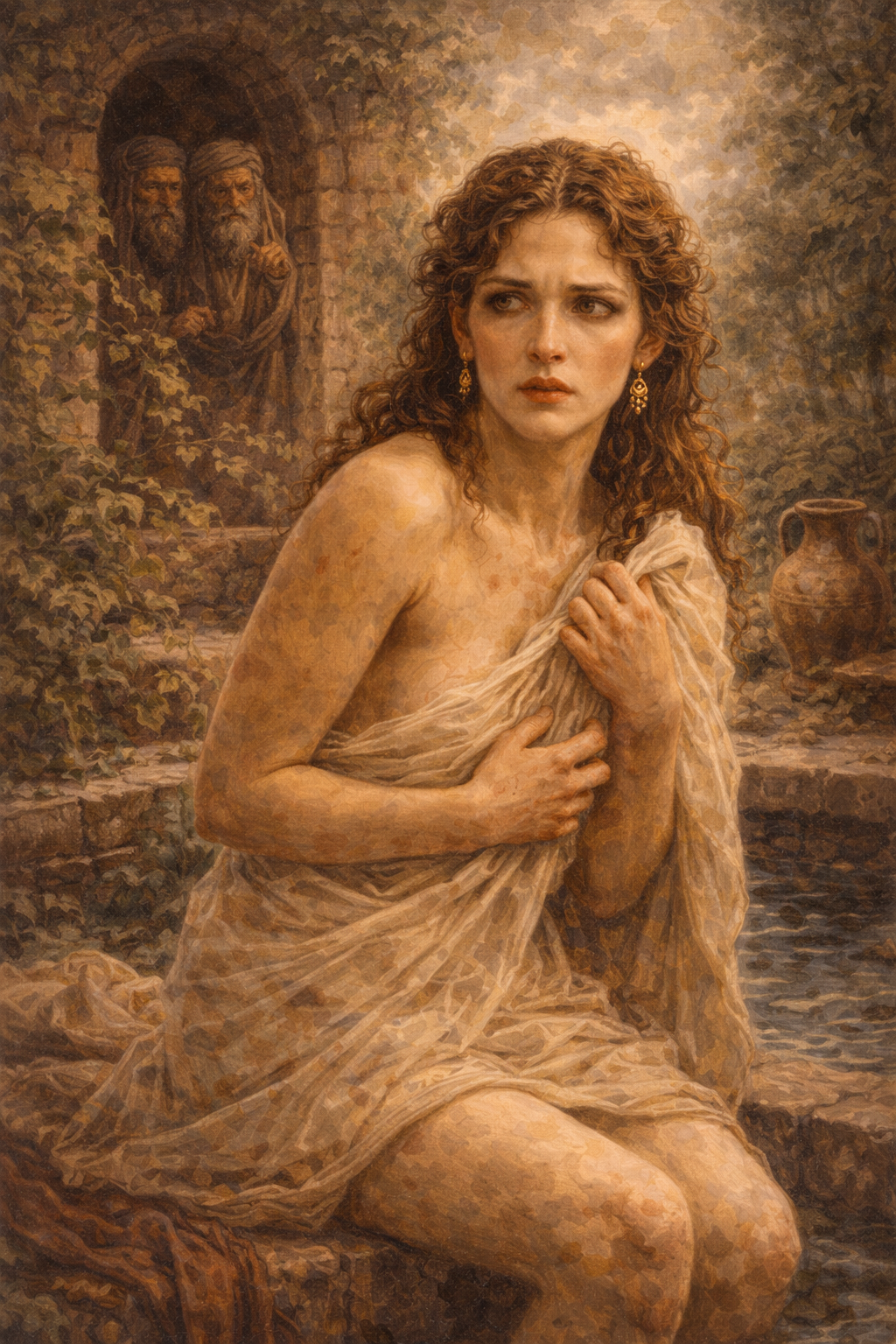
One day, as they were watching for an opportune moment, Susanna entered the garden as usual with only her two maids, and it was very hot. She decided to bathe in the garden and sent her maids to bring her oil and ointments and to shut the garden doors so she could bathe in privacy. The maids did as commanded and left by the side doors to fetch what she needed, not knowing the elders were hiding in the garden.
As soon as the maids had left, the two elders ran to Susanna and said, “Look, the garden doors are shut and no one can see us. We are burning with desire for you; so consent and lie with us. If you refuse, we will testify against you that a young man was with you and that is why you sent your maids away.”
Susanna groaned and said, “I am completely trapped. If I do this thing, it means death for me; if I do not, I cannot escape your power. Yet it is better for me to fall into your power without doing it than to sin in the sight of the Lord.” Then she cried out with a loud voice.
The two elders also shouted against her, and one of them ran and opened the garden doors. When the household servants heard the shouting in the garden, they rushed in through the side door to see what had happened. When the elders told their story, the servants were greatly ashamed, for nothing like this had ever been said about Susanna.
The next day, when the people assembled at Joakim’s house, the two wicked elders came, fully determined to have Susanna put to death. They sent for Susanna, daughter of Hilkiah, wife of Joakim. She came with her parents, her children, and all her relatives.
Susanna was very delicate and beautiful in appearance, and because she was veiled, the scoundrels ordered that she be unveiled so they could feast on her beauty. All who knew her wept. The two elders stood up before the people and laid their hands on her head, and she, weeping, looked up toward heaven, for her heart trusted in the Lord.
The elders testified, claiming they had seen Susanna with a young man in the garden who escaped. The assembly believed them because they were elders and judges of the people, and they condemned Susanna to death.
Susanna cried out with a loud voice, “O eternal God, who knows what is secret, who are aware of all things before they come to be, you know that these men have given false evidence against me. And now I am to die, though I have done none of the wicked things they have charged against me!”
The Lord heard her cry, and just as she was being led away to execution, God stirred up the holy spirit of a young lad named Daniel. He shouted, “I want no part in shedding this woman’s blood!” Daniel demanded that the elders be separated and examined individually.
When questioned, each elder identified a different tree under which the alleged act had taken place. Daniel exposed their lies, declaring that their false testimony had condemned them by their own words.
The whole assembly raised a great shout and blessed God who saves those who hope in Him. In accordance with the Law of Moses, the people did to the elders what they had wickedly planned for Susanna, and they were put to death. Thus innocent blood was spared that day.
Hilkiah and his wife praised God for their daughter Susanna, as did her husband Joakim and all her relatives, because she was found innocent of a shameful deed. From that day onward, Daniel had a great reputation among the people.
Susanna’s story has been celebrated throughout Christian history as an example of courageous chastity, trust in God in desperate circumstances, and vindication of the innocent through divine intervention. Her choice to risk death rather than sin demonstrates heroic virtue and serves as a powerful warning against corrupt leadership and the necessity of justice grounded in truth.