Saint profile
Solomonia
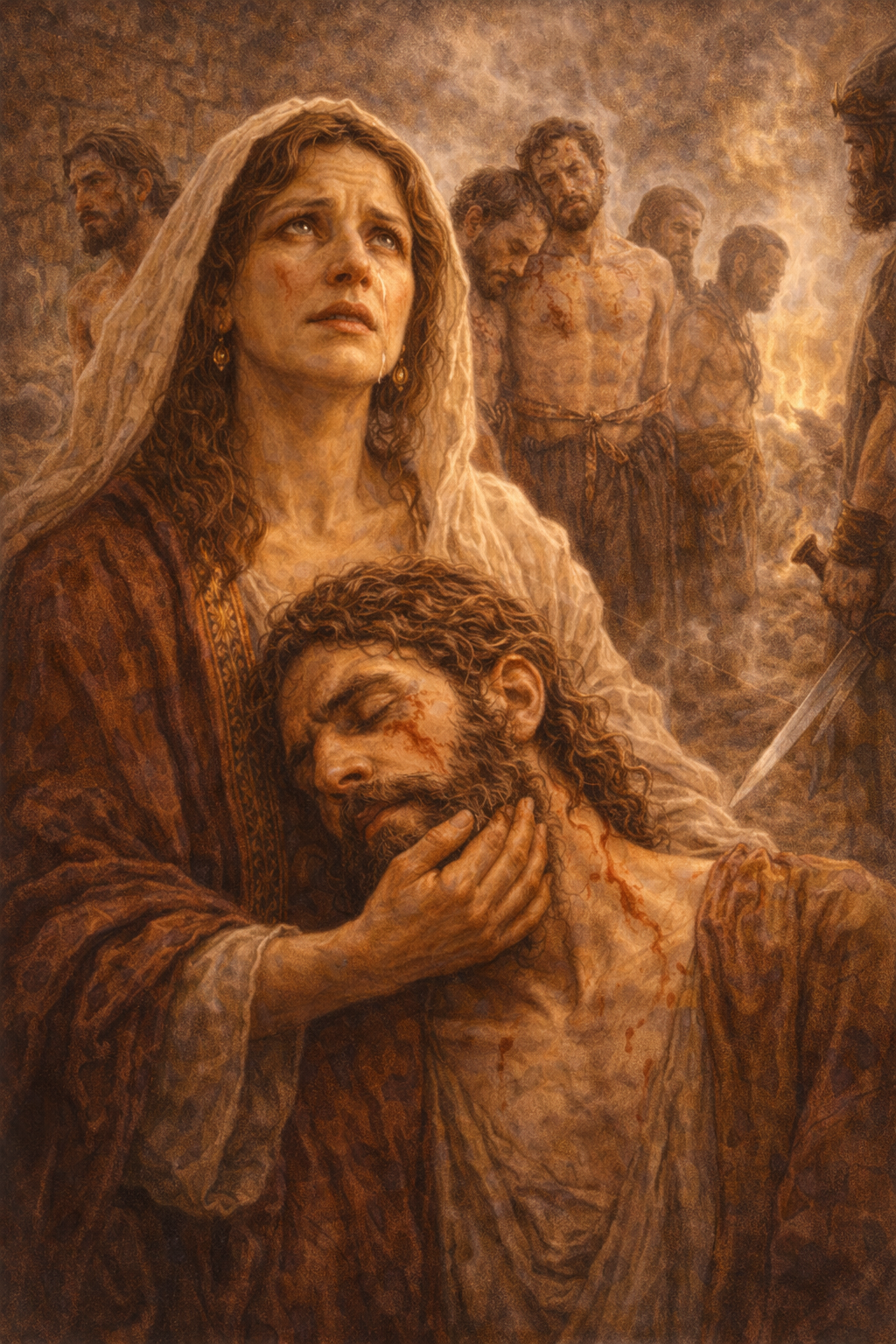
About Solomonia
Solomonia, also known as the Mother of the Maccabees or, in Jewish tradition, sometimes as Hannah, was a Jewish woman whose faith and courage in the face of horrific persecution have been honored by Jews and Christians for over two millennia. Her story is recorded in 2 Maccabees chapter 7 and represents one of the most powerful testimonies of maternal strength and faithfulness to God in all of Scripture.
During the persecution under Antiochus IV Epiphanes around 167 BC, shortly after the martyrdom of the elderly scribe Eleazar, this remarkable woman and her seven sons were arrested and brought before the king. They were ordered to taste pork in violation of God’s law and were tortured with whips and scourges to force their compliance. The eldest son spoke for them all, declaring, “What do you intend to ask and learn from us? For we are ready to die rather than transgress the laws of our ancestors.”
The enraged king ordered that pans and caldrons be heated, and when they were immediately heated, he commanded that the tongue of the spokesman be cut out, that he be scalped, and that his hands and feet be cut off, while his mother and brothers watched. When he was utterly helpless but still breathing, the king ordered him to be brought to the fire and fried in the pan. As the smoke spread widely, the brothers and their mother encouraged one another to die nobly, saying, “The Lord God is watching over us and in truth has compassion on us.”
The second brother was then brought forward for torture. After the skin of his head with the hair was torn off, they demanded that he eat pork rather than be tortured limb by limb. He replied in the language of his fathers, “No!” As he died, he proclaimed, “You accursed wretch, you dismiss us from this present life, but the King of the universe will raise us up to an everlasting renewal of life, because we have died for his laws.”
The third brother courageously put out his tongue and stretched forth his hands, saying, “I got these from Heaven, and because of his laws I disdain them, and from him I hope to get them back again.” Even the king and those with him were astonished at his spirit, for he regarded his sufferings as nothing. The fourth brother was tortured in the same way, declaring near death that it was better to die at the hands of mortals while cherishing the hope of resurrection, while warning the king that there would be no resurrection to life for him.
The fifth son was dragged forward and tortured, telling the king not to think that God had forsaken His people and warning that divine judgment would come upon him and his descendants. The sixth brother followed, explaining that their suffering was the result of their own sins against God, but that the king himself would not go unpunished for fighting against God.
Throughout all this, the mother was especially admirable and worthy of honorable memory. Although she saw her seven sons perish within a single day, she bore it with courage because of her hope in the Lord. She encouraged each of them in the language of their fathers, filled with a noble spirit and reinforcing her woman’s reasoning with a man’s courage. She reminded them that God, the Creator of the world, would in His mercy give them life and breath again because they were dying for His laws.
When only the youngest son remained, Antiochus appealed to him with promises of wealth, power, and friendship if he would abandon the ways of his ancestors. The king even urged the mother to persuade her son to save himself. Pretending to comply, she leaned close to him and, speaking in their native language, urged him instead to remain faithful, reminding him of creation, God’s power, and the hope of resurrection.
The youngest son openly defied the king, declaring that he would obey the law given through Moses rather than the king’s command. Enraged, Antiochus tortured him more cruelly than the others, and he too died in purity, placing his full trust in the Lord. Last of all, after her sons, the mother herself died.
This remarkable account of Solomonia and her seven sons has been commemorated in both Jewish and Christian tradition as a supreme example of maternal courage and faithfulness. Her strength in encouraging each son to remain faithful, her theological depth in speaking of creation and resurrection, and her willingness to die rather than compromise God’s law made her a model for believers facing persecution.
The seven brothers are honored as martyrs, with later Christian traditions assigning them names not found in the original text. Their martyrdom is especially significant for its clear articulation of belief in bodily resurrection within Jewish thought. Their deaths, following shortly after that of Eleazar, helped inspire the Maccabean revolt that eventually restored the temple, though they did not live to see that victory.
Their feast is celebrated on August 1 in both the Roman Catholic and Eastern Orthodox calendars. The courage of Solomonia and her sons has inspired countless martyrs throughout history and stands as a testament to the power of faith, the importance of parents modeling fidelity to God, belief in resurrection and divine justice, and the ultimate triumph of those who remain faithful to God even unto death.