Saint profile
Peter
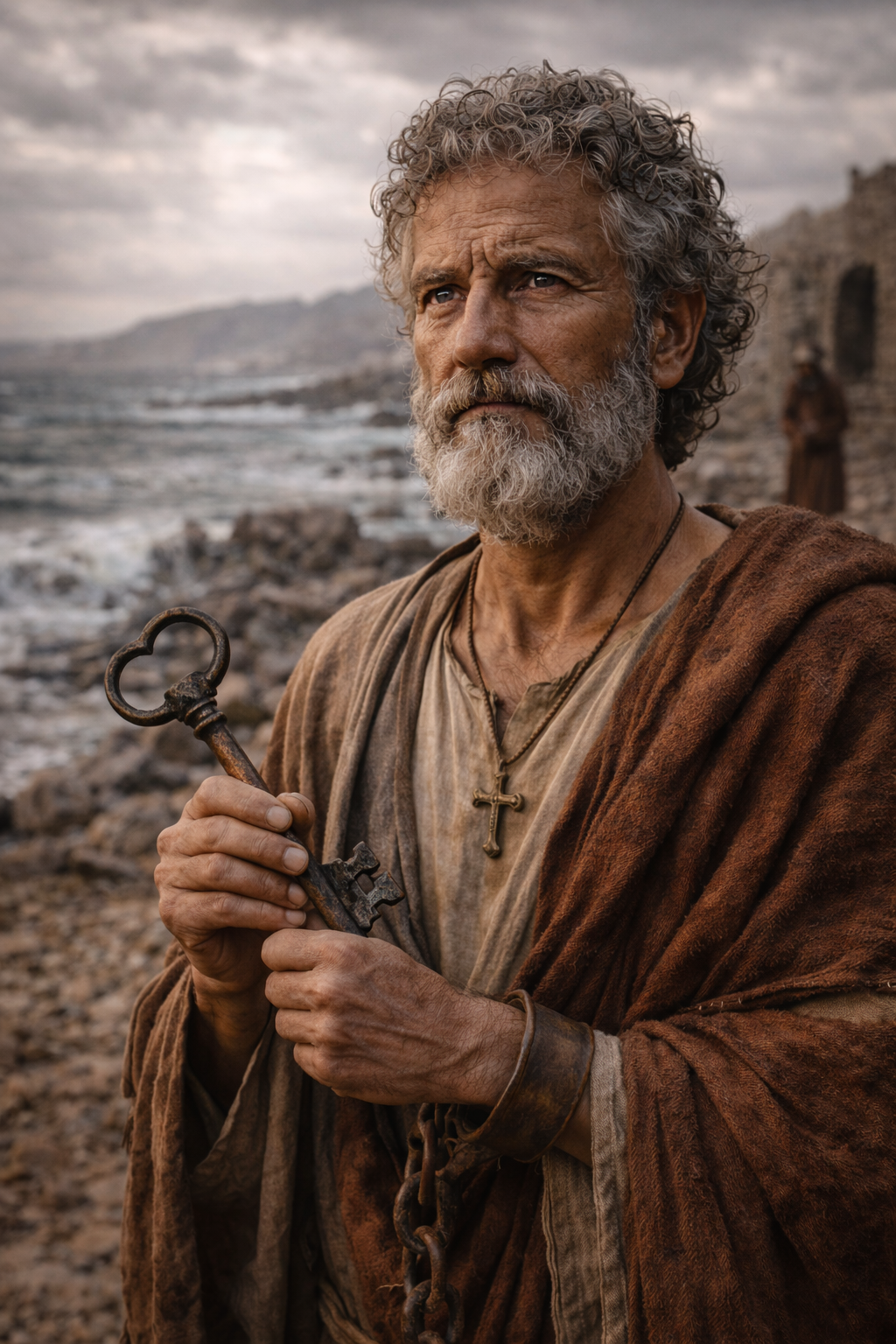
About Peter
Simon Peter, also called Cephas (both meaning "rock"), was a fisherman from Bethsaida who became the leader of the twelve apostles and a foundational figure in the early Christian church. He was the son of John (or Jonah) and the brother of Andrew, who first brought him to Jesus. When Jesus called Simon, He looked at him and said, "You are Simon son of John. You will be called Cephas" (which is translated Peter), giving him a new name that would define his future role.
Peter was married, as the Gospels mention Jesus healing his mother-in-law, and he initially made his living as a fisherman on the Sea of Galilee in partnership with James and John, the sons of Zebedee. His calling came when Jesus found him and Andrew casting nets into the lake and said, "Come, follow me, and I will send you out to fish for people." Immediately they left their nets and followed Him. Peter quickly emerged as the spokesperson for the twelve, often speaking on behalf of the group, asking questions, and expressing their concerns.
Peter was part of Jesus' inner circle, along with James and John, who witnessed events the other apostles did not see: the raising of Jairus' daughter, the Transfiguration where they saw Jesus speaking with Moses and Elijah, and Jesus' agony in the Garden of Gethsemane. At the Transfiguration, it was Peter who impetuously suggested building three shelters. Peter was known for his passionate, impulsive nature—he walked on water toward Jesus but began to sink when his faith wavered; he rebuked Jesus for predicting His death and was sharply corrected; he declared he would never deny Jesus but did so three times on the night of Jesus' arrest.
The pivotal moment in Peter's relationship with Jesus came at Caesarea Philippi when Jesus asked, "Who do you say I am?" Peter answered, "You are the Messiah, the Son of the living God." Jesus responded, "Blessed are you, Simon son of Jonah, for this was not revealed to you by flesh and blood, but by my Father in heaven. And I tell you that you are Peter, and on this rock I will build my church, and the gates of Hades will not overcome it. I will give you the keys of the kingdom of heaven; whatever you bind on earth will be bound in heaven, and whatever you loose on earth will be loosed in heaven." This declaration established Peter's unique role in the church.
Despite his bold confession and promises of loyalty, Peter's greatest failure came on the night Jesus was arrested. After following Jesus to the high priest's courtyard, Peter was recognized as one of Jesus' followers. Three times he denied knowing Jesus, and when the rooster crowed, Peter remembered Jesus' prediction and went out and wept bitterly. Yet Jesus had told Peter, "Simon, Simon, Satan has asked to sift all of you as wheat. But I have prayed for you, Simon, that your faith may not fail. And when you have turned back, strengthen your brothers."
After the resurrection, Jesus appeared to the disciples by the Sea of Galilee and specifically restored Peter through a threefold questioning—"Simon son of John, do you love me?"—corresponding to his threefold denial. Each time Peter affirmed his love, Jesus commissioned him: "Feed my lambs... Take care of my sheep... Feed my sheep." Jesus also predicted Peter's martyrdom, saying that when Peter was old, he would stretch out his hands and someone else would lead him where he did not want to go, indicating the kind of death by which Peter would glorify God.
After Pentecost, when the Holy Spirit came upon the disciples, Peter emerged as the bold leader of the early church. He preached the first Christian sermon, resulting in three thousand conversions. He performed the first apostolic miracle, healing a lame beggar at the temple gate. He confronted the religious authorities with courage, declaring, "We must obey God rather than human beings!" He received the vision of the sheet with unclean animals that led him to understand that the gospel was for Gentiles as well as Jews, and he baptized the first Gentile converts in Cornelius' household.
Peter wrote two epistles that are part of the New Testament, encouraging believers facing persecution to stand firm in faith, describing Jesus as the cornerstone, and urging holiness and mutual love. According to early church tradition, Peter traveled extensively, eventually going to Rome where he led the church. During Nero's persecution around AD 64-67, Peter was arrested and sentenced to crucifixion. Tradition holds that he requested to be crucified upside down, considering himself unworthy to die in the same manner as his Lord. He was buried on Vatican Hill, and the great basilica of St. Peter was built over his tomb. Peter's transformation from an impulsive, failing fisherman to the rock-solid leader of the church demonstrates the power of Christ's forgiveness, restoration, and grace. He remains a model of both human weakness and divine strength, showing that God can use flawed individuals who truly love Him to accomplish extraordinary purposes.