Saint profile
Andrew
About Andrew
Andrew was one of the twelve apostles and holds the distinction of being the first-called disciple of Jesus, as well as the one who brought his brother Simon Peter to Christ. He was a fisherman from Bethsaida in Galilee, and before following Jesus, he had been a disciple of John the Baptist. Andrew's name is Greek, meaning "manly" or "brave," which may indicate his family had some connection to the Hellenistic world despite being Jewish.
Andrew's calling is recorded in the Gospel of John. He was standing with John the Baptist and another disciple when John saw Jesus passing by and declared, "Look, the Lamb of God!" Immediately, Andrew and the other disciple (likely John, the son of Zebedee) followed Jesus. When Jesus turned and saw them following, He asked, "What do you want?" They replied, "Rabbi, where are you staying?" Jesus said, "Come and you will see," and they spent the rest of that day with Him. This was likely the most significant day of Andrew's life, as he encountered the Messiah he had been waiting for.
The first thing Andrew did after meeting Jesus was find his brother Simon and tell him, "We have found the Messiah." Andrew brought Simon to Jesus, who looked at him and gave him the new name Cephas (Peter), meaning rock. This pattern of bringing others to Jesus characterized Andrew's ministry—he was an introducer, a bridge-builder, someone who connected people to Christ. While Peter became the more prominent leader, it was Andrew who made that leadership possible by bringing Peter to Jesus in the first place.
Later, Jesus called Andrew and Peter while they were fishing on the Sea of Galilee, saying, "Come, follow me, and I will send you out to fish for people." Immediately they left their nets and followed Him. Andrew is listed among the first four disciples called, along with his brother Peter and the brothers James and John, sons of Zebedee. These four fishermen formed the core of Jesus' earliest followers.
Although Andrew was not part of the inner circle of Peter, James, and John who witnessed certain events like the Transfiguration and Jesus' agony in Gethsemane, he appears at several crucial moments in the Gospels, often in his characteristic role of bringing others to Jesus. When a large crowd had gathered and Jesus wanted to feed them, it was Andrew who brought the boy with five loaves and two fish to Jesus, though he added doubtfully, "But how far will they go among so many?" Nevertheless, Jesus used that small offering to perform the miracle of feeding the five thousand.
When some Greeks came to Philip wanting to see Jesus, Philip told Andrew, and together they went and told Jesus. This may indicate that Andrew, with his Greek name and perhaps his personality, was seen as approachable by Gentiles and served as a bridge between different groups. In the Gospel of Mark, Andrew is mentioned as one of the four disciples who privately asked Jesus about the signs of the end times, showing his desire to understand Jesus' teachings more deeply.
After Pentecost, Andrew's activities are not recorded in the New Testament, but early church tradition provides accounts of his missionary work. According to these traditions, Andrew preached the gospel in Scythia (roughly modern-day Ukraine and southern Russia), in Greece, Asia Minor, and along the Black Sea region. The early church historian Eusebius mentions Andrew's mission to Scythia, and this tradition led to Andrew becoming the patron saint of Russia and Ukraine.
The most detailed tradition concerns Andrew's ministry in Achaia, Greece, particularly in the city of Patras. According to the Acts of Andrew, a second-century document, he performed many miracles, converted many to Christianity including members of noble families, and aroused the anger of the Roman proconsul Aegeates (or Aegeas) when the proconsul's own wife Maximilla became a Christian and refused to continue marital relations with her pagan husband.
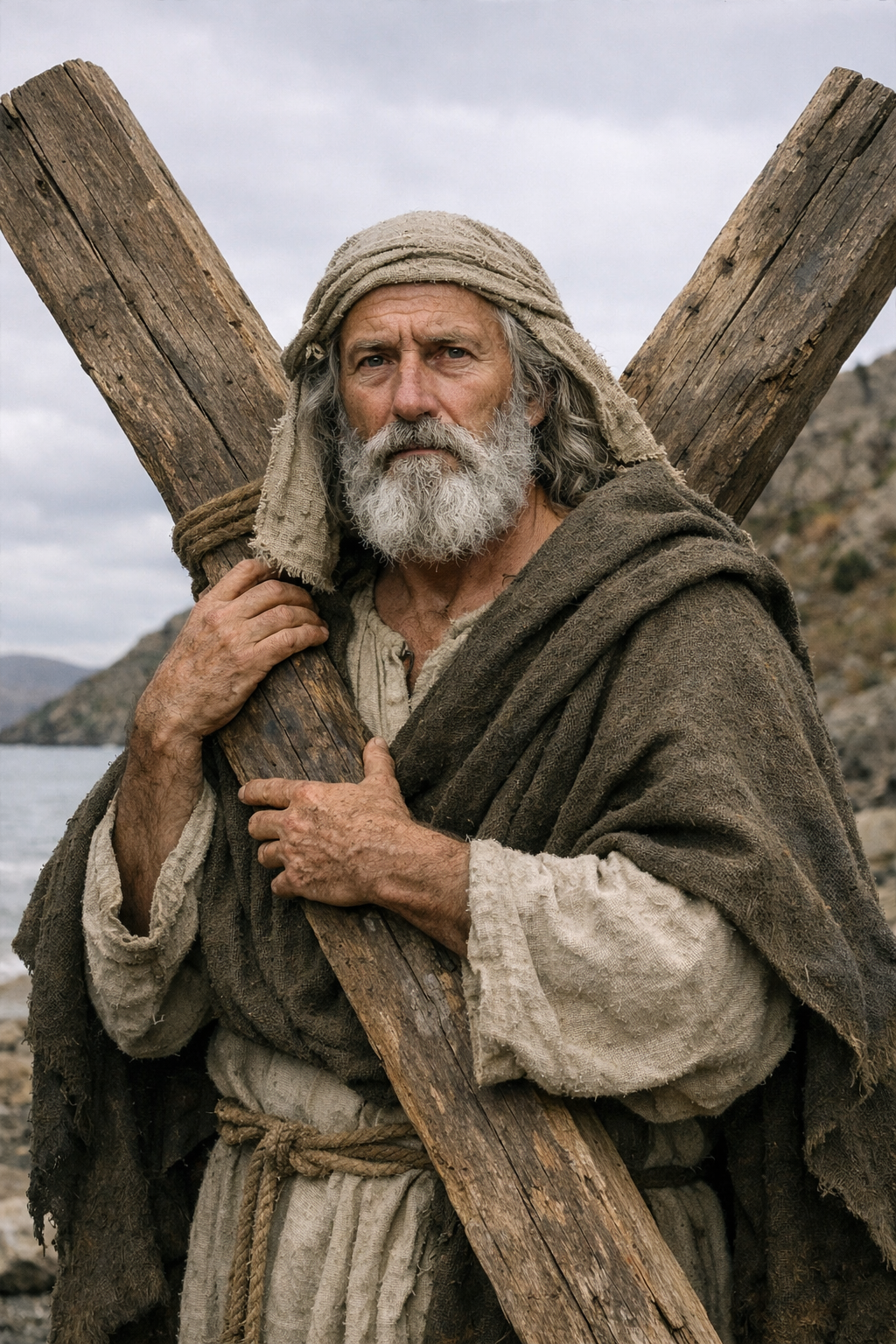
Andrew was arrested and condemned to death by crucifixion. According to tradition, he was crucified on an X-shaped cross (now called a St. Andrew's Cross or saltire) in Patras around AD 60. Some accounts say he requested this different form of cross because he felt unworthy to be crucified on the same type of cross as his Lord. Andrew reportedly hung on the cross for two days, during which time he preached to passersby about Christ, encouraging the believers and leading others to faith before he finally died.
Andrew's relics were believed to have been moved to Constantinople in the fourth century, and later some were taken to Scotland, leading to Andrew becoming the patron saint of Scotland. The St. Andrew's Cross appears on the Scottish flag, and his feast day (November 30) is celebrated as Scotland's national day. Andrew is also patron saint of Russia, Greece, and Romania, and is venerated throughout the Orthodox Church.
Andrew's significance lies not in spectacular miracles or extensive writings, but in his role as a faithful witness who brought others to Christ. He was the first to recognize Jesus as Messiah, the first to bring someone (Peter) to Jesus, and he continued this ministry of connection throughout his life. His humility is evident—though he was called before Peter, he never competed with his brother for prominence but rejoiced in Peter's leadership. Andrew exemplifies the truth that the kingdom of God advances not only through prominent leaders but also through faithful individuals who quietly bring others to the Savior, and that the first may be last and the last first in God's economy. His willingness to die a prolonged death by crucifixion while preaching Christ demonstrates the transformation from fisherman to fisher of men, willing to sacrifice everything for the gospel he had embraced that first day when he followed the Lamb of God.