Saint profile
Joseph of Nazareth
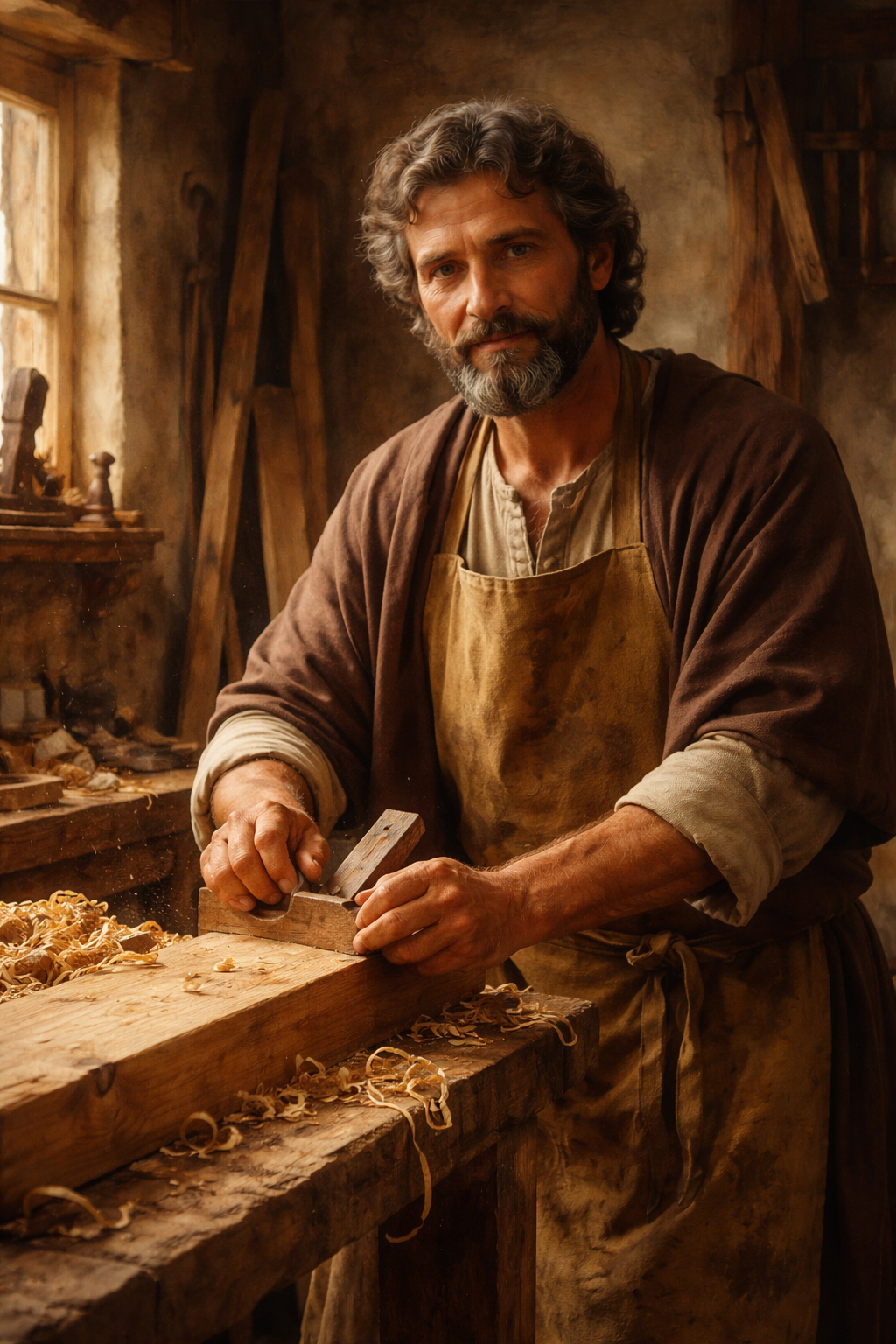
About Joseph of Nazareth
Saint Joseph stands as one of the most quietly profound figures in Christian tradition. Though he never speaks a recorded word in the canonical Gospels, his life, actions, and vocation reveal a depth of righteousness, courage, and obedience that have made him a model for faith across centuries. Known primarily as the husband of the Virgin Mary and the earthly foster-father of Jesus Christ, Joseph embodies a holiness rooted not in public proclamation, but in faithful action, trust in God, and sacrificial love.
Joseph was a Jewish man of the tribe of Judah and of the house of David, a lineage of great significance within biblical theology. The Gospels of Matthew and Luke carefully trace Jesus’ legal descent through Joseph to King David, underscoring Joseph’s role in fulfilling messianic prophecy. By trade, Joseph was a tekton, traditionally rendered as “carpenter,” though the term more broadly suggests a skilled craftsman—someone who worked with wood, stone, or metal. This implies a life of steady labor, practical intelligence, and physical endurance, placing Joseph firmly among the working poor of first-century Judea.
The defining moment of Joseph’s life occurs when he discovers that Mary, his betrothed, is pregnant. In Jewish law, betrothal was a legally binding commitment, and apparent infidelity could bring public disgrace or severe punishment. The Gospel of Matthew describes Joseph as a “righteous man,” meaning one who lived in faithful observance of God’s law. Yet his righteousness is shown not in strict condemnation but in mercy: he resolves to divorce Mary quietly, sparing her public shame. It is here that Joseph’s interior life becomes evident. He is just, compassionate, and self-controlled, seeking to do what is right while minimizing harm.
God’s intervention comes through a dream, a motif repeated several times in Joseph’s story. An angel tells him not to fear taking Mary as his wife, explaining that the child she carries is conceived by the Holy Spirit and destined to save his people from their sins. Joseph’s response is immediate and complete. He does not argue, question, or delay. He awakens and does exactly as the angel commands. This obedience, given without visible proof and at great personal cost, is one of Joseph’s most striking virtues. By accepting Mary and naming the child Jesus, Joseph legally adopts him, conferring upon him Davidic lineage and publicly embracing his role as father.
Joseph’s guardianship of Jesus is marked by vigilance and courage. Shortly after Jesus’ birth, Joseph again receives divine guidance through dreams. Warned of King Herod’s murderous intent, Joseph takes Mary and the child and flees into Egypt under cover of night. This flight required decisive action, trust in God’s protection, and the willingness to live as a refugee in a foreign land. Joseph becomes, in this moment, the protector of the Savior, placing himself between the vulnerable child and the violent forces of the world. His role is not symbolic or passive; it is active, dangerous, and sacrificial.
After Herod’s death, Joseph is instructed to return, eventually settling his family in Nazareth. There, Joseph fades almost entirely from the Gospel narrative, which itself speaks volumes. The silence suggests a life of ordinary faithfulness: working, providing, teaching, and forming Jesus in the rhythms of daily life. It was Joseph who taught Jesus how to pray the psalms, how to work with his hands, how to observe the Law, and how to live within a family and community. The humility of this hidden life has become one of Joseph’s most powerful legacies. In a tradition that often celebrates martyrs, prophets, and miracle-workers, Joseph is honored as a saint whose greatness lay in fidelity to daily duty.
The last explicit biblical mention of Joseph occurs when Jesus is twelve years old and is found in the Temple after being lost for three days. Joseph is present but silent, standing beside Mary as she questions her son. After this episode, Joseph disappears from the Gospel accounts, leading most scholars and tradition to conclude that he died before Jesus began his public ministry. This assumption shaped the Church’s later understanding of Joseph as the patron of a happy death—one who likely died in the presence of Jesus and Mary, surrounded by love and divine peace.
Over the centuries, devotion to Saint Joseph grew slowly but steadily. Early Christianity focused primarily on martyrs and apostles, but by the Middle Ages Joseph’s virtues of humility, chastity, and obedience began to receive wider recognition. Saints such as Bernard of Clairvaux and Teresa of Ávila promoted devotion to Joseph, emphasizing his powerful intercession and quiet authority. In 1870, Pope Pius IX declared Saint Joseph the Patron of the Universal Church, recognizing him as the protector of Christ’s mystical body, just as he had protected Christ’s physical body on earth.
Saint Joseph is now venerated under many titles: Patron of the Universal Church, Patron of Workers, Patron of Fathers, Patron of Families, Patron of the Dying, and Terror of Demons. Each title reflects an aspect of his life. As a worker, he sanctifies human labor. As a father, he models strength without domination and authority rooted in love. As a husband, he exemplifies fidelity and self-giving devotion. As a spiritual protector, he is invoked against evil, not through dramatic confrontation, but through steadfast righteousness.
In art and iconography, Joseph is often depicted as older, emphasizing chastity and wisdom, though historically he may have been younger than tradition suggests. Regardless of age, he is commonly shown with tools of his trade, a lily symbolizing purity, or the child Jesus in his arms. These images reinforce the paradox at the heart of Joseph’s life: a man entrusted with an unparalleled responsibility, who carried it out without acclaim, speech, or recognition.
Saint Joseph’s enduring relevance lies in his accessibility. He is not portrayed as a mystic visionary or a public preacher, but as a man who listened, trusted, worked, and loved. His sanctity was forged in obscurity, obedience, and perseverance. In a world that often prizes visibility and self-assertion, Joseph offers a countercultural vision of greatness—one defined by faithfulness to God’s will, care for others, and integrity in the hidden places of life.