Saint profile
Michael the Archangel
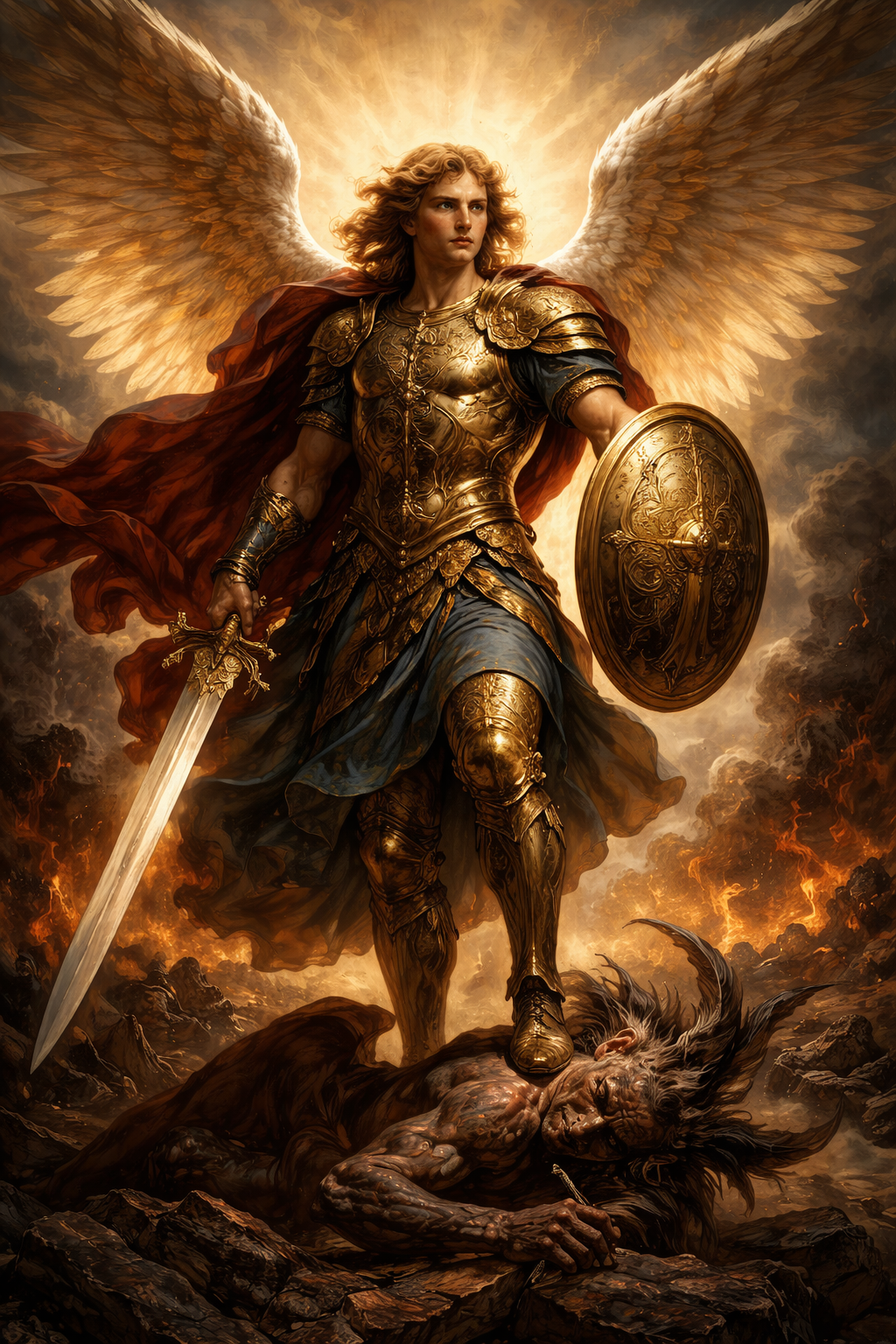
About Michael the Archangel
Michael the Archangel is one of the most powerful and enduring figures in Jewish, Christian, and Islamic tradition, revered as the great defender of God’s sovereignty and the champion against evil. His very name, derived from the Hebrew Mikhaʾel, is a rhetorical question—“Who is like God?”—a declaration that no created being can rival the authority, majesty, or holiness of the Creator. This name encapsulates Michael’s identity and mission: absolute fidelity to God and uncompromising opposition to pride, rebellion, and chaos.
Michael appears explicitly in Scripture as a warrior and protector long before later Christian devotion expanded his role. In the Book of Daniel, he is described as the “great prince” who stands guard over the people of Israel. Here, Michael is not merely an individual angel but a cosmic guardian, assigned to defend God’s chosen people against spiritual forces arrayed against them. This depiction establishes him as both protector and leader, acting within a divinely ordered hierarchy of angelic beings. His authority is not self-derived; it flows entirely from obedience to God’s will.
The New Testament further elevates Michael’s role, most dramatically in the Book of Revelation. In its vivid apocalyptic imagery, Michael leads the armies of heaven in battle against the dragon—identified as Satan—and his fallen angels. This is not a battle between equals. Michael does not defeat evil through brute force alone, but through divine authority. The victory belongs to God, and Michael is the instrument through whom that victory is enacted. This scene cemented Michael’s identity in Christian consciousness as the supreme warrior against evil and the visible symbol of God’s ultimate triumph over darkness.
Michael also appears in the Epistle of Jude, where he is shown disputing with the devil over the body of Moses. Notably, Michael does not pronounce judgment on his own authority but says, “The Lord rebuke you.” This moment is theologically significant. Despite his immense power, Michael remains perfectly obedient and humble, refusing to act beyond his divinely appointed role. This humility sharply contrasts with Satan’s pride and reinforces Michael’s status as the model of faithful service.
Over time, Christian theology and devotion developed a rich understanding of Michael’s role within the angelic hierarchy. He is traditionally identified as the chief of the archangels and, in many traditions, the leader of all heavenly hosts. As such, he is seen not only as a warrior but as a commander, strategist, and guardian of divine order. His authority is cosmic in scope, extending from the defense of God’s people on earth to the maintenance of order in the spiritual realm.
Michael’s functions are not limited to battle alone. In Christian tradition, he is also associated with judgment and the care of souls. He is often depicted holding scales, weighing souls at the time of death, symbolizing divine justice tempered by mercy. This imagery emphasizes that Michael’s opposition to evil is not merely destructive; it is restorative, aimed at preserving righteousness and escorting the faithful into God’s presence. Because of this role, he became associated with protection at the hour of death and guidance of souls into heaven.
Devotion to Michael expanded significantly in late antiquity and the Middle Ages. Shrines dedicated to him arose across Europe and the Near East, often in elevated or dramatic locations—mountaintops, caves, and fortified places—symbolizing his role as a heavenly sentinel. Famous sanctuaries such as Monte Gargano in Italy and Mont-Saint-Michel in France reinforced the perception of Michael as a guardian standing at the threshold between heaven and earth. These locations were not chosen at random; they visually expressed the belief that Michael stands watch over the world from on high.
In liturgy and prayer, Michael occupies a unique position. He is invoked as a protector of the Church, defender against spiritual danger, and intercessor in times of trial. The well-known prayer asking for his defense “in battle” reflects a worldview in which evil is not abstract but active, requiring vigilance, humility, and divine assistance. Michael is not worshiped—worship belongs to God alone—but he is honored as a powerful ally whose intercession reflects God’s protective care.
Michael’s significance extends beyond Christianity. In Jewish tradition, he remains a principal angel, often associated with mercy and advocacy for Israel. In Islamic tradition, he is known as Mikail and is regarded as an angel of provision and mercy, associated with sustenance and divine generosity rather than warfare alone. These overlapping yet distinct portrayals highlight the breadth of Michael’s character: warrior, protector, advocate, and servant of divine compassion.
Artistically, Michael has been portrayed in countless forms across centuries. He is most often depicted as a youthful yet powerful figure clad in armor, bearing a sword or spear, and standing triumphantly over a defeated demon or dragon. His wings signify his angelic nature and swiftness in carrying out God’s commands, while his armor reflects spiritual readiness and divine authority. Despite the martial imagery, Michael’s expression is often serene rather than wrathful, emphasizing that his strength is disciplined and purposeful, not driven by rage.
Symbolically, Michael represents the triumph of obedience over pride, humility over arrogance, and truth over deception. He stands as the antithesis of Satan, not because he seeks glory, but because he refuses it. Where Satan declares “I will not serve,” Michael’s name proclaims “Who is like God?”—a constant reminder that all power, authority, and victory belong to the divine source alone.
In Christian spirituality, Michael’s relevance remains strong. He is invoked in times of moral confusion, spiritual struggle, and cultural upheaval, when believers feel surrounded by forces that challenge truth and goodness. He is also a patron of soldiers, police officers, and those who place themselves in harm’s way to protect others, reflecting his role as defender and guardian.
Ultimately, Michael the Archangel is not merely a figure of ancient texts or dramatic imagery. He embodies a timeless spiritual reality: that evil, no matter how powerful it appears, is never equal to God; that humility is stronger than pride; and that faithful obedience is the path to victory. As leader of the heavenly host and servant of the Most High, Michael stands as a reminder that the cosmic struggle between good and evil is real—but that its outcome is already assured under God’s sovereign rule.