Saint profile
Bartholomew
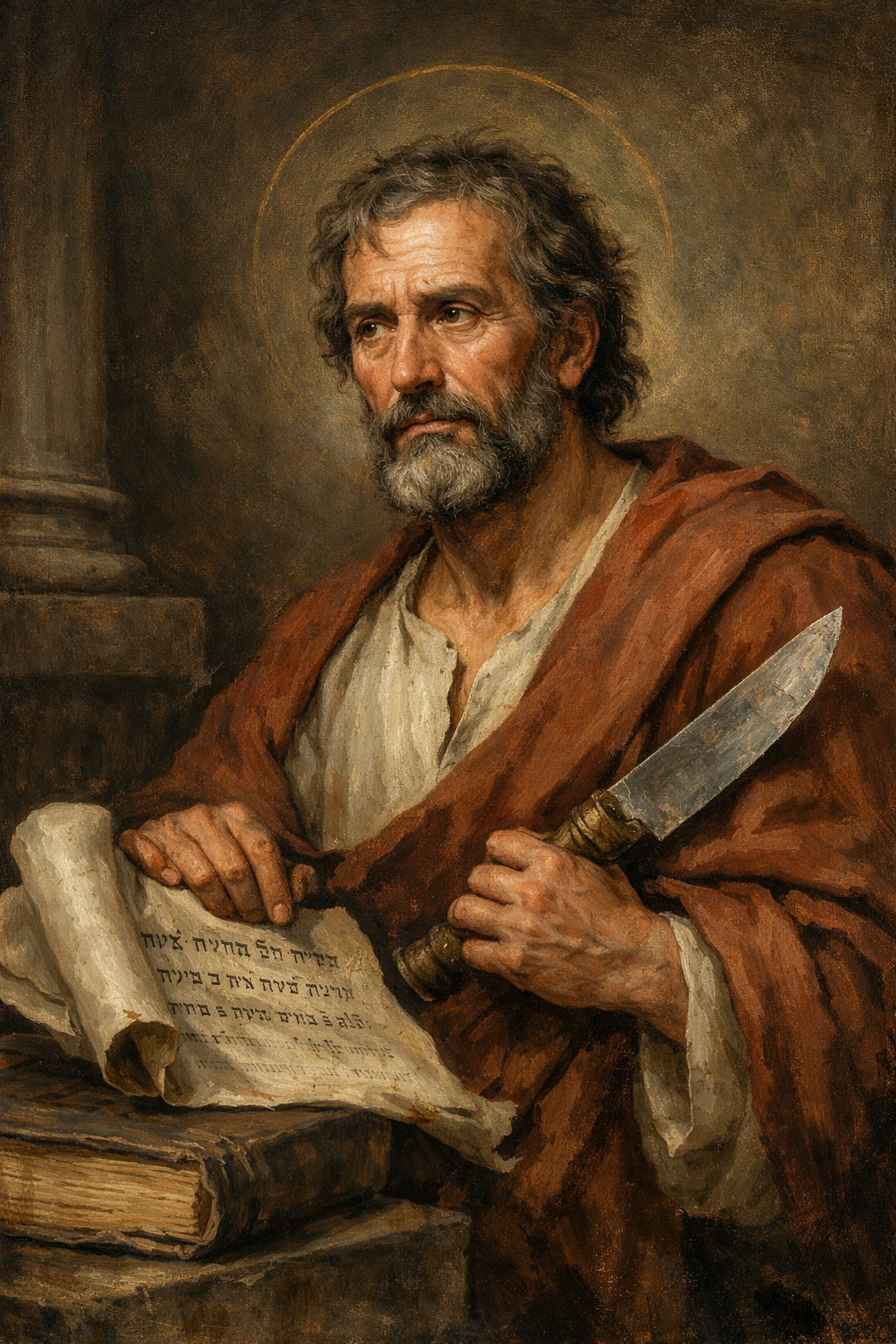
About Bartholomew
Bartholomew, who is widely believed to be the same person as Nathanael mentioned in John's Gospel, was one of the twelve apostles chosen by Jesus. The name Bartholomew means "son of Tolmai" and is a patronymic rather than a personal name, which is why many scholars identify him with Nathanael, whose calling is described in detail in the Gospel of John. In the synoptic Gospels, Bartholomew is always mentioned alongside Philip in the lists of apostles, and in John's Gospel, it is Philip who brings Nathanael to Jesus, supporting the identification of the two as the same person.
Nathanael came from Cana in Galilee, the town where Jesus would perform His first miracle of turning water into wine. According to John's Gospel, after Philip met Jesus and decided to follow Him, he immediately found Nathanael and told him, "We have found the one Moses wrote about in the Law, and about whom the prophets also wrote—Jesus of Nazareth, the son of Joseph." Nathanael's response was skeptical: "Nazareth! Can anything good come from there?" This question, while expressing doubt, also showed Nathanael was familiar with Scripture and Jewish expectations about the Messiah, who was prophesied to come from Bethlehem rather than the insignificant village of Nazareth. Philip wisely didn't argue but simply invited him: "Come and see."
When Jesus saw Nathanael approaching, He made a remarkable statement: "Here truly is an Israelite in whom there is no deceit." This was high praise, essentially calling Nathanael a true son of Israel, unlike Jacob (whose name Israel meant "he deceives" or "he struggles with God"), who had been deceptive in his early life. Nathanael was surprised that Jesus knew anything about him and asked, "How do you know me?" Jesus answered, "I saw you while you were still under the fig tree before Philip called you." This seemingly simple statement had profound impact on Nathanael.
Scholars have long wondered what Jesus meant about seeing Nathanael under the fig tree and why this affected Nathanael so powerfully. In Jewish culture, sitting under a fig tree was associated with meditation on the Torah and prayer. The phrase "under his own vine and fig tree" appears in Scripture as an image of peace, security, and communion with God. Whatever Nathanael had been doing or thinking about under that fig tree—perhaps praying about the Messiah, studying prophecies, or seeking God's truth—Jesus' knowledge of it convinced Nathanael of Jesus' divine insight.
Nathanael's response was immediate and dramatic: "Rabbi, you are the Son of God; you are the king of Israel." This confession, coming so early in Jesus' ministry, was a remarkable declaration of faith. Jesus responded, "You believe because I told you I saw you under the fig tree. You will see greater things than that," and went on to promise that Nathanael would see heaven opened and the angels of God ascending and descending on the Son of Man—a reference to Jacob's ladder, suggesting that Jesus Himself is the connection between heaven and earth.
After this calling narrative, Nathanael/Bartholomew appears in the lists of the twelve apostles in Matthew, Mark, and Luke, always in close association with Philip. He was present with the other apostles after the resurrection when Jesus appeared to them by the Sea of Galilee, as recorded in John 21. Beyond these references, the New Testament tells us nothing more about Bartholomew's activities during or after Jesus' ministry.
However, early church tradition provides extensive accounts of Bartholomew's missionary work. According to various sources, he preached the gospel in India, Armenia, Ethiopia, Mesopotamia, Parthia, Lycaonia, and Phrygia. The most persistent traditions associate him particularly with Armenia and India. Eusebius, the early church historian, recorded that Pantaenus of Alexandria went to India in the second century and found there a copy of the Gospel of Matthew in Hebrew that had been brought by Bartholomew.
The strongest tradition places Bartholomew's martyrdom in Albanopolis (modern-day Baku in Azerbaijan) or in Armenia. According to this account, Bartholomew's preaching was so effective that he converted the king of Armenia, Polymius, along with his family and many of the people. This aroused the fury of the king's brother Astyages and the pagan priests, who saw their influence waning. Bartholomew was arrested, and when he refused to worship idols, he was subjected to a horrific martyrdom—he was flayed alive (skinned) and then either crucified upside down or beheaded.
This brutal martyrdom, while horrifying, became a powerful symbol of Bartholomew's complete dedication to Christ and his willingness to be stripped of everything, even his own skin, for the sake of the gospel. In Christian art, Bartholomew is often depicted holding his own skin, along with the knife used in his martyrdom, making him the patron saint of tanners, leather workers, and bookbinders. The image of the flayed saint has been powerfully rendered in art, most famously in Michelangelo's Last Judgment in the Sistine Chapel, where St. Bartholomew holds his own skin.
Bartholomew's relics were eventually brought to Rome and are now enshrined in the Church of St. Bartholomew on Tiber Island. He is particularly venerated in Armenia, where he is considered one of the patron saints and is credited with bringing Christianity to the Armenian people, making Armenia one of the first nations to adopt Christianity as a state religion.
Bartholomew's journey from the skeptical questioner under the fig tree to the faithful apostle martyred for his witness demonstrates the transformative power of encountering Christ. His initial doubt—"Can anything good come from Nazareth?"—was honest rather than cynical, and when presented with evidence, he responded with faith. His declaration that Jesus was the Son of God and King of Israel, made early in Jesus' ministry before most others recognized His true identity, marks him as a man of spiritual insight. Jesus' commendation of him as "an Israelite in whom there is no deceit" suggests a character of exceptional integrity and honesty, qualities that would sustain him through years of missionary work and ultimately through the terrible ordeal of his martyrdom. Bartholomew represents those who seek truth sincerely, respond to evidence with faith, and remain faithful to that truth regardless of the cost.