Saint profile
James (son of Alphaeus)
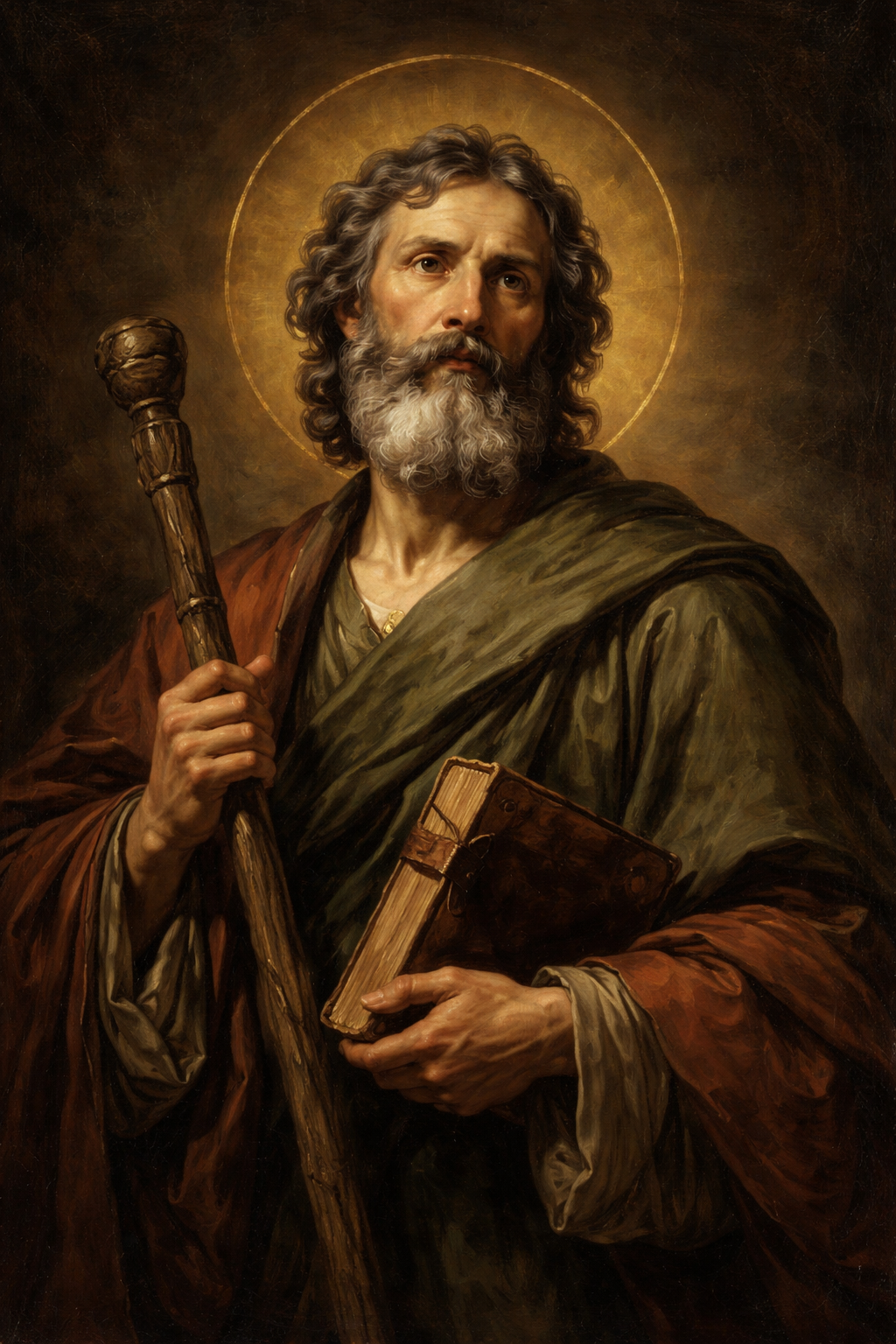
About James (son of Alphaeus)
James the son of Alphaeus, also known as James the Less or James the Younger, was one of the twelve apostles. He is called "the Less" not to diminish his importance but likely to distinguish him from James the son of Zebedee, who may have been older, taller, or called to apostleship earlier. Very little is recorded about this James in the New Testament, making him one of the more obscure apostles, yet his inclusion among the Twelve and his faithfulness to Christ despite his relative anonymity make him a model of humble, unheralded service.
James appears in all four lists of the apostles in the New Testament (Matthew 10, Mark 3, Luke 6, and Acts 1), always identified as "the son of Alphaeus" to distinguish him from James the son of Zebedee. Some scholars have suggested he might be the same person as "James the brother of the Lord" mentioned elsewhere in the New Testament, or the son of Mary who stood at the cross (called "Mary the mother of James the younger and of Joseph"). However, these identifications are debated, and it is perhaps safer to acknowledge that we simply do not know much about this apostle with certainty.
If James son of Alphaeus is indeed different from James the brother of Jesus (which seems likely, as Jesus' brothers did not believe in Him during His ministry according to John 7:5), then he was chosen as one of the Twelve purely on the basis of Jesus' divine selection rather than family connection. This makes his calling a powerful testimony to Jesus' sovereign choice—He calls whom He wills, not based on human credentials or connections, but according to His own purposes.
The obscurity of James the Less in the Gospel narratives teaches an important lesson about discipleship. Not every follower of Jesus is called to prominence or public recognition. Some are called to faithful service in relative anonymity, and their reward is not earthly fame but heavenly treasure. James was present for Jesus' teachings, witnessed His miracles, heard His parables, saw the crucifixion and resurrection, received the Holy Spirit at Pentecost, and presumably participated in the early church's mission. Yet his individual contributions are not recorded for posterity. This demonstrates that God values faithfulness regardless of visibility, and that the kingdom of God advances through both prominent leaders and unknown servants.
Tradition attempts to fill in the gaps left by Scripture. According to some early church sources, James the Less preached the gospel in Syria and Persia. Other traditions associate him with Egypt. The most common tradition states that he was martyred by being sawed in half, which led to him becoming the patron saint of pharmacists (who in medieval times used saws in their work). However, this martyrdom account may be confused with James the brother of the Lord, who according to the Jewish historian Josephus and early church tradition was thrown from the pinnacle of the temple and then beaten to death with a fuller's club around AD 62.
Another tradition holds that James the Less was crucified in Ostrakine, Egypt, where he had been preaching the gospel. Still other accounts place his martyrdom in different locations or describe different methods. The uncertainty about the details of his life and death, in contrast to the better-documented lives of apostles like Peter and John, underscores his humble position even within the apostolic circle.
Despite the scarcity of information, several important truths emerge from what we know of James the Less. First, he was personally chosen by Jesus to be one of the Twelve, an honor shared by only a select few. Second, he remained faithful to this calling, continuing with the other apostles after the resurrection and being present in the upper room before Pentecost. Third, according to tradition, he eventually gave his life for Christ, sealing his testimony with martyrdom. Fourth, his relative obscurity in the biblical record demonstrates that discipleship is not about achieving fame or recognition but about faithful obedience to Jesus' call.
James the Less represents the countless Christians throughout history who have served Christ faithfully without earthly recognition or acclaim. They are the unknown saints, the quiet believers, the faithful servants who pray, give, teach, care for others, and witness to Christ without expecting applause or acknowledgment. In God's economy, these hidden servants are just as valuable as the prominent leaders. Jesus taught that "the last will be first, and the first will be last," and that whoever would be greatest must be servant of all.
The fact that Scripture records James' name among the apostles but tells us little else about him is itself a message. It reminds us that God knows each of His servants by name even when the world does not know them. It assures us that faithful service to Christ has eternal value regardless of temporal recognition. It encourages those who labor in obscurity, teaching Sunday school classes that no one praises, visiting the sick whom no one else remembers, giving generously without seeking honor, praying faithfully without anyone knowing.
James the Less also reminds us of the danger of judging significance by visibility. We naturally focus on the Peters and Johns and Pauls—the prominent figures whose words and deeds are recorded extensively. But the kingdom of God has always depended equally on the Jameses—those whose names we know but whose stories remain largely untold, who served faithfully in their generation and now enjoy the Master's commendation: "Well done, good and faithful servant." In heaven, we may discover that some of the "lesser" apostles achieved "greater" glory because they served without the corruption that sometimes accompanies fame, remained humble without the temptation to pride that prominence brings, and loved Christ purely without the mixed motives that recognition can foster. James the Less, by his very obscurity, illuminates an essential truth of Christian discipleship: it is not about being known by the world but about being known and loved by God, not about earthly acclaim but about heavenly approval, not about building our own reputation but about glorifying Christ through faithful, humble service wherever He places us.