Saint profile
Mary
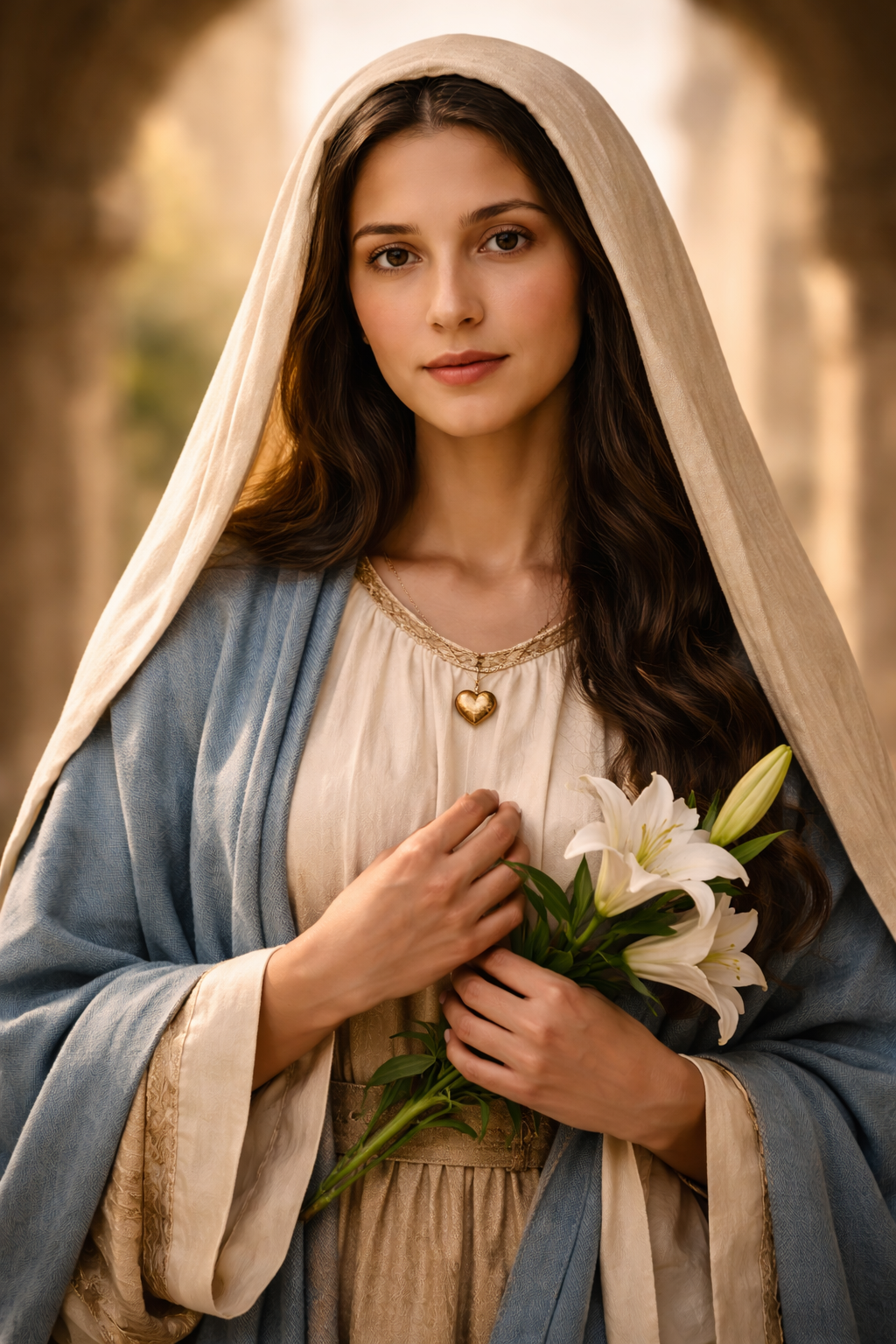
About Mary
Virgin Mary occupies a unique and profoundly important place in the Bible, not as a divine figure herself, but as the chosen woman through whom God entered human history in the Incarnation. From a biblical perspective, Mary’s significance lies in her faithful response to God, her role in salvation history, and her enduring example of obedience, humility, and trust.
Mary first appears prominently in the Gospel of Luke, where she is introduced as a young virgin living in Nazareth, betrothed to Joseph of the house of David. The angel Gabriel announces to her that she has found favor with God and will conceive by the power of the Holy Spirit, bearing a son who will be called Jesus, the Son of the Most High. This moment, known as the Annunciation, reveals several essential biblical themes. Mary is not portrayed as powerful or influential by worldly standards, but as lowly and ordinary. God’s choice of her reflects a recurring biblical pattern in which God works through the humble and unexpected.
Mary’s response to the angel is central to the biblical portrait of her: “Behold, I am the handmaid of the Lord; let it be to me according to your word.” With these words, she freely consents to God’s plan despite the personal cost—social scandal, misunderstanding, and potential danger. Scripture emphasizes her faith rather than her privilege. Mary does not fully understand how God’s promise will unfold, yet she trusts completely. Her obedience stands in contrast to human disobedience earlier in Scripture and marks her as a model believer.
Immediately following the Annunciation, Mary visits her relative Elizabeth, who greets her as “the mother of my Lord.” Elizabeth’s words affirm Mary’s role in God’s redemptive plan and highlight the blessedness of her faith: “Blessed is she who believed that the Lord’s word to her would be fulfilled.” Mary responds with the Magnificat, a hymn of praise that echoes the language and themes of the Old Testament. In it, she glorifies God for lifting up the lowly, filling the hungry with good things, and remembering His covenant mercy. Biblically, this song reveals Mary as deeply rooted in Israel’s Scriptures and conscious that her personal calling is part of God’s larger plan of salvation.
The Gospels of Matthew and Luke recount the birth of Jesus, presenting Mary as a quiet yet central presence. She gives birth in humility, lays her child in a manger, and treasures events in her heart. Scripture repeatedly emphasizes her reflective faith. When shepherds and later Simeon speak prophetic words about her son, Mary listens and ponders rather than speaks at length. Simeon’s prophecy that a sword will pierce her soul foreshadows the suffering she will endure, showing that her role as mother of the Messiah includes sorrow as well as joy.
Mary appears again during Jesus’ public ministry, though less frequently than one might expect. This biblical restraint is significant. The Gospels consistently center on Christ, not on Mary, yet they include her when her presence illuminates something essential about discipleship. At the wedding at Cana, Mary brings a need to Jesus’ attention and then instructs the servants, “Do whatever he tells you.” These are her last recorded words in Scripture, and they encapsulate her biblical role: pointing others toward obedience to Christ. The miracle that follows marks the beginning of Jesus’ signs and reveals his glory, with Mary quietly in the background.
At times, the Gospels show Mary sharing in the misunderstandings and tensions surrounding Jesus’ mission. When family members seek him during his ministry, Jesus responds by redefining family in terms of those who hear and do God’s word. This does not diminish Mary but instead situates her within the community of disciples. She is blessed not only because she bore Christ physically, but because she heard God’s word and kept it. Scripture thus presents Mary first and foremost as a believer.
Mary’s presence reaches its most profound moment at the crucifixion. The Gospel of John places her at the foot of the cross, witnessing the suffering and death of her son. Here, the earlier prophecy of sorrow is fulfilled. Jesus entrusts her to the beloved disciple, forming a new familial bond rooted in faith. Biblically, this scene highlights Mary’s perseverance. She who once consented to God’s plan in joy now remains faithful amid unimaginable grief. Her faith does not shield her from suffering, but it sustains her through it.
After the resurrection and ascension of Jesus, Mary appears one final time in Scripture in the Acts of the Apostles. She is found praying with the disciples as they await the coming of the Holy Spirit at Pentecost. This last biblical image of Mary is deeply significant: she is not set apart from the Church, but present within it, praying in hope and expectation. She who first received Christ by the Spirit now joins the community that will receive the Spirit for the Church’s mission.
From a biblical perspective, Mary is never portrayed as the source of salvation, but as its most receptive servant. All that Scripture says about her ultimately points to God’s action and Christ’s identity. Yet the Bible also presents her as the highest example of faithful response to God’s word. She listens, believes, obeys, suffers, and perseveres. Her life traces a path from promise to fulfillment, from joy to sorrow to hope, mirroring the journey of faith itself.
In summary, the Bible presents the Virgin Mary as the humble mother of Jesus, the obedient servant of the Lord, and a faithful disciple whose life is woven into the story of salvation. Her greatness, according to Scripture, lies not in power or status, but in her trust in God and her willingness to say yes to His will.