Saint profile
Stephen of Jerusalem
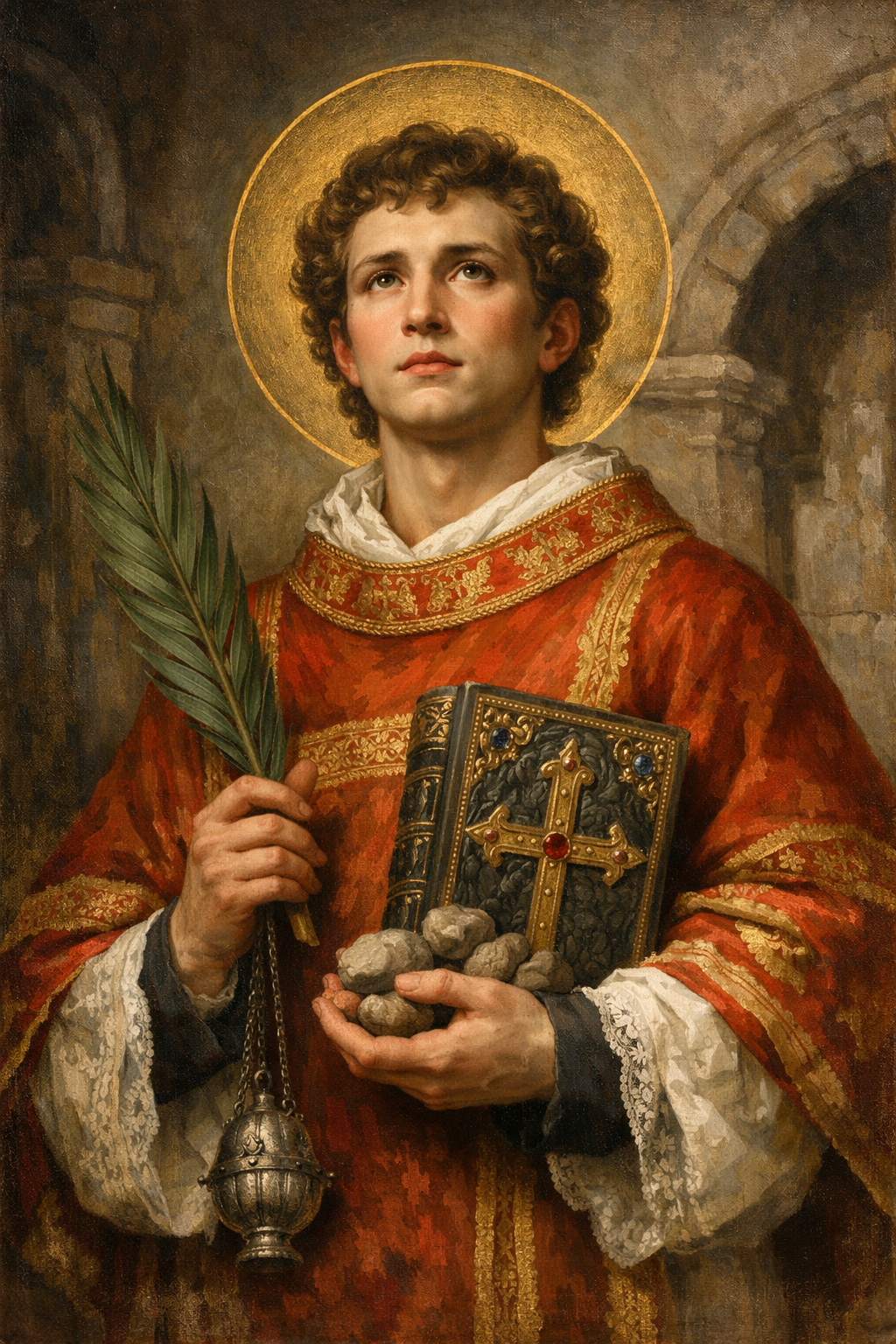
About Stephen of Jerusalem
Saint Stephen holds a unique and foundational place in Christian history as the first martyr of the Church and a powerful witness to faith, charity, and courage in the earliest days of Christianity. His story, preserved primarily in the Acts of the Apostles (Acts 6–7), reveals a man whose life and death helped shape the identity and mission of the early Christian community.
Stephen appears during a time of rapid growth in the Church following Pentecost. As the number of believers increased, practical challenges emerged, particularly in caring for the poor. A dispute arose between Greek-speaking and Hebrew-speaking Christians over the fair distribution of food to widows. In response, the apostles chose seven reputable men to oversee this charitable work so that the apostles could devote themselves to prayer and preaching. Stephen is listed first among these seven, indicating his prominence. Scripture describes him as “a man full of faith and of the Holy Spirit,” highlighting both his spiritual depth and his integrity.
Although Stephen is often referred to as one of the first deacons, his role extended far beyond administrative service. He was also a powerful preacher and apologist. Acts records that he was “full of grace and power” and performed great wonders and signs among the people. His preaching attracted opposition from members of various synagogues in Jerusalem, particularly among Jews of the Diaspora. Unable to refute his wisdom, his opponents resorted to false accusations, claiming that he spoke against the Law of Moses and the Temple—charges similar to those brought against Jesus himself.
Stephen was arrested and brought before the Sanhedrin, the highest Jewish council. There, he delivered one of the longest and most significant speeches in the New Testament. Rather than offering a direct defense, Stephen recounted the history of Israel, beginning with Abraham and continuing through Moses, the prophets, and Solomon. His speech emphasized God’s initiative in salvation history and Israel’s repeated resistance to God’s messengers. Stephen stressed that God’s presence was never confined to a single place or building, subtly challenging an overly rigid attachment to the Temple.
The climax of Stephen’s speech was a bold and uncompromising indictment of his judges. He accused them of being stiff-necked, resisting the Holy Spirit, persecuting the prophets, and ultimately betraying and murdering the Righteous One, Jesus Christ. This prophetic confrontation echoed the language of the Old Testament prophets and demonstrated Stephen’s fearless commitment to truth, even in the face of mortal danger.
Stephen’s words enraged the council. As they ground their teeth in fury, Stephen, filled with the Holy Spirit, experienced a vision of heaven. He declared that he saw the glory of God and Jesus standing at the right hand of God. This statement was perceived as blasphemous and sealed his fate. The crowd dragged him outside the city and stoned him, carrying out an execution without formal Roman authorization.
Stephen’s martyrdom is remarkable not only for its brutality but also for his Christ-like response. As he was being stoned, he prayed, “Lord Jesus, receive my spirit,” echoing Jesus’ words from the cross. He then cried out, “Lord, do not hold this sin against them,” demonstrating radical forgiveness toward his executioners. With these words, Stephen died, becoming the first Christian to give his life explicitly for faith in Christ.
Present at Stephen’s execution was a young man named Saul, who guarded the cloaks of those who carried out the stoning. Saul approved of Stephen’s death and would soon lead a fierce persecution against Christians. The Church has long recognized the profound significance of this detail. Stephen’s witness, prayer, and martyrdom are often seen as planting the seeds that later bore fruit in Saul’s dramatic conversion, transforming him into Paul the Apostle. In this way, Stephen’s death indirectly contributed to the spread of Christianity far beyond Jerusalem.
The impact of Stephen’s martyrdom was immediate and far-reaching. His death sparked a broader persecution that scattered Christians throughout Judea and Samaria. Rather than silencing the Gospel, this dispersion led to its expansion. Believers carried the message of Christ wherever they fled, fulfilling Jesus’ command to be his witnesses “to the ends of the earth.” Stephen’s sacrifice thus marked a turning point in the Church’s mission.
Theologically, Stephen stands as a bridge between the ministry of Jesus and the apostolic Church. His teaching affirms continuity with Israel’s history while also proclaiming the fulfillment of that history in Christ. His vision of Jesus standing at God’s right hand emphasizes Christ’s ongoing activity and authority, as well as his advocacy for those who suffer for his name. Stephen’s emphasis on the Holy Spirit highlights the Spirit’s role in empowering believers to witness boldly.
Stephen is traditionally honored as the patron saint of deacons, altar servers, and those facing persecution. His symbols include stones, representing his martyrdom, and a palm branch, signifying victory through sacrifice. His feast day, celebrated on December 26 in the Western Church, deliberately follows Christmas Day, underscoring a profound truth: the joy of Christ’s birth is inseparable from the cost of discipleship.
Spiritually, Saint Stephen offers a compelling model of Christian life. He combines service to the poor, deep knowledge of Scripture, fearless proclamation of truth, and extraordinary forgiveness. His example reminds believers that holiness is not limited to clergy or apostles but is accessible to all who open themselves fully to God’s grace. Stephen shows that authentic faith expresses itself in both love of neighbor and unwavering loyalty to Christ.
In summary, Saint Stephen is remembered not simply as the first martyr, but as a luminous witness to the Gospel’s power. His life demonstrates how faith, courage, and charity can transform service into testimony and suffering into victory. His death, marked by forgiveness and hope, stands as a timeless challenge to Christians to live and die in the spirit of Christ, trusting that no act of faithful witness is ever wasted in God’s plan.