Saint profile
Lazarus of Bethany
About Lazarus of Bethany
Saint Lazarus of Bethany occupies a unique and deeply moving place in Christian history and theology, not because of sermons he preached or travels he undertook, but because his life became the stage upon which one of the most profound miracles of Jesus Christ was revealed. Lazarus is remembered above all as the man whom Jesus raised from the dead, a sign that revealed Christ’s authority over death and foreshadowed the resurrection promised to all believers. His story confronts grief, challenges human expectations of divine timing, and proclaims hope in the face of mortality.
Lazarus lived in the small village of Bethany, just outside Jerusalem, with his sisters Mary and Martha. The Gospels portray their household as one of warmth, hospitality, and deep affection for Jesus. Unlike many encounters recorded in Scripture, Jesus’ relationship with this family was personal and enduring. The Gospel of John states plainly that Jesus loved Martha, her sister, and Lazarus. This love is central to understanding the story, because it demonstrates that intimacy with Christ does not shield a person from suffering. Lazarus was loved by God, and yet he fell gravely ill and died.
When Lazarus became sick, his sisters sent word to Jesus, trusting that His love alone would prompt Him to act. Instead of rushing to Bethany, Jesus delayed. This delay puzzled and distressed those who loved Lazarus, but it was deliberate. By the time Jesus arrived, Lazarus had been dead and buried for four days. In Jewish belief, this length of time confirmed that death was final. There could be no doubt, no suggestion of error or recovery. The hopelessness of the situation was complete, and grief had fully taken hold.
Martha was the first to meet Jesus when He arrived. Her words expressed both faith and sorrow: she believed Jesus could have healed her brother, yet she also trusted in God’s ultimate plan. Jesus responded not by offering comfort alone, but by making one of the most powerful declarations in the Gospel: “I am the resurrection and the life.” With these words, He shifted the understanding of resurrection from a distant future event to a living reality found in Himself. Faith was no longer merely belief in something to come, but trust in a person standing before her.
Mary soon came as well, overwhelmed by grief and weeping at Jesus’ feet. The sight of her sorrow, combined with the mourning of the crowd, moved Jesus deeply. In one of the most human moments in all of Scripture, Jesus wept. Though He knew what He was about to do, He still felt the pain of loss and the weight of death’s cruelty. This moment reveals a God who does not stand distant from human suffering, but enters into it fully.
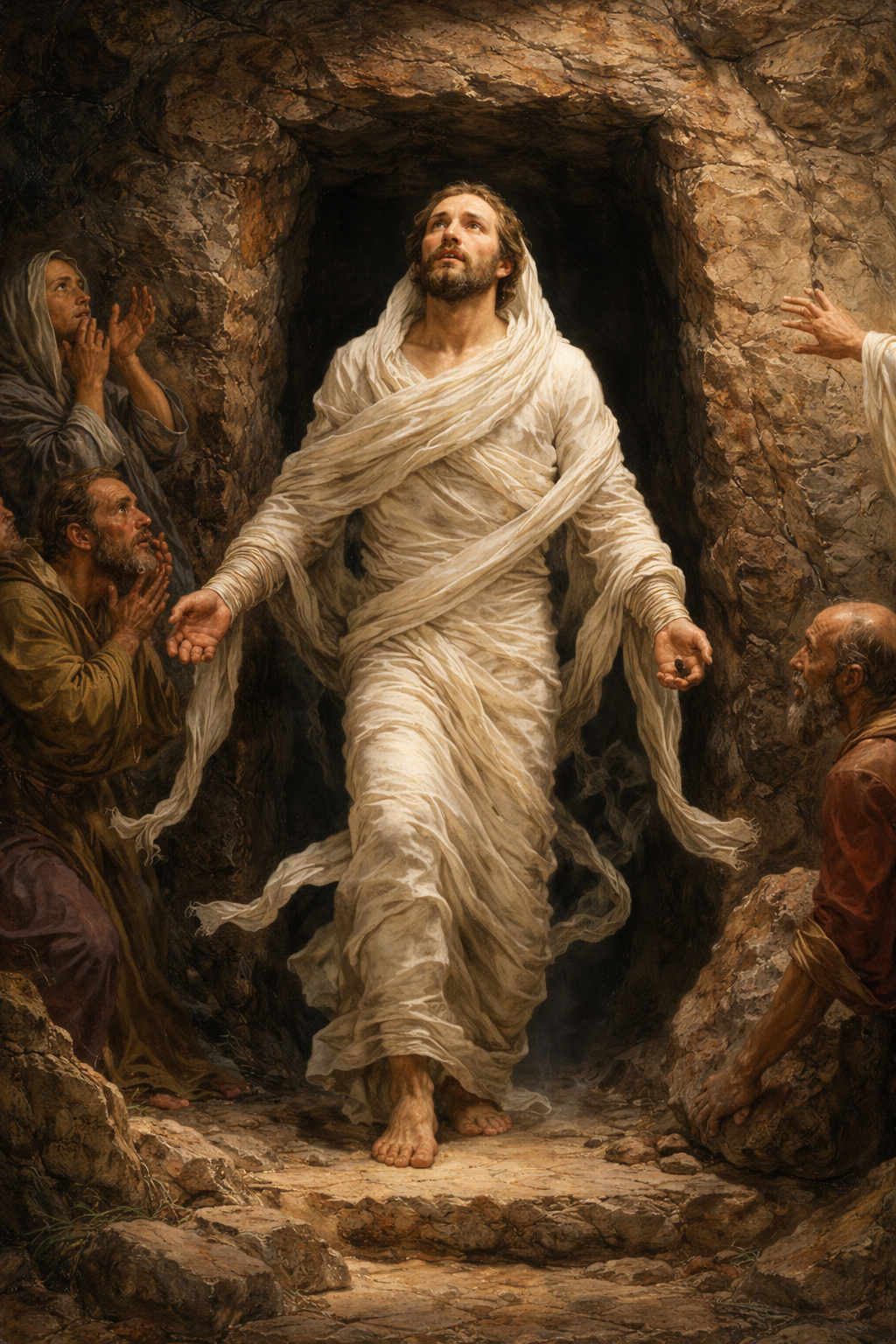
At the tomb, Jesus commanded that the stone be rolled away. Martha protested, reminding Him that her brother had been dead for days and that decay had begun. Jesus insisted, calling her back to faith and promising that belief would reveal the glory of God. Then, after praying aloud, Jesus cried out with authority, calling Lazarus by name and commanding him to come out. At the sound of Christ’s voice, Lazarus emerged from the tomb alive, still wrapped in burial cloths. Jesus instructed those present to unbind him and let him go, completing the miracle before their eyes.
This miracle stands as one of the most extraordinary signs in the New Testament. Unlike earlier resurrections, Lazarus had been dead long enough to erase all doubt. His return to life could not be explained away, and its impact was immediate. Many who witnessed it believed in Jesus, recognizing divine power at work. At the same time, the miracle intensified opposition from religious authorities, who now saw both Jesus and Lazarus as threats. Lazarus’ continued existence became living testimony to Christ’s authority, and Scripture records that there were plans to kill him as well.
After this moment, Lazarus largely disappears from the biblical narrative. He does not preach, write, or seek attention. His role was not to speak, but to be a sign. Early Christian tradition, especially in the Eastern Church, holds that Lazarus later fled persecution and eventually became bishop of Kition, in present-day Cyprus. Tradition says he lived many years after his resurrection, marked by sobriety and humility, and eventually died a natural death. Having once been called out of the grave, he would enter it again, awaiting the final resurrection promised to all.
The raising of Lazarus carries immense theological meaning. It reveals Jesus not only as a healer, but as the Lord of life and death. It anticipates His own resurrection, which would follow shortly, and serves as a sign of the greater victory over death that Easter proclaims. Lazarus himself was restored to mortal life, but the miracle pointed beyond itself to something eternal. It declared that death is not the end, and that the voice of Christ reaches even into the grave.
In Christian devotion, Lazarus has become a symbol of hope for the sick and the dying. His story assures believers that God’s apparent delays are not abandonment, and that divine love is not negated by suffering. Jesus did not come too late; He came at the appointed time, revealing a glory greater than immediate healing could have shown. Through Lazarus, believers learn that faith sometimes requires waiting in darkness before light is revealed.
Ultimately, Lazarus represents all humanity. He was loved, he suffered, he died, and he was called by name into new life. His miracle is not merely a past event, but a promise that echoes through Christian belief: that those who hear the voice of Christ and respond in faith will live. Lazarus’ life and resurrection stand as a powerful witness that death does not have the final word, and that in Christ, even the tomb must open.