Saint profile
Ambrose of Milan
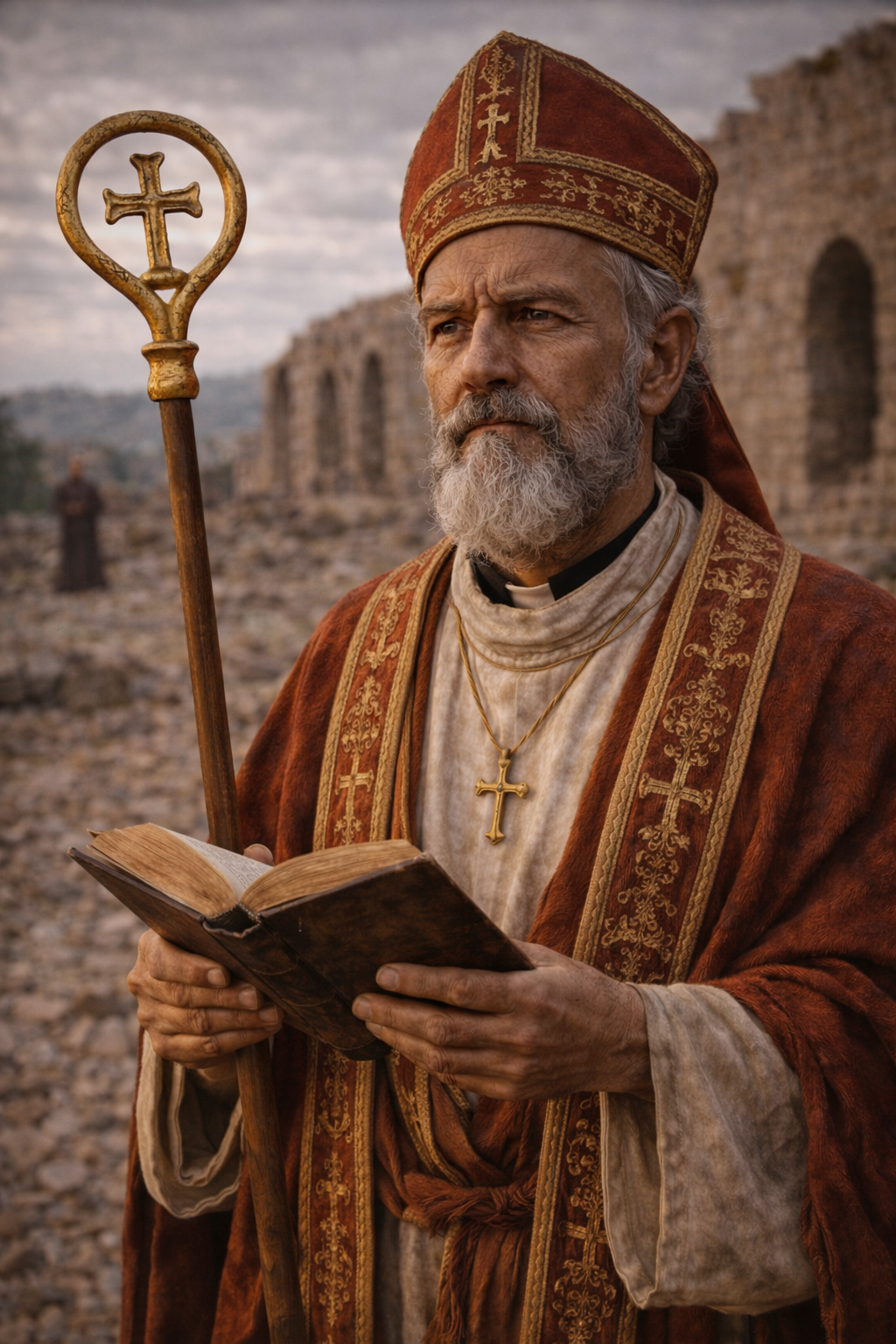
About Ambrose of Milan
Ambrose was born into a Christian Roman family of high status—his father was Praetorian Prefect of Gaul. After his father's death, Ambrose studied law and rhetoric in Rome and by age 30 was appointed governor of Aemilia-Liguria, with headquarters in Milan.
In 374 AD, when the Arian Bishop Auxentius died, fierce conflict erupted over choosing his successor. As governor, Ambrose went to the cathedral to preserve order. While he was speaking, a child's voice reportedly cried out, "Ambrose for bishop!" The crowd took up the cry. Ambrose, still a catechumen (unbaptized), protested vigorously—even trying to flee the city. But popular demand and the emperor's approval prevailed.
Within eight days, Ambrose was baptized, ordained through all the clerical ranks, and consecrated bishop. This rapid elevation was unusual but not illegal. Despite his protests, Ambrose proved an outstanding bishop. He gave away his wealth to the poor, lived ascetically, and devoted himself to studying Scripture and theology with the help of learned advisors.
Ambrose became a powerful defender of orthodoxy against Arianism, which still had imperial support. He refused Emperor Valentinian II's Arian mother Justina's demands to hand over a basilica for Arian use, famously declaring, "The emperor is within the Church, not above it." When imperial troops surrounded his church, Ambrose and his congregation held vigil, singing hymns he composed—introducing congregational hymn-singing to the West.
His greatest achievement may have been his influence on Augustine of Hippo. When Augustine came to Milan as a skeptical pagan rhetorician, Ambrose's preaching and intellectual approach to Scripture helped lead to Augustine's conversion. Ambrose baptized Augustine at Easter 387.
Ambrose also demonstrated that the Church held moral authority over the state when he required Emperor Theodosius to do public penance after ordering a massacre in Thessalonica. Theodosius, the most powerful man in the world, submitted, establishing a precedent for the Church's prophetic voice.
As a theologian, Ambrose wrote commentaries, treatises on virginity and the sacraments, and hymns still sung today. He died on Good Friday, 397 AD, revered for his integrity, courage, eloquence, and pastoral care. He is one of the four great Latin Doctors of the Church.