Saint profile
Hildegard of Bingen
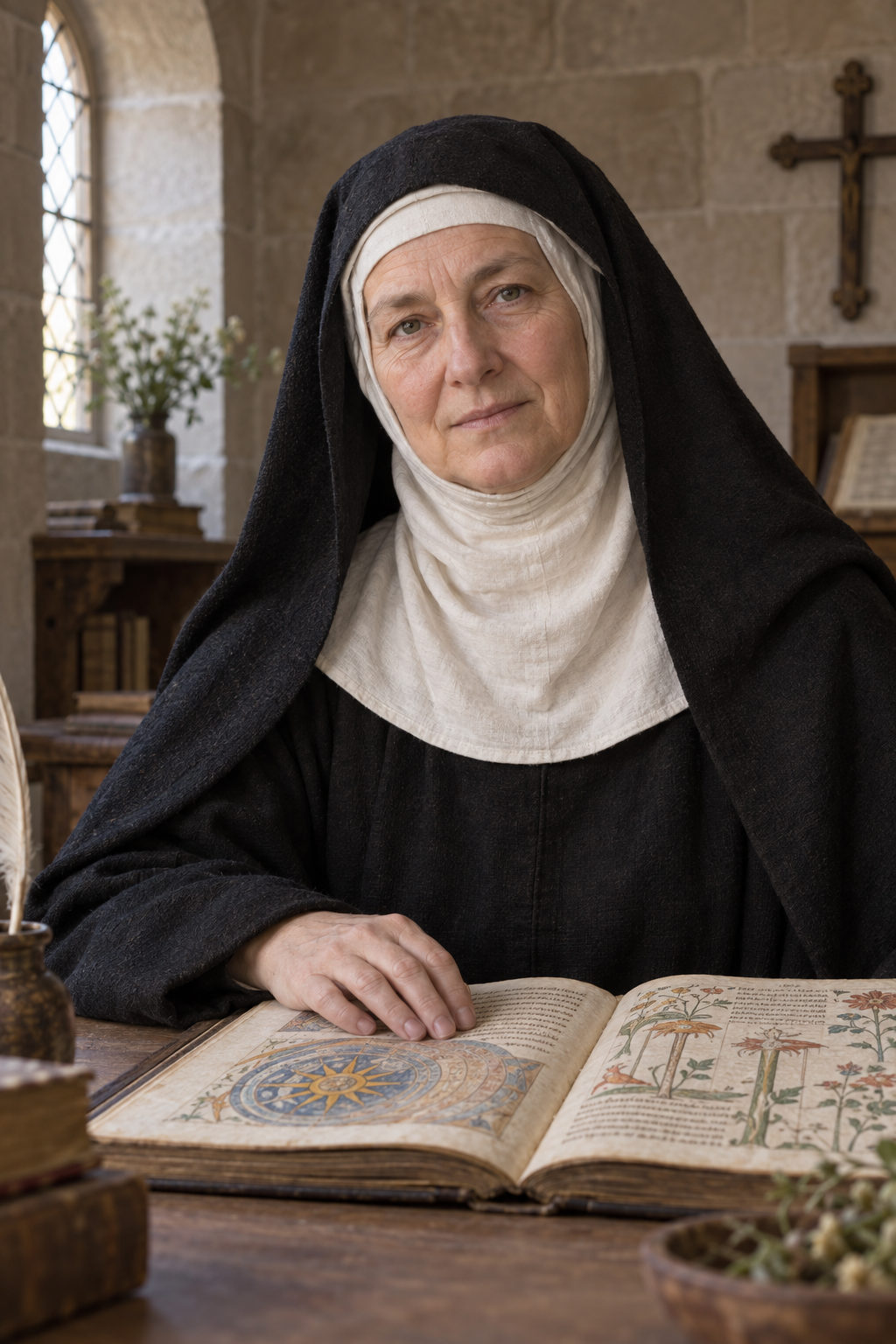
About Hildegard of Bingen
Hildegard of Bingen was a Benedictine abbess, mystic, composer, writer, and polymath—one of the most remarkable women of the Middle Ages. Born to noble parents in Germany, Hildegard experienced visions from early childhood, seeing "the reflection of the living Light" while remaining aware of her surroundings.
At age eight, Hildegard was entrusted to Blessed Jutta, an anchoress attached to the Benedictine monastery at Disibodenberg, for religious education. Hildegard took vows and lived in this small community until Jutta's death in 1136, when Hildegard, age 38, was elected leader.
At age 42, Hildegard received a divine command to write down her visions. After initial hesitation and illness, she began dictating "Scivias" (Know the Ways), a complex theological work containing 26 visions with detailed commentary on creation, redemption, and the church. Her writings were examined and approved by Pope Eugenius III at the Synod of Trier (1147-48), giving her unprecedented authority as a woman teacher.
Hildegard founded her own monastery at Rupertsberg near Bingen around 1150, establishing independence from Disibodenberg. She later founded a daughter house at Eibingen. She corresponded with popes, emperors, bishops, and abbots, offering counsel and prophetic correction without hesitation—an extraordinary position for a medieval woman.
Hildegard's output was astonishing: three major theological works (Scivias, Book of Life's Merits, Book of Divine Works), extensive biblical commentaries, scientific and medical texts (Physica, Causae et Curae), a morality play, invented language (Lingua Ignota), over 70 musical compositions, and hundreds of letters. Her music, featuring soaring melodies and poetic texts, is performed and recorded today.
Her scientific works showed keen observation of nature, describing plants, animals, minerals, and medical treatments. While containing medieval misconceptions, they demonstrate Hildegard's empirical approach and holistic view of health.
Hildegard went on four preaching tours—rare for any medieval woman—denouncing clerical corruption and calling for reform. She died at Rupertsberg in 1179, age 81. Though venerated for centuries, she was only officially canonized and declared a Doctor of the Church in 2012, recognition of her extraordinary theological and intellectual contributions.