Biography
Adalard of Corbie
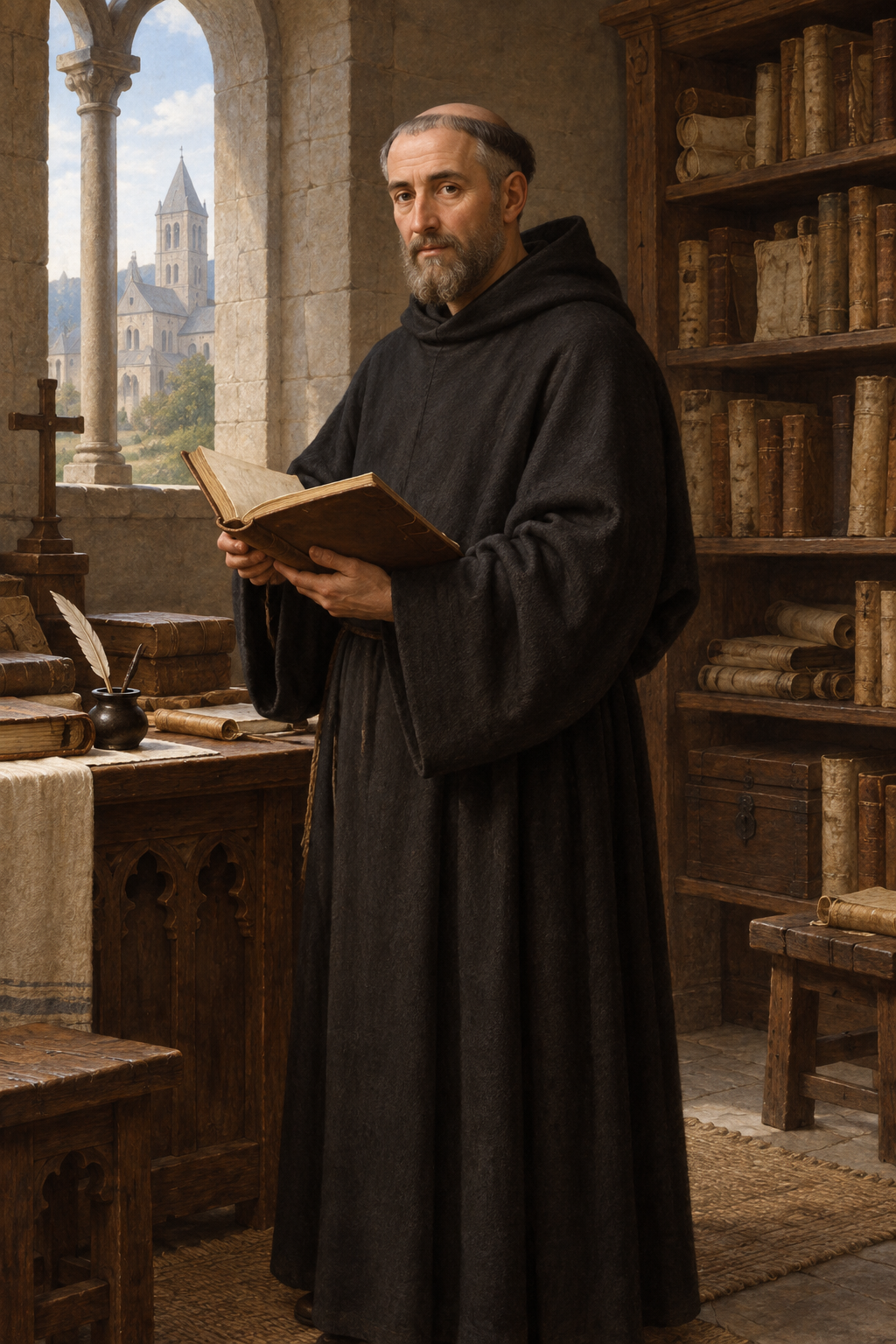
About Adalard of Corbie
Adalard (also written Adalhard) belonged to the Carolingian ruling family, but his best-documented work joined monastic leadership to the practical business of governing an expanding empire. The modern scholarly biography records his birth in 750 as a son of Bernard, a grandson of Charles Martel and cousin of Charlemagne. It does not supply a securely established birthplace. The surviving record presents him first in a world where aristocratic kinship could lead to court office, military and administrative service, or a religious vocation. Adalard eventually chose the monastery, while remaining a figure whom rulers repeatedly called back into public affairs.
The Neue Deutsche Biographie says that Adalard entered Corbie around 770. Its account connects this decision to his opposition to Charlemagne’s repudiation of Bertrada, the king’s mother; this should be read as the biographer’s explanation of his choice, rather than as a private statement preserved in Adalard’s own words. Adalard then sought a more secluded life at Monte Cassino. His withdrawal did not last. Charlemagne summoned him back, and he became abbot of Corbie, a major monastery in the Frankish realm. The contrast between the quiet he sought and the responsibilities he accepted recurs throughout the reliably recoverable outline of his career.
Corbie’s abbot was also trusted with political work. Adalard served as a royal envoy in Rome in 809. From 812 to 814 he acted as missus in Italy, an imperial representative charged with carrying royal authority into the kingdom. The biographical evidence also associates him with the administration of Italy for the young Pippin, Charlemagne’s son and king there. These offices place Adalard among the churchmen and aristocrats who made Carolingian government work across regions. They do not justify imagining a modern-style bureaucrat: the sources describe assignments and offices, not a surviving personal diary or a complete administrative record.
The change of ruler brought a sharp reversal. After Louis the Pious succeeded Charlemagne in 814, Adalard lost his property and was sent into exile at the monastery of Noirmoutier, south of the Loire’s mouth. The NDB notes that Adalard had sought a judicial inquiry into accusations against him, but was banished instead. It records that he returned to Corbie in 821, after roughly seven years. The available account does not warrant filling those years with invented scenes. What can be said is that exile interrupted his service at court but did not end his leadership as a monk. Once recalled, he chose again to direct Corbie rather than resume a permanent role at the imperial center.
Adalard’s most consequential institutional project followed. In 823, he and his brother Wala established a new monastery at Corvey, in Saxony. Louis the Pious granted the royal estate of Huxeria (modern Höxter) for the foundation. The monks were brought from Hethis in the Solling region. Corvey—often called “New Corbie”—extended the older abbey’s religious and cultural presence eastward. The foundation took place amid the Carolingian effort to organize Christian institutions in Saxon territories recently incorporated into the empire. The sources allow us to connect the brothers’ foundation to that wider mission; they do not give a basis for attributing every later conversion in Saxony directly to Adalard.
His work also included shaping communal life and reflecting on government. The NDB reports that Adalard left monastic customs for Corbie. These rules, known through manuscript transmission, offer evidence of his practical concern for the monastery’s order. A lost work on the organization of the palace has also been attributed to him. Archbishop Hincmar of Reims’s ninth-century treatise *De ordine palatii* appears to have used an earlier text by Adalard on the same subject, but the original is not extant, and scholars must distinguish the surviving adaptation from Adalard’s own words. The evidence therefore supports describing him as a contributor to monastic and political thought, while preserving uncertainty about exactly what his lost work said.
Adalard died on 2 January 826, after returning to Corbie. His successor, Paschasius Radbertus, wrote a life of him. Because that life was composed within the monastic community and serves as a remembrance of its abbot, it is an important witness but also a hagiographic work, not a neutral modern biography. Later accounts added miracle stories, and his relics were ceremonially elevated in 1025. Those later devotional traditions belong to the history of his cult; they are not needed to establish his political assignments, exile, return, or foundations. The French bishops’ calendar commemorates him on 2 January.
Adalard’s significance rests on the unusual range of responsibilities documented for one ninth-century monk: he led Corbie, represented rulers abroad, administered in Italy, endured exile, returned to monastic office, and helped establish Corvey. The record is strongest when it describes these institutional actions and more limited when it reaches into his private motives or the details of his lost writings. A careful account can therefore honor his religious legacy without treating later miracle narratives as ordinary historical evidence. His life illustrates how a Carolingian monastery could be both a community of prayer and an institution deeply involved in the government and cultural integration of an empire.
Wondering how to weigh the stories and sources? Learn how to read a saint biography.