Biography
Adeline Blanchard Tyler
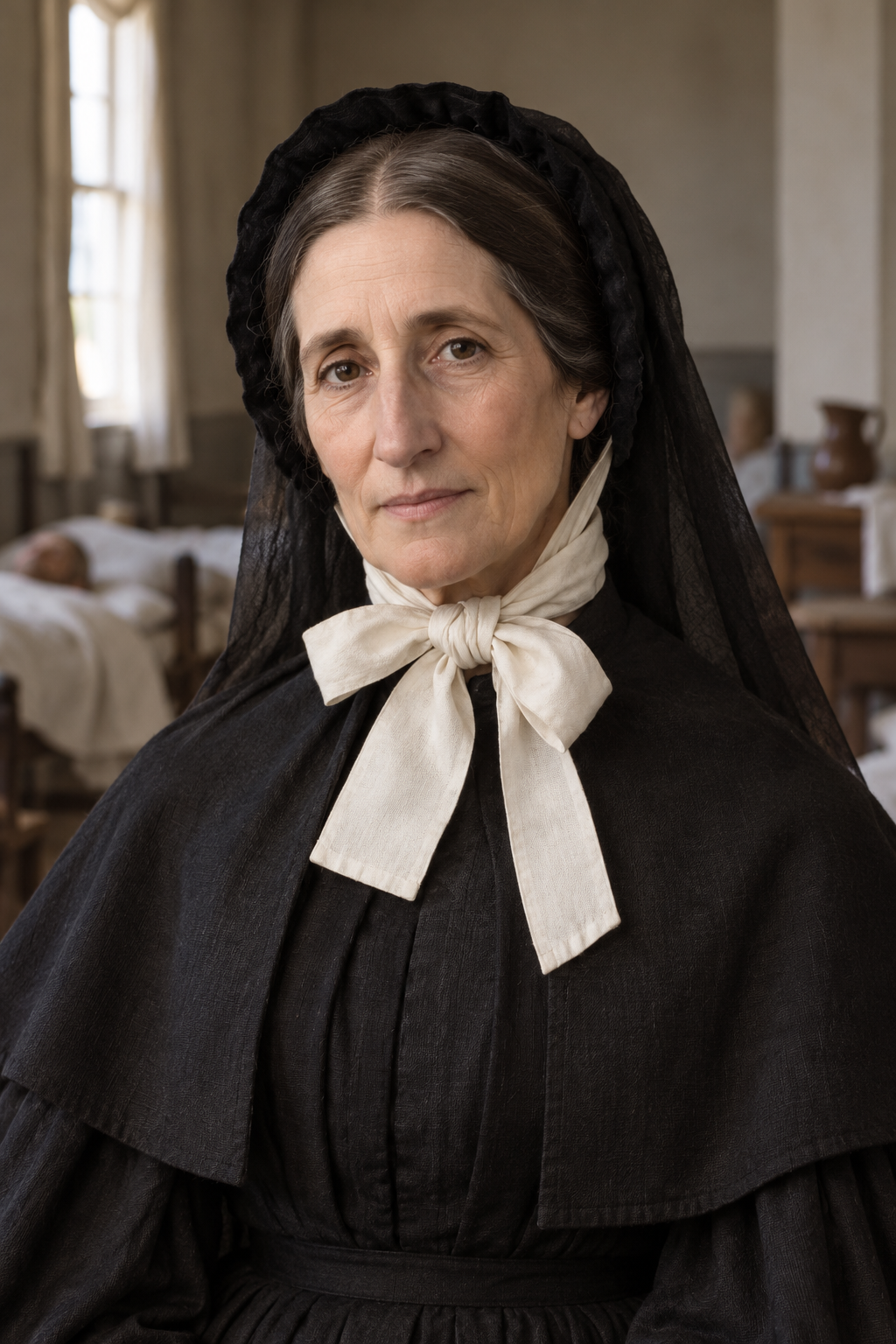
About Adeline Blanchard Tyler
Adeline Blanchard Tyler was an Episcopal deaconess whose work joined nursing, hospital administration and religious service. Known as Sister Tyler, she cared for wounded soldiers during the American Civil War and later helped lead Boston Children’s Hospital. Her career moved among institutions in Baltimore, Chester, Annapolis and Boston, carrying the practical responsibilities of organizing care as well as attending to individual patients.
She was born in Billerica, Massachusetts, on December 8, 1805. She married John Tyler and lived in Boston before beginning the work that would make her known beyond the city. Local historian Bill McEvoy records her eventual death in Needham, Massachusetts, on January 9, 1875. These places frame a life whose best-documented public years were spent caring for people away from her original home.
After her husband died in 1853, she studied nursing at the Deaconesses’ Institute in Kaiserswerth, Germany. On returning to America, she continued charitable work and accepted responsibility for a church-supported infirmary in Baltimore in 1856. Her leadership was not free from conflict. Historian Ronald S. Coddington describes complaints about the extent of her charitable activity and the appointment of a male superior in 1860. She resigned as chief deaconess but continued training other women and visiting sick people, children and prisoners.
Tyler belonged to an emerging form of women’s church service whose terminology and institutional standing were still unsettled. The Episcopal Archives notes that early American accounts did not always distinguish a religious sister from a deaconess. Different histories identify different beginnings for the ministry. It is therefore more accurate to describe Tyler as an early Episcopal deaconess than to imply that every historian agrees she held an identical, formally established office before anyone else.
Her nursing became especially visible after the Baltimore riot of April 19, 1861. Brockett and Vaughan’s 1867 account describes her seeking access to wounded Massachusetts soldiers held at a police station. Officials initially refused her request. She persisted, invoking the possibility of an appeal to the governor of Massachusetts. She then arranged to bring two injured men to the Deaconesses’ Home, where a surgeon treated them and she nursed them.
She subsequently supervised the Camden Street Hospital. Coddington’s account describes a dispute over her insistence that patients receive care without preference for Union or Confederate allegiance. Her impartiality was interpreted as disloyalty, and she lost the position. She later returned to military nursing at Chester, Pennsylvania, and Annapolis, Maryland. The episode shows that an undertaking intended as care for the sick could become entangled with wartime demands for proof of political loyalty.
At Annapolis, she and her colleagues cared for men returning from Confederate prisons in severely weakened condition. Brockett and Vaughan report that she obtained photographs of patients and used copies to make their suffering known in America and Europe. Their narrative also names fellow nurses and acknowledges the assistance without which her work could not have continued. Exhaustion and illness forced her to leave the hospital in May 1864. She traveled in Europe and returned to the United States in November 1865.
Her later work included the Midnight Mission in New York, which offered refuge to women whom contemporary society called fallen. Archival researcher Daphne Noyes describes Tyler’s concern for these women and her continuing correspondence with Bishop William Rollinson Whittingham about where and under whose authority she should serve. In 1869 she returned to Boston as the first lady superintendent of the new Children’s Hospital. Her letters record both demanding responsibilities and the strain they placed upon her.
The hospital began in a converted house, supported by philanthropy and practical gifts from a ladies’ association. Its early patients included children with injuries and infectious diseases. Tyler oversaw daily operations. When illness prevented her from continuing, Sister Theresa and the Sisters of Saint Margaret succeeded her. The hospital’s own history thus places her within a continuing network of nurses, donors and religious women, rather than presenting pediatric care as the achievement of one person alone. The ladies’ association supplied food, clothing, linens, towels, books and toys. Such contributions provided the ordinary materials needed for a functioning hospital, alongside the physicians’ treatment and the daily work of nursing.
Religious practice remained part of this daily work. Noyes records Tyler’s preparation of a chapel soon after arriving in Baltimore and her later establishment of an oratory at Children’s Hospital. Her letters describe regular services there. These details show how she understood nursing and worship as connected responsibilities within the institutions she helped sustain. The hospital oratory occupied an attic room, furnished with an oak altar whose panels were painted.
In 2024, the Episcopal Church authorized a November 4 commemoration of Adeline Blanchard Tyler and her companions for trial use during 2024–2027. This recognition names a shared ministry. Tyler’s record brings together direct nursing, institutional leadership and the difficulties faced by women carrying substantial responsibility within the nineteenth-century church.
Wondering how to weigh the stories and sources? Learn how to read a saint biography.