Biography
Agricola
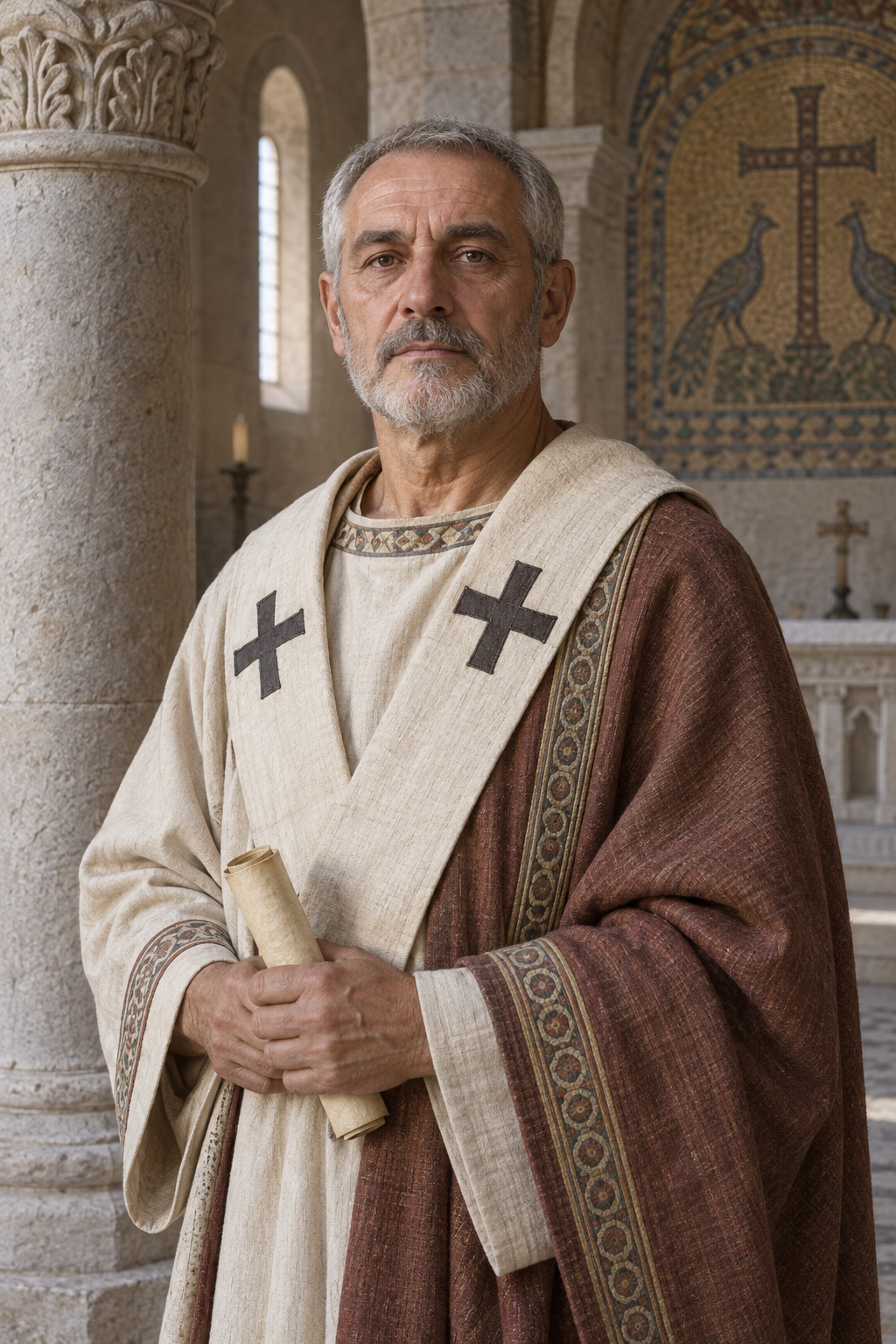
About Agricola
Agricola was bishop of Chalon-sur-Saône in sixth-century Frankish Gaul. His name appears in several spellings, including Agroecola in some council material, and later French tradition calls him Arègle or Agrèle. Those names matter because other saints called Agricola belonged to different places and eras. The bishop of Chalon can be followed through near-contemporary writing and the signatures of church councils. Gregory of Tours, who lived in the same century, provides the fullest short portrait of him. Gregory describes a man of senatorial family, prudence, and considerable eloquence. There is no equally secure record of Agricola's childhood, education, or birthplace. His public role emerges through his years as bishop rather than through a detailed early-life story.
The start of Agricola's episcopate is reconstructed from Gregory's report that he died in its forty-eighth year. It is commonly placed around 532, but the calculation should not be mistaken for a surviving appointment document. By 538, an Orléans council record names a priest, Avolus, acting on Agricola's behalf. The Bollandist editors describe Avolus as his delegate. This makes 538 evidence of Agricola's episcopal responsibility, while also showing why the phrase “Agricola attended in 538” is misleading. A bishop could take part in a council's record through a representative. In Agricola's case, the later subscriptions provide stronger evidence of attendance in person. The distinction keeps a coherent chronology without inflating his travels.
Agricola's own name appears with the bishops at the fourth council of Orléans in 541. The edited Merovingian conciliar collection preserves the subscription evidence. Councils brought bishops together to decide matters that affected communities beyond a single city. A signature shows that Agricola was present in this shared ecclesiastical work, but it does not show what he said in debate or why he supported each decision. This is a useful limit: a record of attendance should not be converted into a private speech or motive. His participation nevertheless places Chalon's bishop within a network of Gallic churches trying to maintain common rules and relationships in a changing political landscape.
A different contemporary witness records Agricola's work within his own see. Aetherius of Lyon wrote a Life of Bishop Nicetius and states that Agricola, bishop of Chalon, ordained Nicetius to the priesthood. The Presbyters Project dates this event to about 543; the text itself does not establish a precise day. This ordination connected the Chalon church to a man who later became bishop of Lyon. It also shows an ordinary but consequential part of Agricola's office: recognizing and commissioning clergy. The testimony comes from a Life devoted to Nicetius rather than Agricola, making it a useful independent check on the bishop's existence and work. It should not be expanded into an unsupported claim that Agricola supervised every stage of Nicetius's career.
In 549 Agricola's name appears again among the subscribers to an Orléans council. The Bollandist dossier distinguishes this from both the earlier delegation and the 541 personal subscription. Three records spread across more than a decade show an active episcopate, not a single ceremonial appearance. C. Wilkinson's study of late Roman Gaul likewise treats Agricola's council activity as a feature of Chalon's links to wider Frankish church life. The acts do not tell how often Agricola traveled, and they cannot by themselves explain every concern of Chalon's people. They do establish that the city's bishop repeatedly took part in decisions made with other bishops. That documentary pattern supports a narrative of sustained office without inventing unrecorded episodes.
Gregory of Tours also describes Agricola's building work in Chalon. He says Agricola made buildings, arranged houses, and raised a church supported by columns and decorated with marble and mosaic. The description is specific, though it does not identify a surviving structure that can be safely pointed out today. Church buildings in a bishop's city served public worship and made the office visible in stone and art.
Gregory's emphasis on materials conveys Agricola's attention to appearance. It does not justify attributing every old church or decorative fragment in Chalon to his hand. The secure historical point is modest: a near-contemporary writer remembered the bishop as a builder who reshaped part of his city.
Another work by Gregory connects Agricola with the memory of Desideratus, a priest admired for his ascetic life. Gregory says Agricola arranged for Desideratus's remains to be brought to a church associated with a hospice for people with leprosy. This is a glimpse of the religious and charitable landscape around Chalon. A bishop's attention to a hospice church does not prove he founded the institution or personally treated those who lived there. It does show him placing a remembered local priest within a place used by people facing illness and exclusion. Later accounts elaborate the episode, so Gregory's narrower testimony is the safer basis for describing it. The action belongs to his pastoral setting without needing a miracle story to make it meaningful.
Gregory praises Agricola's restraint at table and his ability to speak. Such assessments reveal how a contemporary bishop wished him to be remembered, though they are not measurements of private daily life. His account says Agricola died in 580, in the forty-eighth year of his episcopate and the eighty-third year of his age. These numbers support a long tenure, but do not provide a secure exact birth year. The year of death is supported by Gregory's chronology; March 17 is a later commemoration and should not be assumed to be the historical date of death. The Catholic Church in Norway's profile follows the older episcopal tradition and identifies him with the Chalon see. His memory rests first on contemporary testimony, not on a newly reconstructed childhood.
The Roman Martyrology remembers Agricola, bishop of Chalon, on March 17. That brief liturgical identification is significant because it distinguishes him from Agricola the Bologna martyr and from other bishops with similar names. Later local devotion developed around his burial and relics, but those later ceremonies are a separate chapter from the sixth-century life itself. For a reader today, the strongest picture is of a bishop whose name can be checked in conciliar records, whose ordination of Nicetius was recorded by another writer, and whose building work was remembered by Gregory of Tours. His significance is not dependent on a complete private biography. It lies in the visible links between a local church, wider councils, and the people and places he served.
Wondering how to weigh the stories and sources? Learn how to read a saint biography.