Biography
Aidan of Lindisfarne
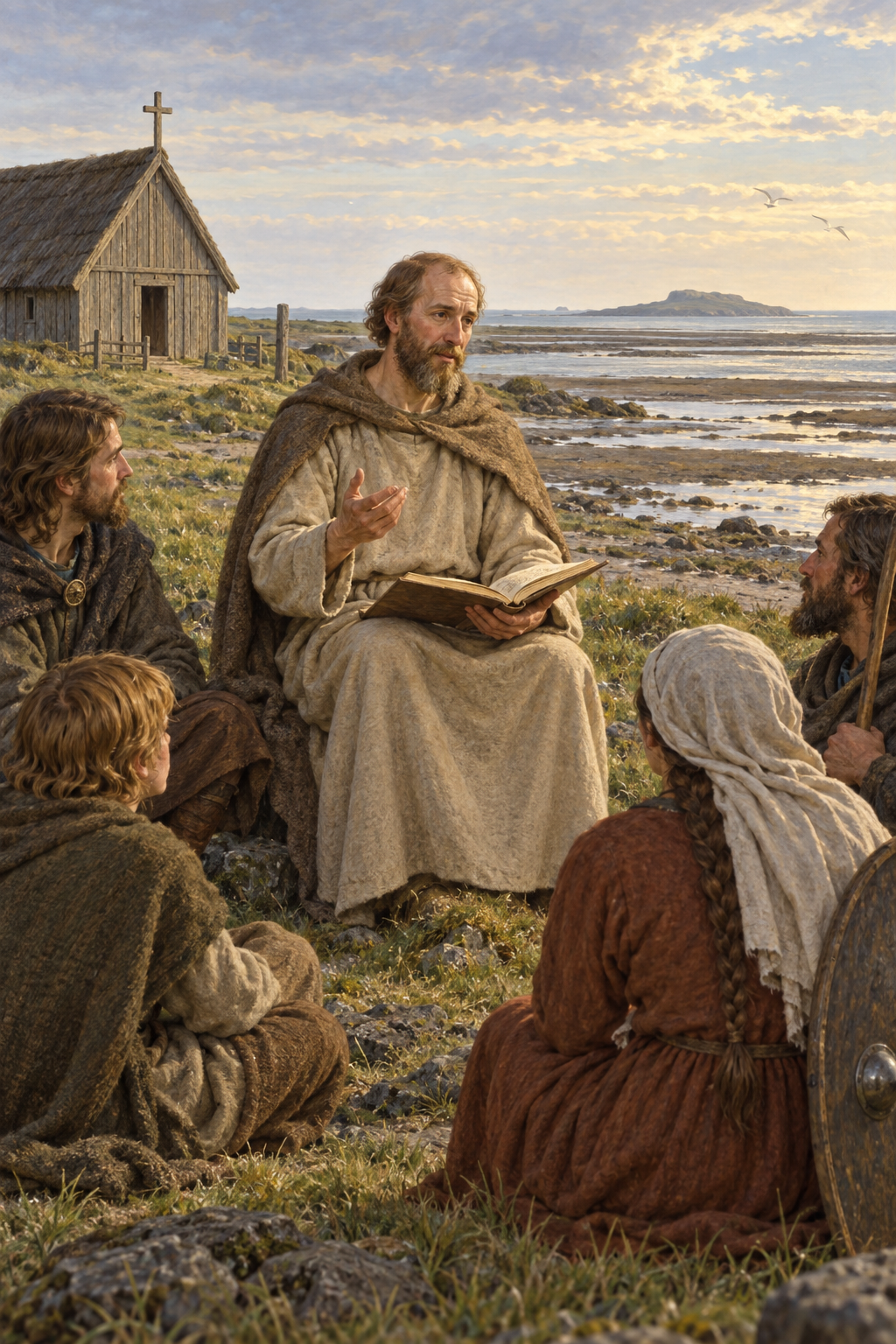
About Aidan of Lindisfarne
Aidan, called Áedán in Irish, was a monk from the community of Iona before he became the first bishop of Lindisfarne. His year and place of birth are not securely known. His early training belonged to a monastic network founded by Columba, whose houses crossed the seas between Ireland and northern Britain. The *Dictionary of Irish Biography* cautions that later Irish identifications of this Aidan with similarly named figures rest on deduction rather than a firm tradition. The clearest historical outline begins when a Northumbrian king asked Iona for help rebuilding Christian life in his kingdom.
King Oswald, who had spent years in exile among Christians connected with Iona, gained the Northumbrian throne in the 630s. He requested a bishop from that community, and Aidan arrived around 635. English Heritage places the founding of his island monastery and episcopal base at Lindisfarne in that year. The island lay close to the royal center at Bamburgh, joining monastic life to routes of royal travel and local communities. The mission had political support from its beginning, but it was a community's work, not a single royal decree. Monks taught, prayed and visited settlements as the Christian network expanded.
Bede, writing in the next century, says that Oswald sometimes interpreted Aidan's preaching because the bishop did not yet speak the English language well and the king knew the language of Iona's monks. This image shows cooperation, and it also reveals a limit: what listeners heard depended on translation and on a king's presence. Aidan could not simply arrive and address every Northumbrian directly. Bede praises the king and bishop together, reflecting his own interest in a Christian monarchy. His text is a precious early witness but does not preserve the private judgments of all who heard the preaching.
Lindisfarne became more than a place where one bishop lived. English Heritage describes its role as a base for mission and, over time, a major center of learning. Under Aidan the first buildings were simple; the famous illuminated Lindisfarne Gospels were created generations after his death, and the stone priory visible today belongs to a much later rebuilding. Separating those periods protects the reality of his modest early community from being swallowed by the monument that followed it. Its endurance depended on a succession of monks and bishops who carried the work beyond Aidan's lifetime.
The community also trained local people. Bede remembers Eata among a group of Northumbrian boys instructed by Aidan when he first became bishop; Eata later led a monastic house. Instruction meant that the mission could acquire local voices instead of relying forever on outsiders and royal interpreters. The story is about formation within an unequal early medieval society, so it should not be turned into a claim that every child had equal access to learning. It does show a deliberate effort to build a continuing community through people of the region.
Aidan's ministry continued after Oswald's death in battle in 642. Later rulers gave varying levels of support, and the bishop continued visiting settlements from royal estates. Older Catholic reference literature records his continued work under Oswald's successors. Bede's account does not provide a full list of communities established during those years, a limit of the written record rather than proof that only Lindisfarne existed. Aidan's position as bishop gave him reach, while changing royal circumstances could affect where his companions worked. The mission must be understood within both monastic commitment and Northumbrian power.
Stories about his generosity passed into Christian memory. The Orthodox Church in America's life retells Bede's episode in which King Oswin gave Aidan a horse and Aidan handed it to a person asking for help. The account presents the gift as a vivid sign of how he valued a poor neighbor. It is an early narrated episode, yet its reported conversations and later prediction belong to Bede's shaping of an exemplary bishop. The safer historical point is the enduring reputation for giving away resources rather than treating every spoken word as a transcript. His position near kings did not have to separate him from the needs of people without their access.
Bede admired Aidan while criticizing the calculation of Easter used by the monks of Iona. The disagreement concerned the dating of a central Christian feast in a church that had multiple regional customs. It was not a dispute between the later Catholic and Protestant communities, and Aidan should not be assigned to a modern denomination on that basis. The *New Catholic Encyclopedia* places him within the same early Northumbrian church history as other missionaries and bishops. Remembering both Bede's praise and his criticism helps keep his portrait historical: admiration did not make every practice identical across Christian Britain and Ireland.
Aidan died on 31 August 651 at a royal estate near Bamburgh. The Catholic Church in Norway's biography gives the same date and location, and the Irish biographical record says he was buried at Lindisfarne. Later stories describe a wooden church structure near the place of death and its preservation as a relic. A University College London study cautions that no material evidence of that original building survives. The remembered scene and the archaeological limit need to stand side by side. Neither the Norman priory ruins nor a later castle should be mistaken for the place where Aidan lived and died.
His 31 August remembrance appears in Catholic and Orthodox sources, reflecting a legacy older than their later separation. The island community he helped establish became an enduring center of worship, teaching and mission. Its later fame owes much to successors, especially Cuthbert, and to works made after Aidan's death. Aidan's own distinct importance lies in his part in forming that first community, working with Oswald and later rulers, and training people who could continue the work in their own land. The sources show a patient missionary bishop within a network of monks and neighbors, rather than a solitary founder who accomplished every later achievement of Lindisfarne.
Wondering how to weigh the stories and sources? Learn how to read a saint biography.