Biography
Aldhelm
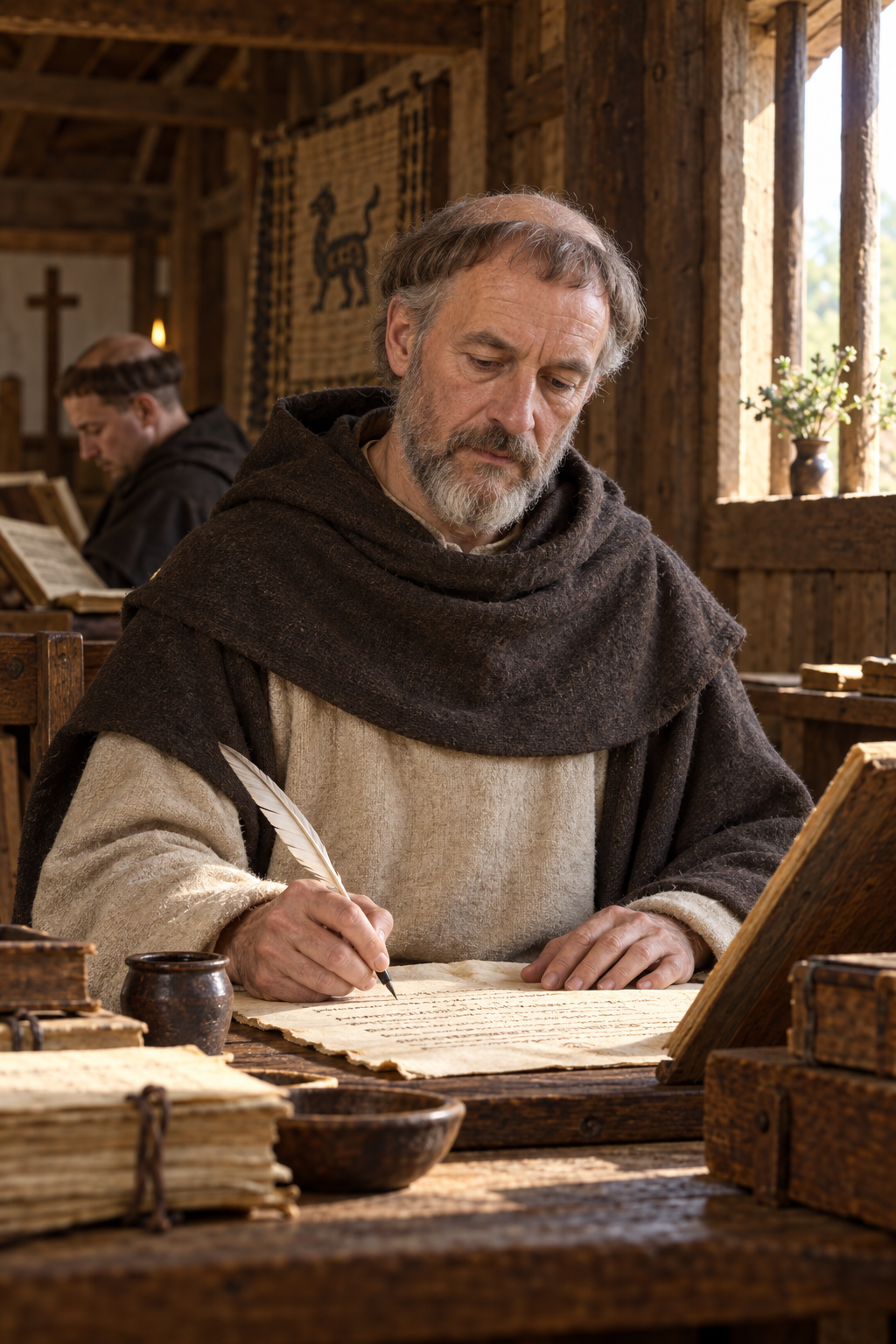
About Aldhelm
Aldhelm was an abbot and bishop in the West Saxon church who became one of early England's most distinctive Latin writers. His birthplace and birth year cannot be fixed with confidence. The secure outline starts with his leadership at Malmesbury and the writings that survive from that period, rather than a complete childhood story. An older Catholic reference surveys his surviving letters, prose and verse while warning that exact dates supplied by some biographers depend on doubtful charters. His writing gives us an active intellectual life, while many ordinary details of the person remain unknown.
At Malmesbury Aldhelm led a monastic community in a region where royal power and church institutions were still taking shape. The local Athelstan Museum associates him with the expansion of the school and with the first abbacy there, beginning in the later seventh century. These descriptions preserve a strong local memory, but their precise chronology rests on evidence later than Aldhelm himself. His role as abbot is much firmer than a specific accession year. Leadership meant responsibility for learning, worship, people and property, although the surviving sources reveal more of his books than of the daily decisions of the community.
His learning was wide even by the standards of a monastic author. Love lists letters, a treatise on Latin meter containing one hundred riddles, dedicatory verses, and both prose and metrical treatments of virginity. Aldhelm worked in Latin though it was not his native spoken language. His elaborate style could be difficult, but later manuscript readers added abundant glosses, evidence that generations studied rather than simply admired him from a distance. To call him a writer is therefore to name a form of teaching that continued after his lifetime. None of that reception proves every later anecdote about his preaching.
The prose *De virginitate* was addressed to religious women whose names included Hildelith. It gathered examples of holy lives to discuss a Christian ideal, and Aldhelm also made a verse treatment. The audience matters: educated women were participants in the exchange of texts, rather than background figures in a story only about male scholars. Athelstan Museum relates the work to Hildelith and the women at Barking. Scholars debate whether every named woman belonged to that one house; the address itself shows a network of readers, but it does not settle where each reader lived.
Gernot Wieland's review of a scholarly edition explains why interpretations of this work require care. One proposal treats it as a missionary text and the named women as ten abbesses of separate communities. Wieland finds both claims intriguing but unproven. A Latin treatise directed to committed religious women cannot simply be taken as a record of Aldhelm preaching to pagans. The argument over recipients also turns on how names and titles are read against fragmentary charters. The surviving writing can illuminate women's learning and ideals without providing an uncontested map of ten houses.
Aldhelm also took part in disagreements about the calculation of Easter. A recent study examines his letter to Geraint of Dumnonia, in which he urged acceptance of the Roman practice while appealing to the unity of British and English Christians. Scholars dispute which synod commissioned the letter and how to date it. The writing offers a glimpse of relations among neighboring churches, but does not show that Aldhelm personally visited every community involved. The question affected church unity and regional custom in his own century; assigning it the lines of much later Christian divisions would distort it.
In 705 the West Saxon bishopric was divided after Bishop Haedde's death. Daniel received one portion and Aldhelm the other, centered on Sherborne. The episcopate was short, following decades associated with Malmesbury. This was part of a reorganization with another bishop, not a solitary creation of a new church. An older Catholic synthesis cautions that some precise details given by Aldhelm's later biographers depend on charters of doubtful authenticity; it also identifies him as the first bishop of Sherborne. Its statement about a visit to Rome and an alleged papal exemption deserves the same caution, since the purported document is spurious.
A document dated 705 and attributed to Aldhelm describes his wish that the communities of Malmesbury, Frome and Bradford-on-Avon retain freedom to elect their abbots after his death. It portrays a bishop who still cared about houses he had led, and it includes the voice of monks resisting an immediate replacement. Yet the Electronic Sawyer catalogue records a direct scholarly dispute about authenticity: one assessment calls it probably genuine, another fabricated without a genuine basis. It is useful evidence of later claims about monastic autonomy, but cannot be made the sole proof that Aldhelm performed each action the charter narrates.
The end of Aldhelm's life is remembered strongly at Malmesbury. The local museum gives 25 May 709 for his death and describes the return of his body to the monastery. Malmesbury History Society, discussing a later account by William of Malmesbury, notes a different day in May for the last journey. Bede supplies neither exact day nor death place in his brief notice, though his four-year episcopate points to around 709. A memorial date is therefore safer to retain as a feast than to convert into a verified death date. The place and exact day remain open in this review.
His reputation joined learning and holiness. Local accounts tell of singing to listeners and of miracles connected with him and his shrine, while Bede himself reports healing stories around the place of his death. Such narratives show how communities remembered a revered bishop; they cannot be checked as ordinary observations of his private life. The works he left provide a firmer trace: a writer shaped by monastic teaching, religious women readers, church debates, and a final episcopal office. Aldhelm's legacy is the continuing conversation his writing made possible across generations of scholars and worshippers.
Wondering how to weigh the stories and sources? Learn how to read a saint biography.