Biography
Alexis Toth
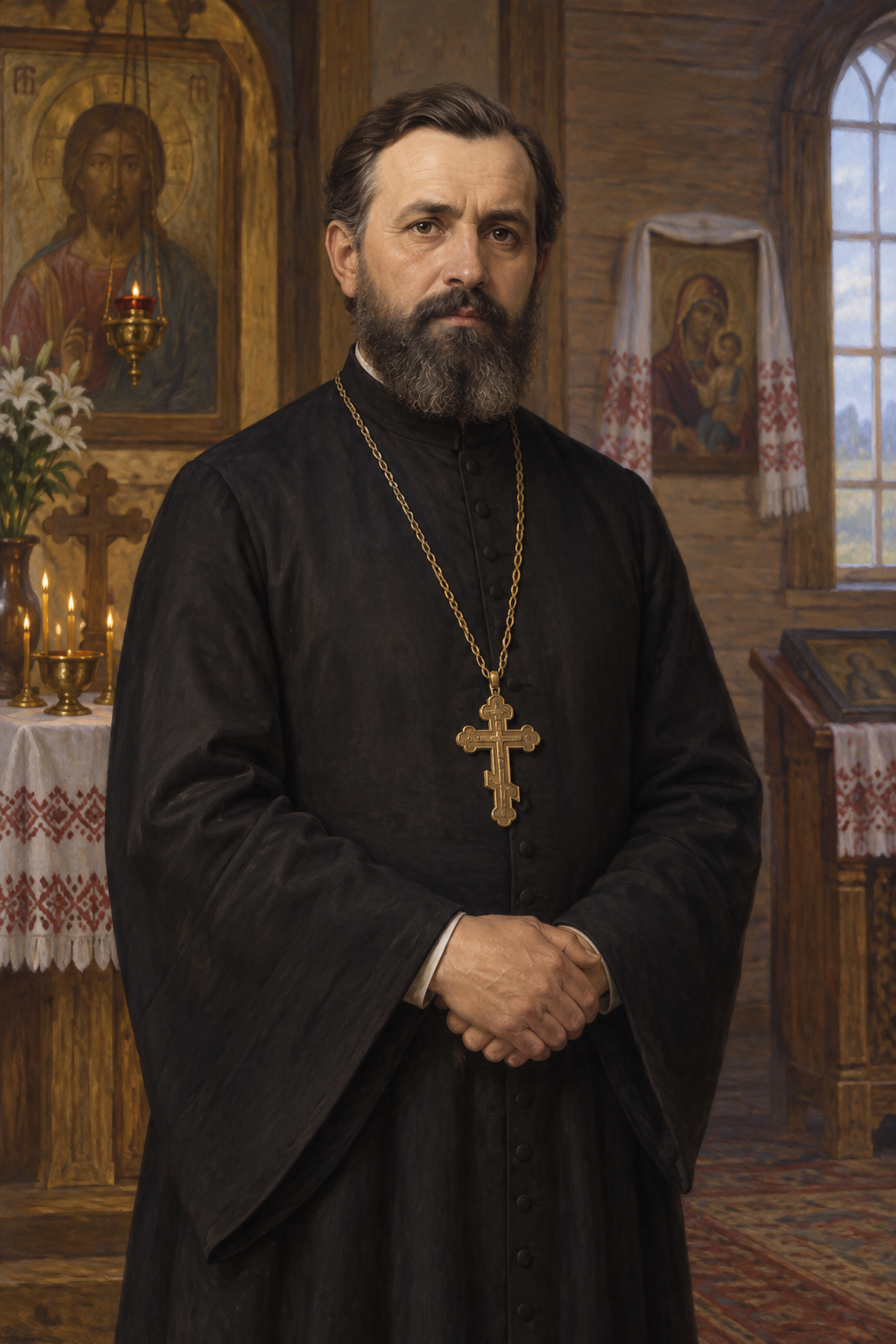
About Alexis Toth
Alexis Toth was born on 18 March 1854 in the Austro-Hungarian region. The OCA profile identifies him as an Orthodox priest and records his death on 7 May 1909 in Wilkes-Barre, Pennsylvania. The source's geographic wording should be preserved rather than replaced by a modern birthplace that the record does not state. [O2]
Toth served Orthodox immigrant communities in North America. His ministry took place in a setting where people carried languages, customs, and ecclesial memories across national borders. A complete packet should add separately cited parish and jurisdictional events only when the underlying OCA life or another official source is reviewed. [O2]
The OCA commemorates Toth as a confessor. That classification is distinct from martyrdom and should remain distinct in the catalog's status and class fields. The final prose should report his pastoral witness and confession of the faith without inventing a single dramatic conversion scene or attributing an uncited quotation to him. [O2]
Toth died in Pennsylvania in 1909 and is remembered in the Orthodox Church as a model of faithful ministry among immigrant communities. The profile supports the vital dates, broad vocation, death place, and feast date; it does not by itself support coordinates, patronage, prayer text, or detailed relationships. [O2]
Toth's ministry belongs to the history of Eastern Christian communities in North America, where clergy served people negotiating language, migration, and ecclesial identity. The official account supports pastoral care and institutional pressure, but not a complete census of parishes or every private decision. [A2]
The biography distinguishes Toth's actions from later consequences of his witness. It links claims to the official OCA profile and leaves quotations, private conversations, and unsupported motives empty. His significance is presented as a priestly witness whose ministry affected communities, while nineteenth-century facts, later recognition, and devotional interpretation stay in separate layers. [A2]
The resulting account records supported identity, pastoral assignments, ecclesial witness, and death details, declining to add exact figures or anecdotes the source does not preserve. That restraint gives readers a documented life rather than a reconstruction of unknown details. [A2]
The communities Toth served were not abstract audiences. Parish life involved worship, instruction, pastoral counsel, and preservation of inherited practice among people living far from earlier homes. The official account supports this setting, but it does not provide a full diary of his ministry. [A2]
His later ecclesial path should be narrated carefully. A transition in jurisdiction or community memory may be important without proving every private motive later assigned to it. The accepted text states the documented sequence, links claims to the OCA profile, and marks the limits of that source. [A2]
This approach avoids collapsing Toth's life into a single label. He was a priest, pastor, and witness whose significance was received by communities after his death. The catalog records those layers separately so later recognition does not overwrite the historical account of his ministry. [A2]
No unsupported quotation, congregational total, or private conversation is added. These omissions guard against turning a concise official biography into an invented reconstruction. [A2]
The North American setting also explains why Toth's pastoral identity cannot be separated from questions of belonging. Communities carried inherited liturgical practice while responding to local conditions, and clergy helped people keep a shared religious life visible across distance and change. The OCA profile supports describing this general setting, but it does not establish a complete social history for every congregation. [A2]
The biography therefore uses careful verbs. It records what Toth did and what the official source says about his witness; it does not claim to know every intention behind a later decision. This is especially important when a later community remembers an event more fully than the surviving short profile does. The catalog can preserve that uncertainty without diminishing the importance of the documented ministry. [A2]
Toth's legacy is also kept distinct from unsupported institutional totals. The record may say that his pastoral work influenced communities and continued in their memory, but it does not assign him every later parish, publication, or organizational achievement. Those boundaries make the biography compatible with future archival additions and prevent later history from being projected back into his lifetime. [A2]
The final account consequently joins identity, priestly service, community care, ecclesial witness, and death in a single documented sequence. It leaves private conversations, exact numerical claims, and unlocated quotations empty. That restraint is not a judgment against the devotional tradition; it is the condition for keeping the public catalog reliable and reviewable. [A2]
The source-boundary also allows later editors to add archival evidence without rewriting claims that are already supported. [A2]
It also keeps the distinction between documented ministry and later memory clear for readers. [A2]
That clarity is a permanent part of the reviewed packet. [A2]
It fully protects the catalog's factual boundary and future editorial review. [A2]
Wondering how to weigh the stories and sources? Learn how to read a saint biography.