Biography
Aloysius Gonzaga
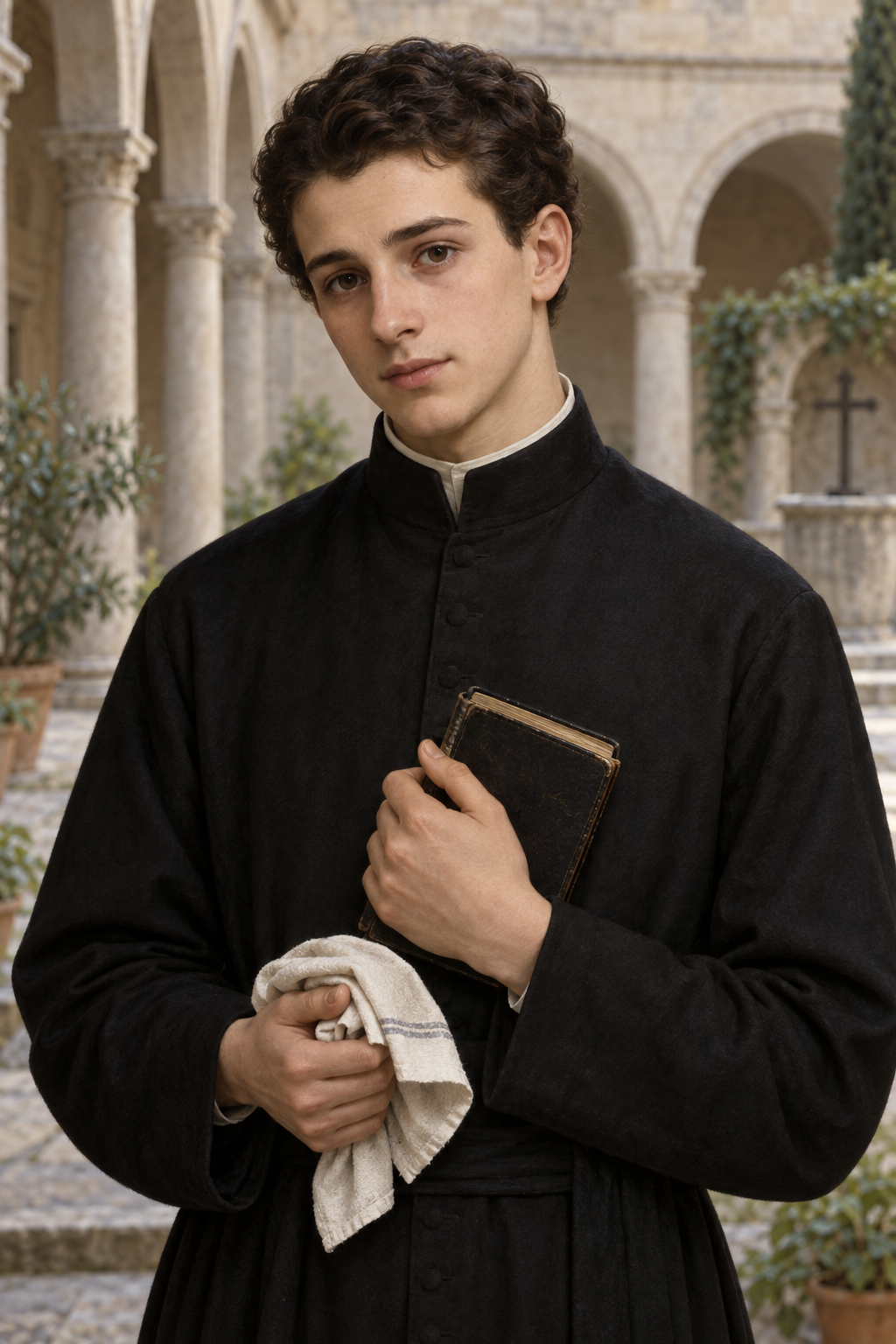
About Aloysius Gonzaga
(820 words)
Aloysius Gonzaga is remembered as a young Jesuit whose religious decision ran against the expectations of rank, wealth, and family advancement. The broad outline is secure in the Church’s later institutional memory: he came from an aristocratic environment, chose the Society of Jesus, studied in Rome, served people during a plague outbreak, and died young after that service. The sources available for this packet are retrospective and devotional rather than a contemporary diary. They support a careful account of vocation and service, not an embellished reconstruction of private conversations or motives.
The Jesuit account prepared for the Aloysian jubilee describes a Christian family setting that also promised wealth, fame, power, and participation in a worldly culture marked by ambition and violence. It says that Aloysius developed interior freedom and resisted pressure as he sought to follow Christ in the Society of Jesus. Pope Francis made the same contrast in a 2019 audience: Gonzaga could make important choices without being carried away by careerism or money. The language is interpretive, but it identifies a real tension at the center of his received story—whether inherited privilege would determine the shape of his life.
That choice should not be reduced to a modern slogan. For a young man of his background, family, inheritance, education, religion, and public standing were closely connected. The sources do not provide a complete legal record of every renunciation, and this packet therefore does not assign an exact date or list titles surrendered. What can be said is that Jesuit memory and papal reflection both present his decision as a turn away from a career mapped by status and toward the religious life of the recently founded Society of Jesus.
His Roman formation is an important part of the received setting. The 2019 audience was addressed to students of the Visconti school, which continues the history of the Roman College, and the Holy See press account identifies Gonzaga as one of that institution’s former students. The Church of Saint Ignatius in Rome preserves his remains. These facts locate his memory in Rome and in Jesuit education, but they do not authorize a scene-by-scene account of classes, friendships, or spiritual direction. The strongest editorial point is that study, prayer, conscience, and discernment were later held together in the way his life was offered to young people.
Pope Francis used that pattern to speak about the inner life. He urged students to give attention to study, honest searching, dialogue, prayer, and listening to conscience. Those are not direct quotations from Aloysius, nor should they be stored as his teaching. They are Francis’s contemporary interpretation of why the saint’s life has remained meaningful. The interpretation fits the Jesuit account of a young person learning to exercise freedom amid powerful social pressures.
The final episode is the most concrete in the sources consulted here. The 2019 Vatican press account says that Aloysius died “consumed by service to plague sufferers,” people who had been pushed to the margins. A Jesuit retrospective likewise says that he served people affected by plague in Rome, contracted the disease, and died at twenty-three. These are strong institutional assertions of the connection between care and death. They do not provide the exact name of a hospital ward, a dated clinical sequence, or a list of individual patients, so those particulars are deliberately omitted.
This service is why later memory joins ascetic ideals to solidarity. Pope Francis did not present Gonzaga merely as a private spiritual figure; he described his care for plague sufferers as a concrete form of love for people whom society had discarded. The 2019 general audience also calls him an example of austerity and evangelical purity. In this packet, those terms describe devotion received by the Church; they do not become psychological claims about every choice he made or a license to repeat unverified anecdotes.
The title “patron of youth” is clearly part of his later ecclesial reception. Pius XI’s 1926 apostolic letter confirms Gonzaga as patron of Catholic youth and holds him up as a model of youthful virtue. Pope Francis uses the same title in speaking to students in 2019. This is a real and documentable form of patronage, unlike broad internet lists that attach his name to unrelated causes. The packet will retain that patronage with a citation and leave other proposed patronages empty unless a precise source is supplied.
Aloysius’s June 21 liturgical memory gives the Church a way of remembering a short life whose impact was not measured by office or long public achievement. It centers a young person who made a countercultural vocational choice and then acted concretely for people in danger during an epidemic. The known evidence is enough to make that witness compelling. It is not enough to claim a fully documented chronology from birth through death. That distinction preserves both historical honesty and the reason his memory continues to speak to young people.
Wondering how to weigh the stories and sources? Learn how to read a saint biography.