Biography
Alphonsus Liguori
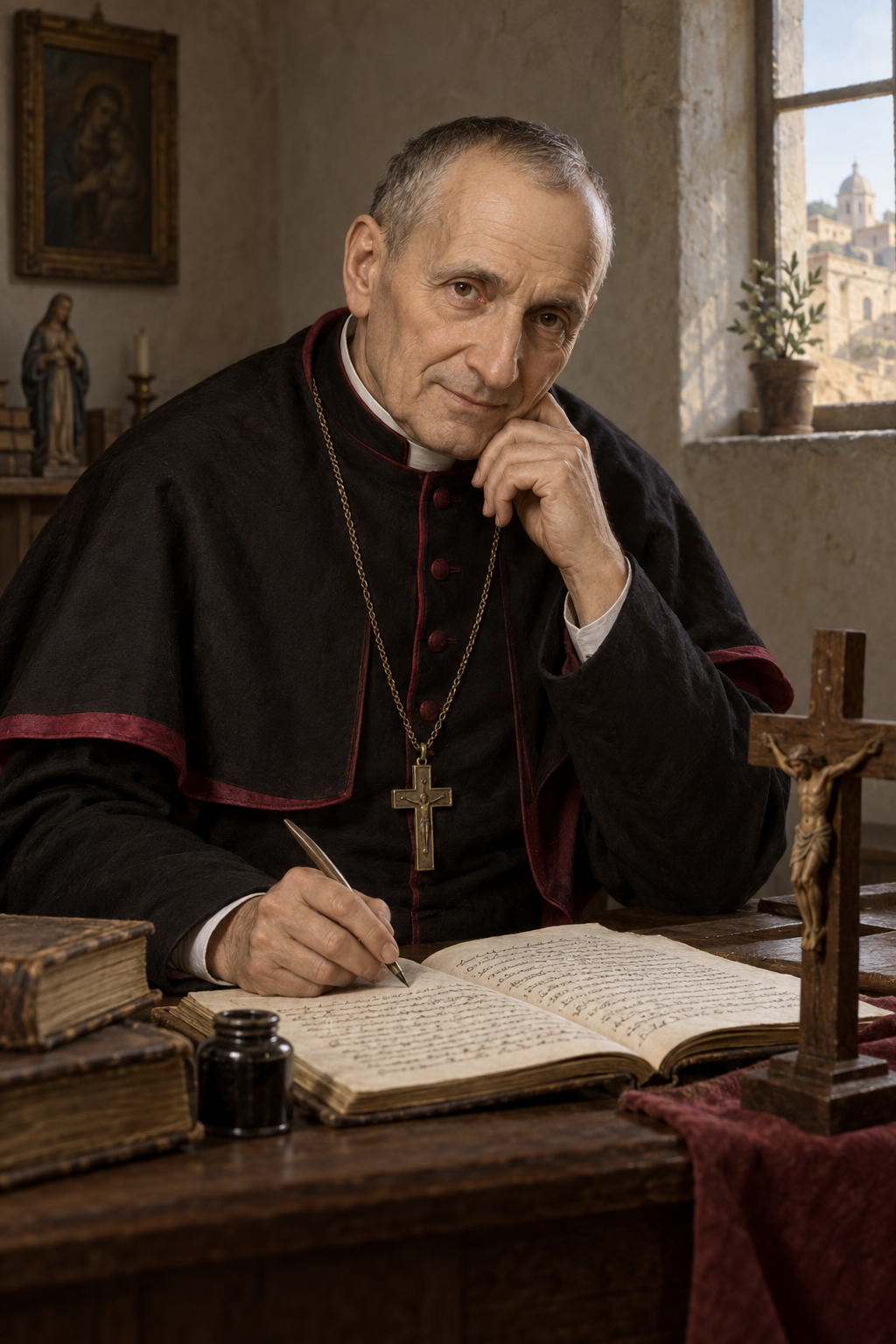
About Alphonsus Liguori
(817 words)
Alphonsus Maria de’ Liguori is remembered as a priest, missionary founder, bishop, moral theologian, spiritual writer, and Doctor of the Church. Benedict XVI’s 2011 audience gives a substantial framework for his life while showing why his work cannot be reduced to offices. He addressed people who were poor, neglected, fearful, or distant from formal religious instruction, and his theology joined moral truth with confidence in God’s mercy.
Benedict says that Alphonsus was born in 1696 into a wealthy noble family in Naples. He received degrees in civil and canon law at sixteen and became a successful lawyer in the Neapolitan tribunal. These claims establish the social advantages available to him, but they do not warrant invented accounts of every case or family conflict. The decisive turn came in 1723, when he abandoned legal work, wealth, and expected success after becoming troubled by corruption and injustice in the legal world. Benedict presents this as a vocational decision made despite his father’s opposition.
He was ordained a priest in 1726. His early ministry included evangelization and catechesis among poorer parts of Neapolitan society. Benedict says he patiently taught people to pray and encouraged a changed way of life. The account describes evening groups in homes and workshops where people prayed and meditated on Scripture with trained catechists. When the archbishop moved those meetings into city chapels, they became known as evening chapels. This describes a pastoral strategy, not proof that every social problem in Naples disappeared.
At about thirty-five, Alphonsus encountered peasants and shepherds in the hinterland of the Kingdom of Naples. Benedict says that religious ignorance and material and spiritual neglect moved him to leave the capital and dedicate himself to them. In 1732 he founded the Congregation of the Most Holy Redeemer under the protection of Bishop Tommaso Falcoia and later served as its superior. The Redemptorists were itinerant missionaries who traveled to remote villages, encouraging conversion, perseverance, and prayer. Their later worldwide work is a continuation, not evidence that every later apostolate can be assigned to him.
His pastoral concern shaped his approach to moral theology. Benedict places him in a period when Jansenist-influenced rigorism could emphasize fear and a severe image of God. Alphonsus’s *Moral Theology* sought a balanced synthesis of God’s law, conscience, freedom, truth, and human development. He asked pastors and confessors to be faithful to Catholic doctrine while being charitable, understanding, and gentle with penitents. This is not permission to ignore moral teaching; it describes the pastoral tone he thought should accompany conversion.
Alphonsus wrote not only for specialists. Benedict identifies works intended for ordinary religious formation and notes their simple style and wide translation. His writing helped shape popular spirituality over two centuries. He emphasized prayer as a way of opening oneself to grace and doing God’s will. Eucharistic adoration, the Incarnation, the Passion, and Marian devotion belong to that spiritual framework. This packet does not include direct quotations or devotional texts, because exact editions, translations, and prayer provenance need a separately bounded review.
In 1762 Alphonsus was named bishop of Sant’Agata dei Goti. Benedict says that he left the office in 1775 because illness had weakened him. He died in 1787 after great suffering. The same account records his canonization in 1839 and his declaration as a Doctor of the Church in 1871. Pope Pius XII later named him patron of confessors and moral theologians. These recognitions show how the Church received his work; they remain distinct from lifetime evidence.
The lasting importance of Alphonsus lies in the way he held together truth, conscience, prayer, and compassion. Benedict calls him a zealous pastor whose preaching and sacramental ministry were marked by gentle, merciful goodness. That is a later papal assessment, but it helps explain why his writings and the Redemptorist tradition endure. He presented holiness as possible in ordinary states of life rather than as a privilege for a spiritual elite.
The source supports a substantial but bounded profile: lawyer, priest, catechist among the poor, founder for rural mission, bishop, writer, and Doctor of the Church. It does not establish every anecdote repeated in devotional literature. This packet therefore leaves unverified interior scenes, detailed travel routes, medical claims, and broad patronage lists aside. That restraint lets the central contribution remain clear: a missionary and theological vision in which people could encounter both the seriousness of Christian moral life and God’s mercy.
That balance also explains why the Church has continued to return to Alphonsus when speaking about pastoral ministry. His response to a moral culture marked by rigor was neither indifference nor an abstract system detached from people’s lives. Benedict presents it as a disciplined attention to doctrine, conscience, and the possibility of grace. The evening chapels, rural missions, theological writing, and spiritual instruction belong together in that vision. They show a pastor trying to make religious formation accessible to people whose social conditions made sustained instruction difficult. A complete profile should keep that accessibility visible without claiming that every later devotional practice or every Redemptorist ministry was personally designed by Alphonsus himself.
Wondering how to weigh the stories and sources? Learn how to read a saint biography.