Biography
Alphonsus Rodriguez
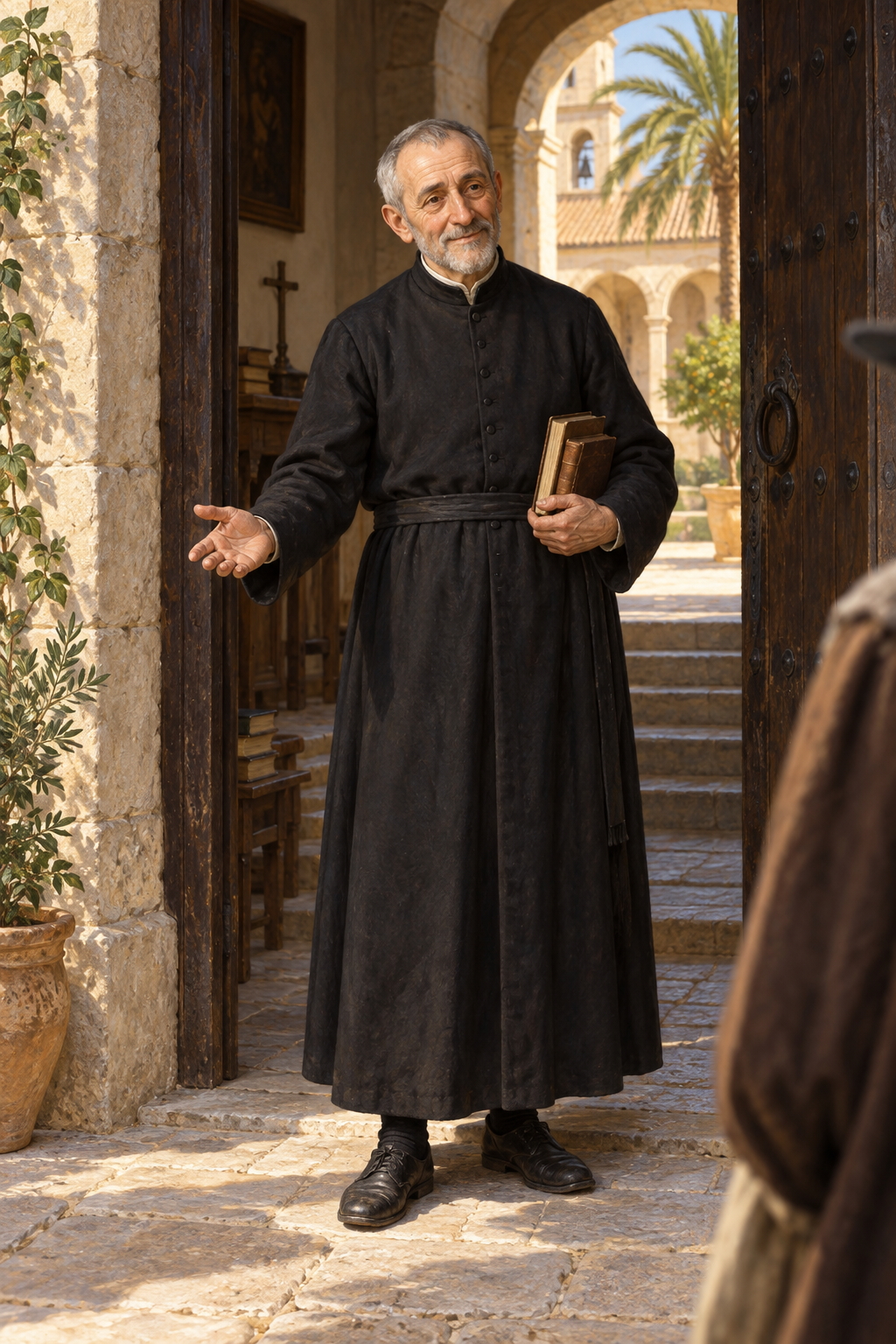
About Alphonsus Rodriguez
Alphonsus Rodríguez, called Alonso in Spanish, was born in Segovia into a family engaged in the wool and cloth trade. His exact birth year is disputed among otherwise serious sources, so it is safer to place him in the early 1530s. He studied for a time at a Jesuit school but returned to help the family business after his father's death. The merchant's work was a substantial part of his adult life before he entered a religious community. It also meant that he knew the anxieties of a household depending on commerce. This saint is the later lay brother of Mallorca, not the contemporary Jesuit priest and spiritual writer who shared his name.
Rodríguez married María Suárez in the late 1550s and became a father. The marriage year varies among accounts, as do some later attempts to compress his family's losses into a single season. The Jesuit Wenceslao Soto describes the deaths of his wife, children and mother, together with the failure of the wool and cloth business, as the upheaval from which Rodríguez sought a new direction. He did not enter the Society of Jesus immediately. Jesuit guidance and renewed study in Valencia preceded acceptance. His religious life followed work, marriage, bereavement and an extended discernment.
The Society initially hesitated because of age, health and limited schooling. Some accounts say he considered priesthood and tried to learn Latin, but that route did not open. He entered as a brother in 1571, when he was in his late thirties. Sources disagree on whether admission occurred on 1 or 31 January; the year is secure. A lay brother made a religious commitment and served the Society without priestly ordination. Calling Rodríguez a priest would erase the vocation Jesuits honor. His transition shows the order had room for experience outside universities.
After his novitiate Rodríguez was sent to the College of Montesión in Palma de Mallorca. There he worked in the sacristy and later at the gate. The porter received visitors, found the person they sought, carried messages, ran errands and helped those asking for material or spiritual support. Such duties could appear ordinary, yet the entrance was the point where a school and religious house met the city. One contemporary Jesuit account treats the role as one of trust. It required listening and care with people whose needs differed. He remained attached to the Mallorca college for the rest of his life.
The *Catholic Encyclopedia* remembers the porter office as the center of his service. It notes his influence on students and visitors who came for advice. Those qualities are reported through Catholic sources that value his example, not measured in a modern personnel record. At the gate, people could approach a brother who was present every day rather than a preacher seen only occasionally. The work gave him repeated opportunities to offer encouragement and practical help. His significance in Jesuit memory lies partly in how he treated an uncelebrated assignment as a continuing responsibility to other people.
A circular letter written just after his death by Miguel Julián, rector of the Mallorca college, offers a rare voice from someone who knew him. It portrays a man whose habits of prayer continued through physical decline. The text was written to other Jesuit houses to remember a respected member, so its devotional language and exemplary stories must be read with that purpose in mind. Its direct observation is especially valuable for his last years at Montesión. Later biographies drew heavily on it. The letter also reminds readers that the daily tasks of a brother, though often absent from public records, could be visible to an entire school community.
One student associated with Rodríguez was Peter Claver, later a Jesuit missionary in Cartagena. A Loyola Marymount University account describes the older brother encouraging Claver's plans, while the Society's own memory treats their friendship as an example of guidance across generations. This connection should not make Rodríguez merely a footnote to a better-known priest. His counsel was one part of wider care for visitors, students and neighbors. Nor should later accounts of Claver's work in the Spanish slave system be confused with Rodríguez's own biography. The historically useful point is that a brother at a college door could influence the choices of people passing through it.
Rodríguez left spiritual notes that became known more fully after his death. The Society of Jesus has used them to reflect on prayer within repetitive work. Their publication history and devotional reception belong to a different genre from Julián's eyewitness letter. Reports of visions and intense inner experiences are important to understanding why later readers called him a mystic, but they remain reports from religious witnesses, not facts independently testable today. His practice can be described more securely through the recorded pattern of service, prayer and counsel. The saint's reputation did not arise from a public office or a book written for fame.
Jesuit historical chronology places the death of the lay brother Rodríguez at Mallorca on 31 October 1617. The rector's letter gives the more exact account, shortly after midnight. The current Roman Martyrology lists him on 31 October, and the Jesuit Superior General celebrated his brothers' patron on that date in 2021. An older reference lists 30 October, but it does not establish the current Roman Martyrology date. The draft corrects the inherited field and records both named observances without claiming a universal calendar rank. The death date is better established than Rodríguez's disputed birth year.
Leo XII beatified Rodríguez in 1825, though sources disagree on the precise day. Leo XIII canonized him on 15 January 1888. The official cause record confirms both popes and the canonization date. His recognition came long after a life lived mostly in one college and an office that kept him close to ordinary visitors. It has also given Jesuit brothers a patron whose story includes family life and skilled work before religious profession. Keeping those stages visible makes his life more than an emblem of humble service: it was a response to loss, a chosen form of community life, and sustained attention to people at the threshold.
Wondering how to weigh the stories and sources? Learn how to read a saint biography.