Biography
Amandus
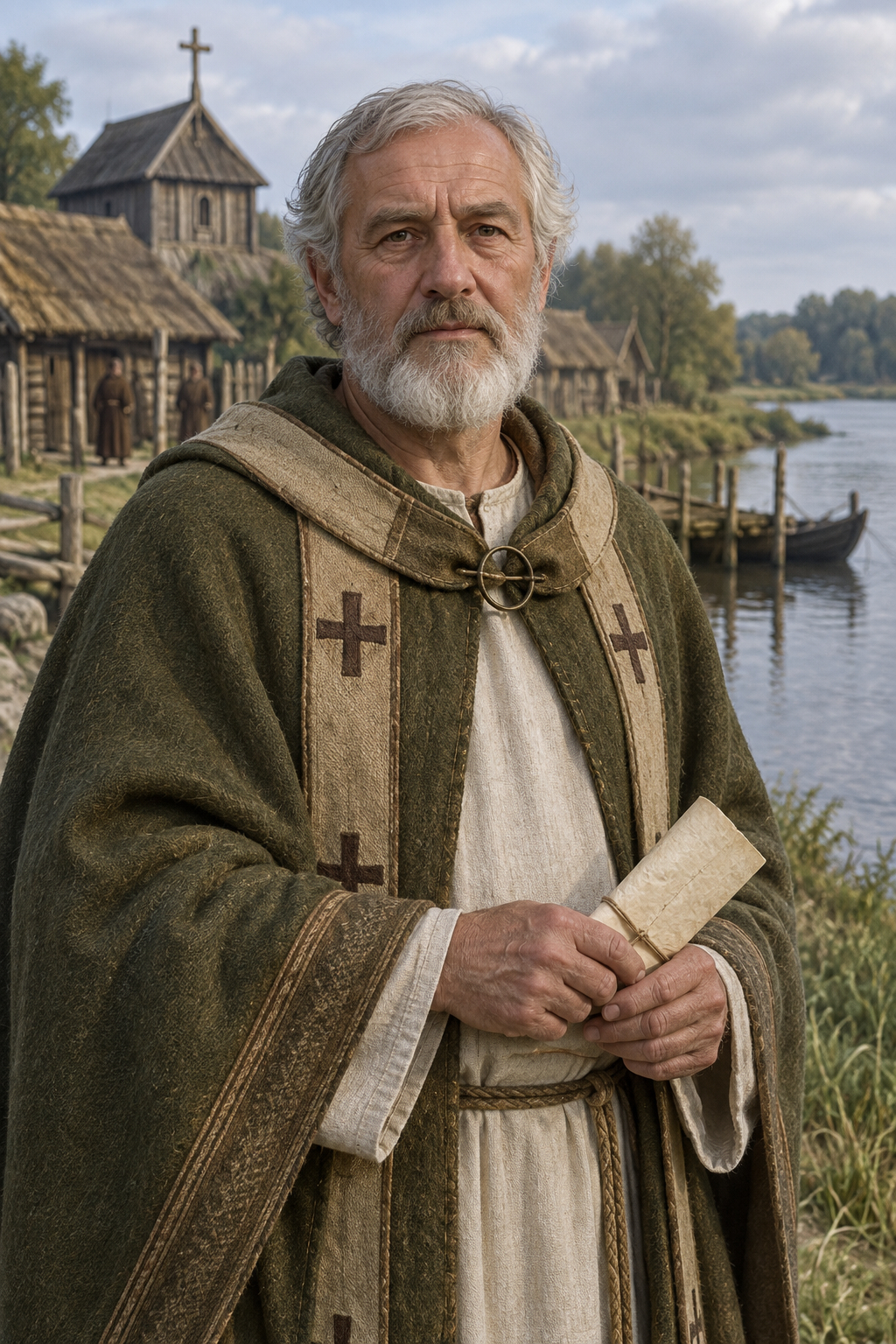
About Amandus
Amandus was a traveling bishop and monastery founder in the Frankish world of the seventh century. He is often called Amandus of Maastricht because he briefly governed the church there, but his work reached along the Scheldt and Scarpe rivers and continued at Elnone. His name also appears as Saint Amand or Amandus of Elnon. Several other saints share the name, making his episcopal see and monastery important identity markers. The *New Catholic Encyclopedia* treats his earliest Life as a major source while warning that its composition date and authorship are disputed. A responsible account can follow the public actions supported by other documents, without treating every episode of the Life as contemporary reporting.
The Life presents Amandus as a young man from Aquitaine who left a privileged home for religious life. Its scenes of solitary prayer and travel convey how later communities understood his vocation, but the historical record does not provide a secure birth year or detailed childhood chronology. Régis de la Haye's study explains that an early saint's Life was shaped for instruction and worship. It can preserve facts while also borrowing familiar literary patterns. Amandus is unusually well documented for his period because his monastery preserved a cluster of additional material. That gives a way to test at least some parts of the Life. His story therefore begins with a witness that needs careful reading and grows firmer where grants, letters, and Elnone’s later documentary claims enter the record.
The mission associated with Amandus took place among communities near the Scheldt. A historical Dutch reference locates his preaching along the river and around Ghent, while noting that earlier authors did not always agree about the Life's authorship. The movement of a bishop across this region was more complex than a simple story of one man converting a whole people. It required support from local households, rulers, and religious companions. The surviving evidence is stronger for his presence and for institutions that kept his memory than for a head count of converts. Later stories about a dramatic confrontation with King Dagobert or missions across distant Europe cannot all be placed securely in a calendar. The river landscape is a setting for his work, not proof of every journey attributed to him.
Elnone became a lasting center of his mission. A CEU medieval studies investigation reviews the evidence that King Dagobert gave land for the monastery before the king died in 639. That is stronger than assigning a precise founding year, which the sources do not settle. The monastery stood near the Scarpe and later gave rise to the town called Saint-Amand-les-Eaux. Monastic houses in this world were places of prayer, teaching, hospitality, and manuscript keeping. For Amandus, Elnone also became a place to which he could return after his travels. The foundation's later archive helped preserve evidence that might otherwise have disappeared. The church's memory of him as a founder has a material basis in that continuing community, even if each early construction stage is unknown.
Near the middle of the century, Amandus accepted the bishopric of Tongeren-Maastricht. Sources differ about its exact years, but they agree that the tenure was short. The German biographical reference describes his effort to address problems among local clergy and his wish to return to missionary work. A fixed see carried different responsibilities from traveling preaching: a bishop had to oversee priests and the regular life of a community. Later narratives can make his frustration seem inevitable or describe every critic as corrupt. The more secure point is that he encountered a dispute serious enough to seek counsel from Rome. His time in Maastricht matters because it generated a rare direct document about his decisions, not because it lasted for many decades.
Pope Martin I wrote to Amandus in 649. The letter responds to concerns about priests and urges him to persevere rather than abandon the office. It also sends material from a Roman synod and asks for help making its decisions known among Gallic bishops and the Frankish king. This second part places Amandus in a wider debate about Christ's wills and about the relationship between churches in Rome and Gaul. The pope's request does not prove every later claim that Amandus personally organized a particular synod or completed an embassy. It does show that Rome addressed him as a bishop whose cooperation mattered. The letter anchors both the Maastricht conflict and a broader responsibility in an actual seventh-century exchange.
After that difficult episcopal interval, Amandus continued to be associated with mission and monastic foundations. Catholic accounts remember work around Ghent and the Scarpe and his later life at Elnone. The Norwegian Catholic profile also warns that later traditions have confused him with another Amandus, especially where places and observances overlap. That warning matters more than a long list of supposed foundations. A name attached to a monastery centuries later does not always prove who established its first community. What can be said with confidence is that Elnone was his own foundation and that his travels were widely remembered. A narrower narrative gives room for the people and institutions around him rather than casting one bishop as the sole maker of a region's Christianity.
Elnone preserved a document called Amandus’s testament, dated 17 April in an uncertain year. It speaks in his voice, recalls his travels, and claims that his body should rest among the monastery’s brothers. Courtney Luckhardt argues that it was probably composed after his death by Baudemundus to defend Elnone’s claim to his relics. Other historians have treated it as a more direct record of Amandus’s last wishes. Both readings show how central Elnone became to his memory; they do not permit a confident statement that he personally dictated or signed the surviving text. Nor does the document settle his death year. His burial and later cult at Elnone are part of the community’s history, while the document’s authorship remains disputed.
The Catholic Church remembers Amandus on February 6. The Roman Martyrology's old notice joins his name to that of Vedastus, while later calendars and regional histories identify him specifically with Maastricht and Elnone. The day is a liturgical observance, not an independently established death date. Different biographies give death years from about 670 to the 680s, a spread too wide for a single exact field. What endures more securely is the record of a monastery he established, a brief episcopate tested by conflict, the pope's letter, and the community that preserved his memory. Those documents make Amandus visible as a person working across local and wider church networks. His memory remained attached to the community that guarded the evidence of his life.
Wondering how to weigh the stories and sources? Learn how to read a saint biography.