Biography
Amatus
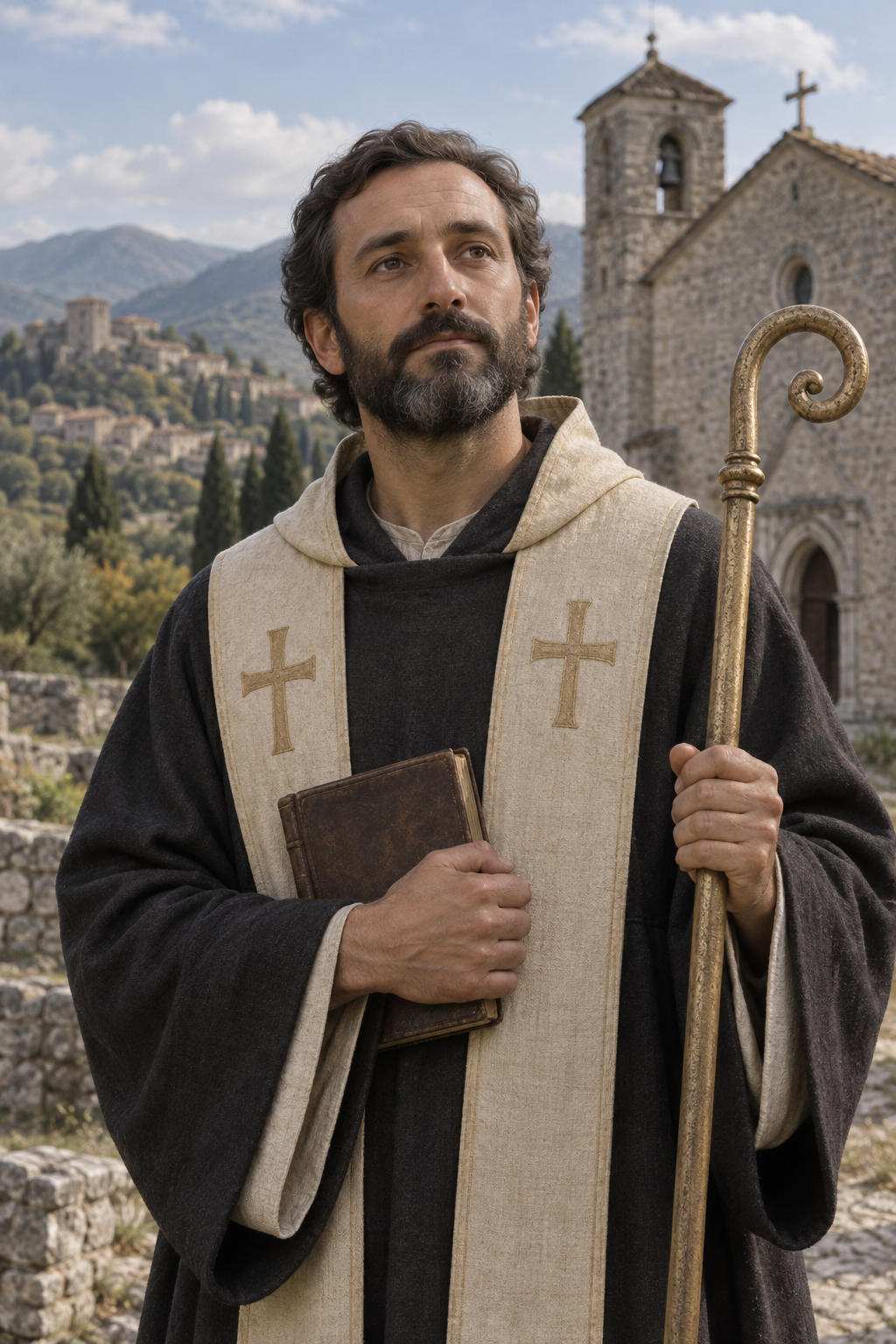
About Amatus
Amatus belonged to the early history of the Diocese of Nusco, in the hills of southern Italy. Italian episcopal records remember him as Amato di Landone. They identify him first as archpriest of the town and then as its first bishop. This is the clearest person-centered outline available for his life: a local cleric took responsibility for a newly defined diocesan community. The exact stages of that responsibility are much less secure than the office itself.
The Italian Episcopal Conference's historical account places the formation of Nusco's diocese in the latter half of the eleventh century. It connects Amatus with the changes brought by Norman power in the region and with the intervention of Alfano, archbishop of Salerno. The account names Amatus as archpriest of the church of Saint Stephen before he was chosen as bishop. These details describe the official diocesan memory; they should not be made more precise than the source permits by assigning an unsupported ordination day or year.
That account also remembers Amatus as a figure of local pastoral and civic importance and says that the church of Saint Stephen became the cathedral. It assigns his death to 30 September 1093. These claims belong to a coherent eleventh-century reconstruction of his episcopacy. They are useful, but the existence of a rival tradition means that the year should remain explicitly approximate in structured data until the underlying documentary dispute is resolved. Nothing in the evidence requires a fabricated birth year.
The rival account describes a different sequence. The New Catholic Encyclopedia says that the earliest life was written only after 1460 and that the two versions differ substantially. One, favored in the Bollandist discussion, places Amatus in the twelfth century: it makes him a Benedictine, founder of the Abbey of Fontignano, and bishop in 1154, dying in 1193. The other places his episcopacy and death in the eleventh century. Neither version can be used to verify the other's chronology, so this draft does not merge the monastic foundation into the diocesan timeline.
The Bollandist editors examined this conflict instead of merely repeating a miracle narrative. Their preliminary commentary notes disagreements over whether Amatus was truly the first bishop of Nusco and scrutinizes a purported testament that had been used as chronological proof. Its authenticity and dating were contested. Their discussion preserves valuable evidence of historical inquiry and of the saint's cult, but does not supply a secure solution to every biographical question. This is why a short account is more truthful than a long scene-by-scene life.
The calendars preserve another part of the dispute without resolving it. Nusco and the current Roman Martyrology commemorate Amatus on 30 September. Historical Benedictine listings used 31 August. A feast date names a community's observance; it cannot by itself prove the day of death. The index's 31 August field should therefore be corrected to the current Roman date, while the older Benedictine remembrance can retain a distinct historical observance.
Amatus's life therefore comes to us through a secure local identity and an unsettled chronology. Later authors developed another account that made him a twelfth-century monk and founder. Those late accounts cannot both give his lifetime accurately.
The official Italian episcopal history links him to the church's eleventh-century beginnings. Respect for both the person and the sources means stating the conflict rather than giving him deeds from incompatible lifetimes. His enduring significance lies in Nusco's episcopal history and in the local memory that kept his name alive.
Wondering how to weigh the stories and sources? Learn how to read a saint biography.