Biography
Anastasius Sinaita
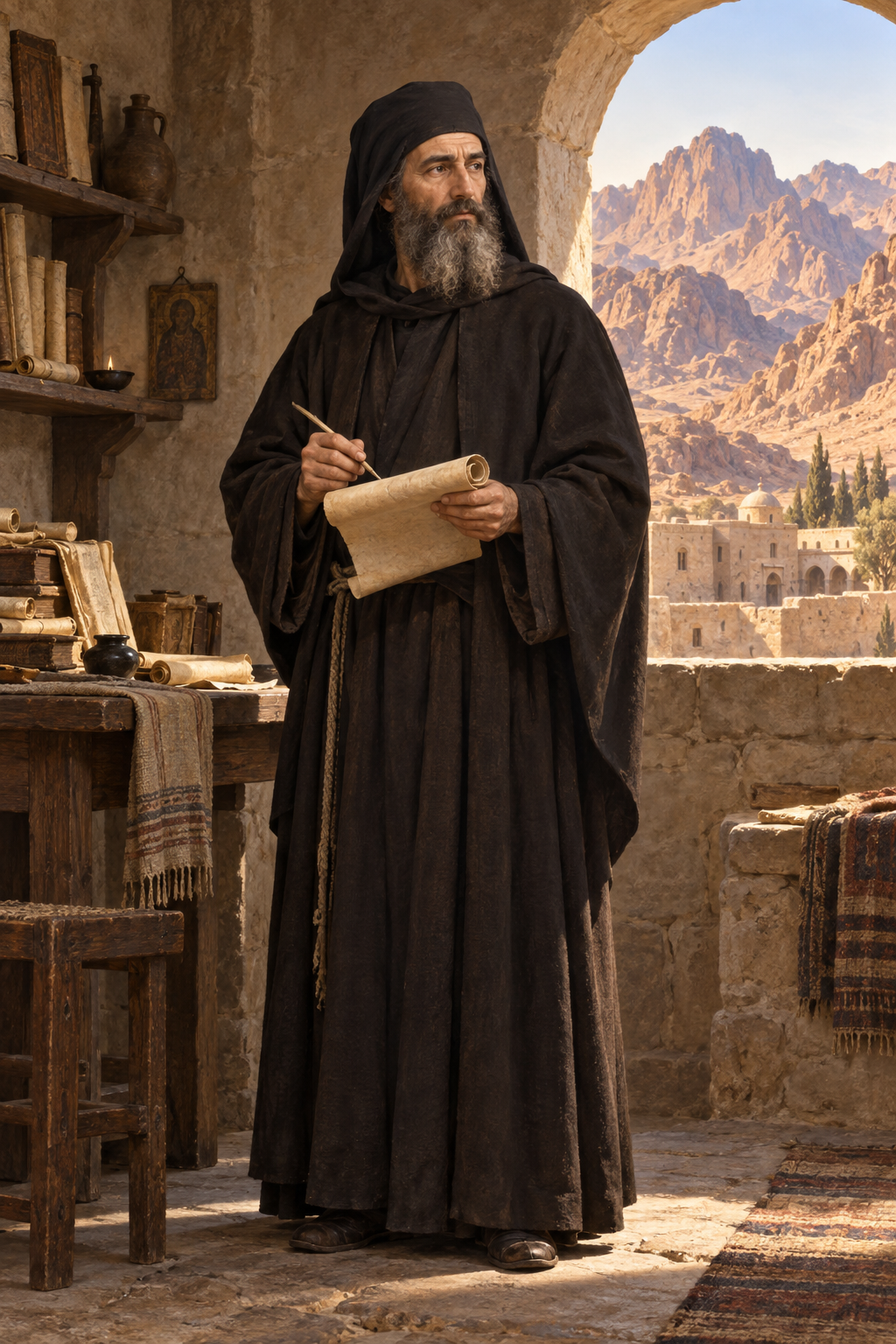
About Anastasius Sinaita
Anastasius of Sinai was a Greek-speaking monk and writer active in the eastern Mediterranean in the later seventh century. His surviving work reveals theological arguments and everyday religious questions more clearly than his childhood. Mount Sinai is central to the identity by which he is remembered, but no contemporary birth record establishes his date or place of birth. The familiar claim of an Alexandrian birthplace should not be treated as settled history.
Sinai was a center of monastic life and pilgrimage, but Anastasius did not spend his whole life in isolation there. The surviving writings place his interests and encounters across Egypt, Palestine and Syria. A modern study of his pastoral writing reads those journeys against the movement of Christian communities within the Umayyad caliphate. The boundaries between these communities were religious as well as geographic. Chalcedonian Christians disagreed with other Christians about how to describe Christ's divine and human natures. Anastasius took those disagreements seriously and used learned argument in their defense. The precise dates of his movements are not recoverable as a reliable itinerary.
The *Hodegos*, or *Guide*, relates doctrinal disputations in Alexandria. Phil Booth has studied its names and circumstances and argues that they belong to the 680s, after the council at Constantinople in 680 and 681. That dating is a scholarly reconstruction from a polemical text, not an independent diary. The account nonetheless points to Anastasius meeting people who challenged his understanding of Christ and answering them in public argument.
Booth identifies a distinct confrontation at Fustat, the administrative center of early Islamic Egypt. He proposes that Anastasius faced Athanasius bar Gumoye, an Edessene theologian, before a Marwanid prince around 686 and lost the debate. The year, setting and outcome are historical arguments built from difficult sources. They should be read as a probable reconstruction, not a scene whose precise spoken words can be recreated.
The *Hodegos* turns controversy into a guide for readers who needed terms, authorities and methods of discussion. Its title promises direction rather than a simple narrative of the author's travels. The guide engages rival interpretations of Christology, and the Alexandrian debates are part of its evidence and argument. Scholars have cautioned that its parts were formed and revised over time; an exact year of publication would misrepresent that process. The text also shows the limits of a biography built from someone's own polemical work. It records the disputes that the writer chose to preserve and organize, while leaving ordinary movements and relationships largely invisible.
Anastasius also answered questions from people whose concerns were less technical. The *Questions and Answers* addresses matters of worship, Scripture, moral conduct and life in mixed religious surroundings. Its form allowed a particular problem to be stated before a response was offered. It therefore brings readers close to the questions circulating among Christians outside elite doctrinal debates. Yet the title now covers a complicated manuscript tradition. A critical edition separated an earlier collection from later expansions, so the presence of a passage in a printed collection does not by itself establish that Anastasius composed it. The secure core, rather than every item ever attached to his name, supports this portrait of him as a teacher.
A modern English translation makes this question-and-answer teaching accessible without smoothing away its unusual range. Some questions are doctrinal, while others are practical and rooted in the anxieties of daily life. Anastasius's responses were meant to guide particular audiences, not to provide a modern handbook for every church. Reading them historically means asking what a questioner feared, what the monk assumed, and which practices he expected Christians to recognize. It also means resisting the urge to lift one response from a much later manuscript and present it as his personal statement. The edited collection matters because it can reveal pastoral attention alongside his public argument.
His interest in practice appears in writings addressed to Christians living alongside other religious communities. A study of the *Edifying Tales* and the question collection describes his concern with recognizable Christian rites, especially participation in communion. The stories are written to encourage, warn and persuade; they are not neutral reports that every narrated marvel occurred. The same study notes that even attribution within the Anastasian corpus is contested, particularly for the *Tales of the Sinai Fathers*.
A scholarly sourcebook places selections from the *Edifying Tales*, the *Hodegos* and the *Questions and Answers* beside other early testimonies about the rise of Islam. That setting helps explain why Anastasius wrote for Christians who were learning to live under new political power. It does not mean that every judgment he made about Muslims, Jews or fellow Christians is a reliable description of those groups. His arguments belonged to a contentious age and frequently portray opponents through the demands of persuasion. Modern readers can value the evidence his works provide while recognizing the sharp, sometimes hostile boundaries in his language.
Anastasius seems to have remained active near the turn of the eighth century. A scholarly study of Sinai's late antique texts notes that he was probably writing in 700 or 701, while the dates of his birth and death remain approximate. Later church memory calls him a saint and associates him closely with Sinai, but it does not give a modern canonization decree or an eyewitness account of his final days. The lasting value of his work lies in the two scales on which he wrote: complex arguments about Christ and direct answers to the questions of ordinary worshippers. His texts remain useful when their uncertain transmission and polemical setting are kept visible.
Wondering how to weigh the stories and sources? Learn how to read a saint biography.