Biography
Andrew Dũng-Lạc
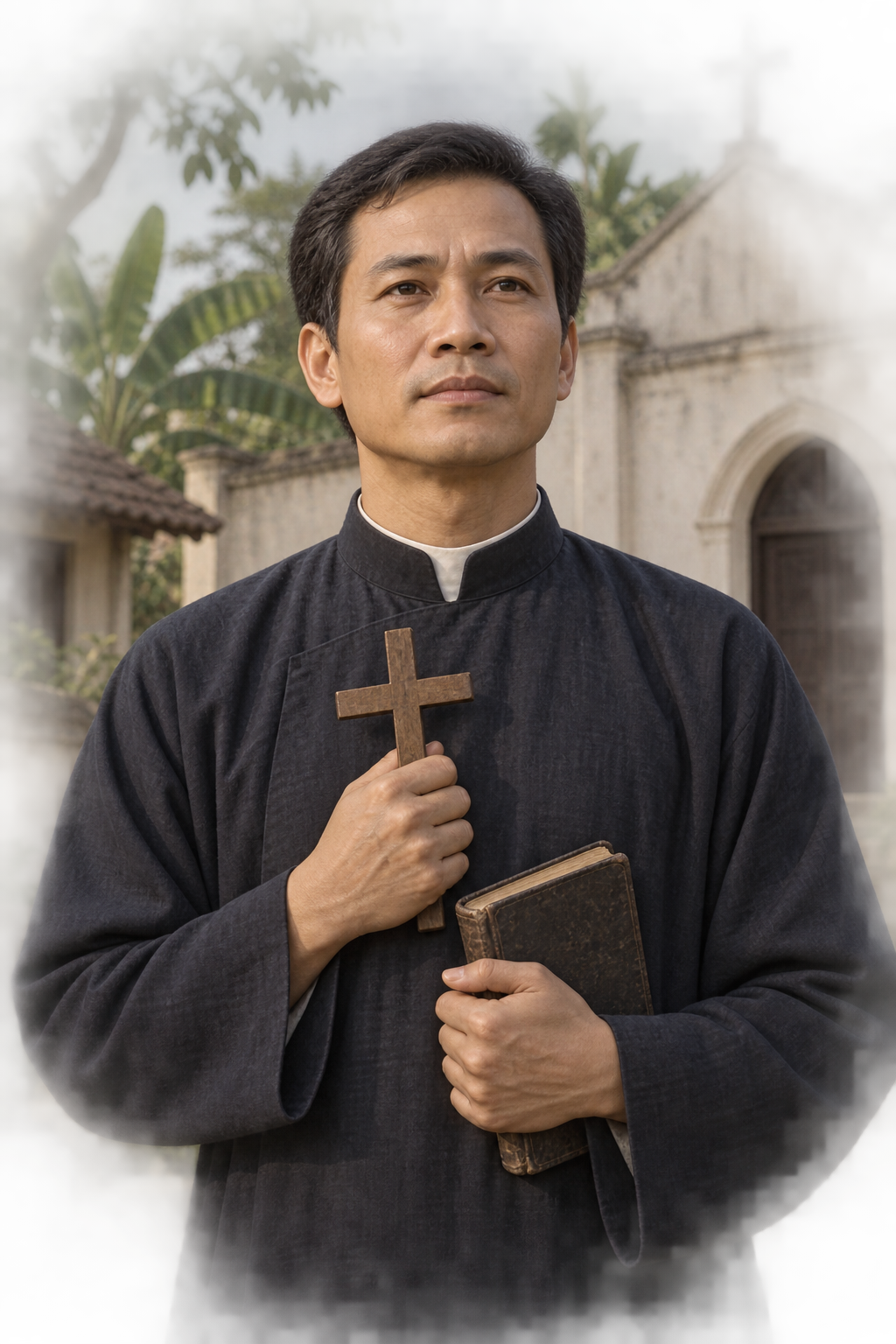
About Andrew Dũng-Lạc
(812 words)
Andrew Dung-Lac is remembered as a Vietnamese priest and martyr within the wider company of 117 Vietnamese Martyrs canonized by John Paul II in 1988. The group spans more than a century of persecution and includes local laypeople, catechists, seminarians, priests, bishops, and missionaries. Andrew’s individual profile is more focused. The sources provide a brief sequence of formation, ordination, pastoral service, arrest, and execution, while leaving many ordinary details of his family life, education, and ministry unknown.
In the canonization homily, John Paul II says that Andrew’s parents were poor and non-Christian and that he was entrusted to a catechist from childhood. This is a meaningful detail because it places Christian formation within a local network of teaching rather than presenting the future priest as isolated from his community. The homily does not give a complete account of his childhood, a birth date, or a named village of origin. A responsible biography should retain the formation story while leaving those absent details blank.
John Paul II states that Andrew became a priest in 1823. The pope then describes him as a parish priest and missionary in different parts of the country. These terms establish that his life involved ordinary pastoral care as well as movement between communities. They do not provide a complete list of parishes, a timeline for each assignment, or a record of sermons and conversions. The point supported by the source is both simple and substantial: before his death, Andrew had been serving Vietnamese Christians as a priest.
The setting of that service was dangerous. The official Vietnamese Martyrs biography describes a long period in which rulers issued anti-Christian edicts, and it lists 58 of the canonized martyrs under the reign of Minh Mạng, which ran from 1820 to 1840. Andrew’s death in 1839 falls within that period. The group source should not be used to assign each policy or sentence to Andrew personally, but it provides necessary context for why repeated arrest was part of his ministry.
The canonization homily says that Andrew was saved from prison more than once by ransom payments made generously by the faithful. This detail shows the reciprocal character of pastoral life under persecution: the priest served local communities, and members of those communities risked resources to free him. The source reports that he later desired martyrdom, but this packet does not use the homily’s words as a personal quotation. It is enough to say that the pope presents him as sustained by zeal and Christian grace amid successive arrests.
Andrew was executed by beheading at Hanoi on 21 December 1839. The official group biography independently lists “Andrea Dung-Lac, priest” with that date, while the canonization homily gives the same date, city, and form of execution. This is the strongest event in his record and may be entered as a documented martyrdom event. The sources do not justify reconstructing the execution ground, final dialogue, or the identities of every official involved. Such details should remain absent rather than being borrowed from later devotional retellings.
The Church’s recognition of Andrew belongs to the history of the group. John Paul II’s canonization decree formally names Andrew Dung-Lac with Thomas Thiên, Emmanuel Phung, bishops, priests, and 111 other companions, declaring them saints and directing that they be honored as martyrs in the universal Church. The decree does not make Andrew a stand-in for every Vietnamese martyr. Its value for this profile is to establish the exact collective scope of the 1988 canonization and to prevent a false impression that his witness was detached from other local and missionary Christians.
The group source is important context, but it has limits. It lists the broad periods of persecution and the different states of life represented among the canonized martyrs. It does not provide a full individual biography for Andrew or establish every detail sometimes repeated under his name. The profile therefore does not assign a complete travel itinerary, name all his communities, or turn his final arrest into an elaborate scene. It keeps the well-supported sequence: formation, ordination, ministry, imprisonment, release, and martyrdom.
Andrew’s surviving profile is a disciplined one. He was formed through a catechist, ordained in 1823, served as parish priest and missionary, endured arrest and release by ransom, and was executed in Hanoi in 1839. These events provide three distinct featured moments without inventing an elaborate life. They also show why Christian communities preserved his name: his pastoral work continued amid coercion, and his death became part of a collective memory of Vietnamese witness. The omissions are not weaknesses to conceal. They are the boundary that lets the documented testimony remain trustworthy.
Benedict XVI later called Andrew a distinctive figure among the Vietnamese martyrs. That is devotional and pastoral reception rather than fresh evidence about the nineteenth century. It can explain why his name appears first in the group’s common title, but it should not support extra biographical claims. Likewise, the history of Vietnam’s Catholic communities should not be compressed into suffering alone; the group source also records diverse local Christians whose names and lives deserve their own treatment.
Andrew’s memorial therefore calls attention both to an individual priest and to a community of witnesses. His documented story does not require invented heroics. It is already clear that he received formation through a catechist, accepted pastoral responsibility, faced repeated danger, and died under persecution. The best way to honor that witness is to retain those grounded claims and leave the rest open rather than treating silence in the record as permission to fill it.
Wondering how to weigh the stories and sources? Learn how to read a saint biography.