Biography
Andrew Kim Tae-gon
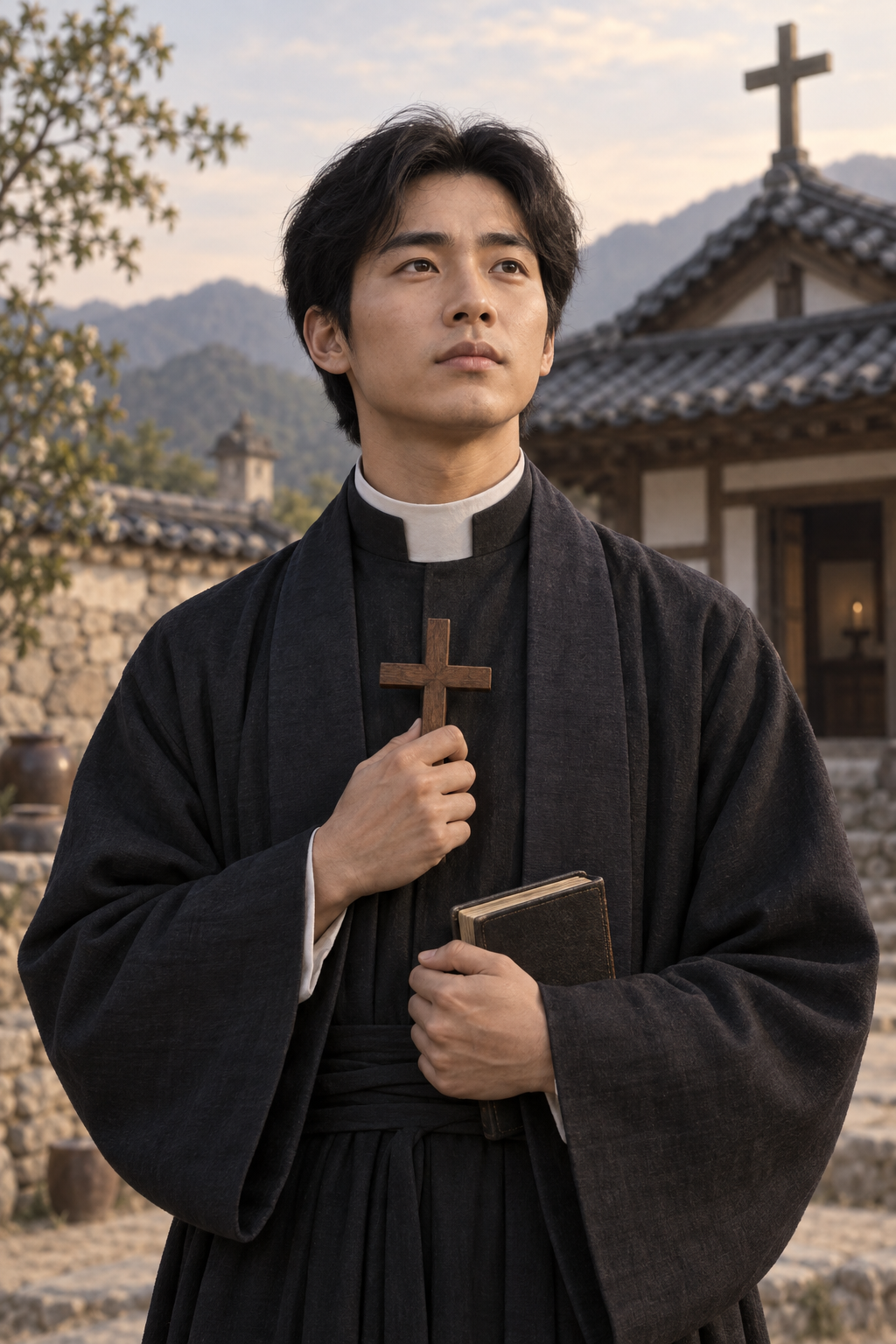
About Andrew Kim Tae-gon
Andrew Kim Tae-gon was born on 21 August 1821 at Solmoe, in Joseon Korea, into a family already marked by Christian faith. That setting matters: Catholic life in Korea had developed under repeated official repression, so ordinary acts of worship, teaching, travel, and welcome could place believers in danger. A Vatican account of his bicentenary describes him as Korea’s first Catholic priest and identifies his birth, martyrdom, and later canonization; it also places his death within a Joseon wave of persecution.
The more detailed traditional account preserved by Vatican News says that Andrew was baptized at fifteen and traveled to Macau for formation. It describes his return after ordination in Shanghai in 1845 and calls him the first native Korean priest. These details give the shape of a vocation that crossed borders because the Church could not train clergy openly at home. They should not obscure the local community that preceded him: the faith had been handed on by Korean Christians, many of them lay people, amid costly restrictions.
Andrew’s priesthood was brief. The bicentenary account says that he was ordained in Shanghai in 1845 and died only thirteen months later. After returning to Korea, he ministered secretly and tried to help establish a way for foreign missionaries to enter from China. That activity was treated by the authorities as criminal. The source does not invite a romantic picture of a solitary hero: his effort belonged to a wider, endangered network of Korean Catholics, catechists, families, and missionaries.
He was arrested, tortured, and beheaded on 16 September 1846. Vatican News identifies Saenamteo, now honored as a martyrs’ shrine in Seoul, as the place of execution and records that he was twenty-five. Its saint-of-the-day account reports the traditional wording of his witness: to be Christian in Korea was to be prepared to give one’s life for Christ. That line is best read as spiritual testimony, not as a license to flatten the human suffering of persecution or the differing experiences of the martyrs.
Pope John Paul II canonized Andrew Kim with Paul Chong Hasang and 101 companions in Seoul on 6 May 1984. The Vatican’s official listing records that canonization and the group of 103 martyrs. The Roman calendar commemorates Saints Andrew Kim Tae-gon, Paul Chong Hasang, and Companions on 20 September; the USCCB’s current memorial page gives the same title and date. Their shared celebration guards against treating Andrew’s prominence as if it exhausted the story of Korean Christian witness.
Andrew Kim’s life therefore joins priestly service, lay endurance, and the vulnerability of a Church living under coercion. The surviving accounts are strongest on the basic chronology—birth, formation abroad, ordination, clandestine return, arrest, execution, canonization, and memorial. They are less suitable for embellishing every scene of his childhood or ministry. A responsible account keeps that distinction visible. It can honor his courage by saying no more than the sources sustain: a young Korean priest served an endangered Church, refused to abandon the faith, and became one of the martyrs through whom Korean Catholics remember a costly inheritance.
The later reception of Andrew Kim also belongs to the story, but it needs to be kept distinct from the nineteenth-century facts. A shrine, a calendar observance, and a canonization are evidence of how the Church remembers a witness; they are not substitutes for evidence about every moment of his early life. The 1984 canonization in Seoul made that corporate memory visible in a place especially connected with the Korean Church. It honored Andrew together with a large company rather than separating him from the lay women and men, catechists, and missionaries whose stories were also shaped by persecution.
This shared setting is important for the meaning of Andrew’s priesthood. He became the first native Korean priest within a Church that already possessed local believers, local networks, and a history of endurance. His training abroad and return home show both the limits imposed on Korean Catholics and their determination to remain connected with the wider Church. The sources do not justify measuring that determination through modern categories of success or failure. They do show that pastoral care, travel, and communication were undertaken under danger.
The memorial on 20 September gives Christians a liturgical way to remember this witness. It does not celebrate suffering for its own sake. The readings and prayers associated with martyrs direct attention to fidelity, hope, and the conviction that violence does not have the final word over a human life. In Andrew’s case, that theological reception sits beside the historical fact that persecution caused real loss to people and families. A careful biography should hold both truths together.
Andrew Kim’s example may be meaningful to people whose faith is lived quietly, through family, work, study, and mutual support rather than public prominence. His brief ministry was possible because a community had already received and guarded the Christian faith. Remembering that community prevents the familiar image of a heroic individual from eclipsing the many believers whose names are less widely known. It also leaves room for the Korean Church’s own ongoing memory and interpretation of its martyrs.
Wondering how to weigh the stories and sources? Learn how to read a saint biography.