Biography
Angela Merici
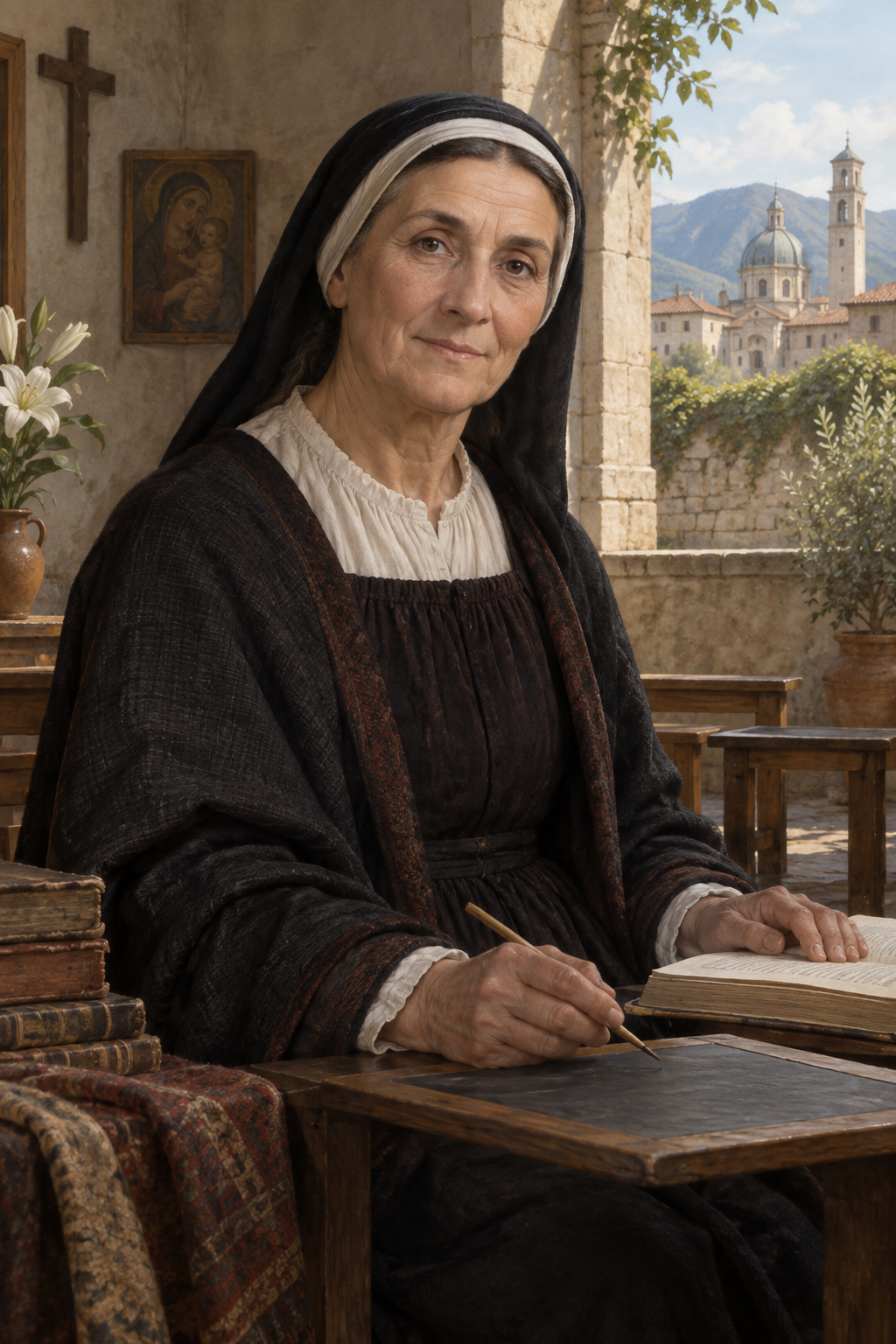
About Angela Merici
Angela Merici was born at Desenzano sul Garda, in the Brescia region, on March 21, 1474. The existing catalog stores that date and place, and this draft preserves them.
Her page should begin with the place and century because they matter. Angela lived in a Renaissance Catholic world where women's choices were often framed by marriage, family dependence, or cloistered religious life.
Angela's witness was not a rejection of the church's older forms of holiness, but it did open a distinctive path. The Dicastery profile stresses a life in the world rather than a holiness hidden only inside a cloister.
That point is essential for the summary, biography, and artwork. The existing catalog classifies her as a virgin, and the page should show consecrated life without turning her visually into a generic nun in an ornate habit.
Angela became known for wisdom, counsel, and spiritual leadership. The page can present that authority concretely through teaching, formation, books, letters, and careful accompaniment rather than through abstract praise.
The Company of Saint Ursula was founded in 1535. That foundation belongs at the center of the page because it gave form to Angela's insight that women could be consecrated, educated, and active in the world.
The Company should not be reduced to a modern school brand. Its original meaning belongs to Christian formation, mutual support, and a way for women to serve God without leaving ordinary society.
That distinction matters because later Ursuline history is large and varied. The page should honor the long educational tradition without making Angela responsible for every later institutional form or using modern categories as if they were already settled in 1535.
That is why the artwork uses a simple Brescia teaching setting: book, writing tablet, bench, courtyard, and modest dress. These cues make her vocation readable without implying a cloister.
Angela's concern for women and girls should be written with dignity. The page can say that she responded to needs in her society without making women appear only as problems to be solved.
The sources remember her spiritual counsel and practical prudence. Those traits belong together: Angela's holiness was not only visionary; it was also orderly, patient, and able to guide a community.
Her prudence should be visible in the writing. A founder had to gather people, teach them how to live the charism, and give them enough structure to remain faithful after her death.
The public page can name that structure without becoming legalistic. Rule, counsel, and company life are part of the witness, but they should serve the narrative of women being formed for holiness in ordinary places.
The Dicastery profile also includes pilgrimage traditions and devotional episodes. This draft does not build the whole biography around those episodes, because the foundational work and lay consecrated form are stronger for a compact public article.
When pilgrimage or miracle traditions are mentioned later, they should be identified as tradition or source memory. The public page should avoid making a single extraordinary episode carry the whole historical portrait.
Angela's death is recorded at Brescia on January 27, 1540. The catalog already stores Brescia as death place and January 27 as feast day, and this draft preserves both.
The feast matters because it ties the page to Roman Catholic liturgical memory. It should not crowd out the narrative, but it confirms that the stored date is not merely a biographical convenience.
Angela was canonized in 1807. That recognition can be mentioned briefly, while the biography's center remains the Company of Saint Ursula and the durable charism that grew from her life.
The late canonization date should not make the article feel distant from the sixteenth century. It is a marker of ecclesial recognition, while Angela's actual life belongs to Brescia, Desenzano, teaching, counsel, prayer, and founding decisions.
Her writings and early Company memory should be handled carefully. The packet does not quote the Rule, Counsels, or Testament, because any direct quotation would need separate source budgeting and textual review.
The Company source is useful because it helps explain continuity of memory from Angela's own charism into the Ursuline family. It should be used as a source of tradition and identity, not as a reason to import modern institutional claims.
The public article should therefore avoid current membership statistics, school-network claims, or promotional language. It should stay with Angela's life, foundation, death, and enduring spiritual significance.
Angela's relevance is clear without exaggeration. She shows that women can lead with spiritual authority, practical wisdom, and educational courage while remaining deeply rooted in ordinary life.
That relevance should be stated without turning the biography into a sermon. The conclusion can point to her concrete pattern: she saw a need, formed women, trusted disciplined freedom, and built a company able to continue after her.
The final page should leave readers with a founder whose holiness was both contemplative and practical: listening, teaching, writing, gathering women, and forming a community that could serve across time.
Artwork should show an older Italian woman in modest dark lay dress and veil, with book, writing tablet, simple bench, and Brescia-region architecture. Avoid ornate habit, modern classroom objects, crowds, logos, readable text, halos, and exact-likeness claims.
The badge crop should keep Angela's face, veil, hands, writing tablet, and teaching context visible. It should read as lay founder and teacher before it reads as a generic religious portrait.
Wondering how to weigh the stories and sources? Learn how to read a saint biography.