Biography
Angela of Foligno
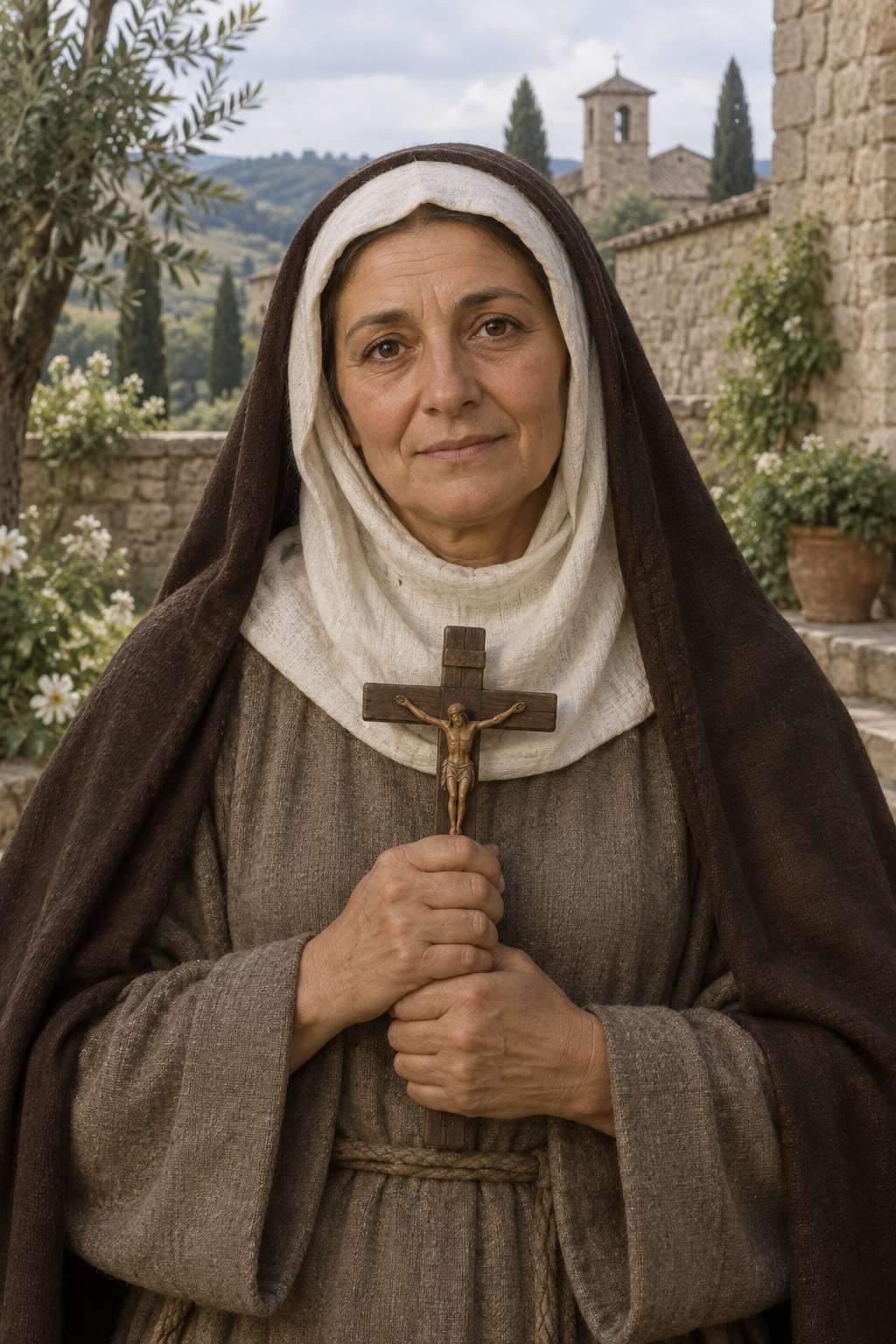
About Angela of Foligno
Angela lived in Foligno, an Umbrian town within the Papal States, during the later thirteenth century. Vatican sources place her birth about 1248 in a prosperous family, but the exact day is not securely established; January 4 belongs to the date of her death and feast, not a documented birthday. She married a prominent local man and had several children. The surviving record says much less about their names and daily household life than later retellings sometimes suggest. Angela's importance begins not with an idealized childhood but with an adult life shaped by marriage, motherhood, bereavement, religious change, and public service.
The principal narrative source is the work now commonly called Angela's Book. Its first part, the Memorial, follows stages in her conversion and reported mystical experience; the Instructions gather teachings transmitted by disciples. Angela did not compose a polished Latin autobiography alone. SISMEL's critical-edition description explains that the Franciscan known as Brother A.—her confessor, relative, and adviser—translated her spoken Foligno dialect into elementary Latin. Modern scholarship dates the collaborative Memorial approximately 1291–1297 and notes that the larger work circulated without one stable title. These layers matter because readers encounter Angela through remembered speech, translation, arrangement, and manuscript transmission.
According to the Book and later Vatican synthesis, Angela's decisive change began around 1285. She described fear, an incomplete confession made difficult by shame, and a later fuller confession that opened a sustained path of penance. Reports of an appearance of Francis of Assisi belong to her religious testimony and should be presented as a reported vision, not external observation. The account arranges her progress in stages, moving from fear and sorrow toward love. This structure is theological as well as biographical: it interprets her past from the standpoint of later conviction rather than offering a civic chronicle of every event.
Angela's mother, husband, and children died within a relatively short period. The sources do not permit a modern writer to describe their deaths as a convenient liberation or to claim certainty about Angela's private emotions. After these losses, she sold her remaining property and distributed proceeds to people in poverty. She traveled to Assisi and in 1291 entered the Franciscan Third Order, a form of Franciscan penitential life for people living outside a monastery. Calling her a nun obscures that lay and urban setting. Widow, Franciscan penitent, and member of the Secular Franciscan tradition describe her vocation more accurately.
Her penitential life had practical expression. Vatican accounts remember her serving people with leprosy and other illnesses, while the Book gives concrete descriptions of hospital care. Such episodes show that contemplation did not remove her from bodily need. They also require careful handling: some actions are narrated in deliberately extreme devotional language and should not be converted into medical advice or romanticized suffering. The defensible historical center is that Angela and companions brought aid, washed patients, and gave material resources. Her charity involved contact with people whom prosperous society often kept at a distance.
Angela also became a teacher within a network of Franciscan spiritual relationships. Brother A. recorded her testimony and struggled to express what she described as beyond ordinary language. Ubertino of Casale later named her as a spiritual mother and credited an encounter with her with renewing his own religious life. His testimony is independent evidence that contemporaries sought her counsel, though his interpretation of spiritual effects remains his own. The Instructions emerged from teaching addressed to spiritual sons and other hearers. Angela's authority was therefore collaborative and relational: spoken teaching passed through scribes, disciples, and readers rather than through a formal university office.
Her teaching repeatedly returns to the suffering of Christ, humility, prayer, and love. Benedict XVI quoted her warning that a person wishing to preserve grace should not turn the soul's gaze from the cross in either joy or sadness. He also cited a letter in which she described her heart as belonging to God. These words come through editions and translations of the mediated Book, so attribution should name that path. Angela's accounts of visions—including experience of the Trinity and language of union with God—are documented as her reported experiences. Historical method can establish the testimony and reception without claiming to verify the supernatural event itself.
Angela died in Foligno on January 4, 1309. Her cult remained strong among Franciscans and in her city. The Holy See records that Clement XI approved liturgical veneration in 1701 and that Pope Francis extended her cult to the universal Catholic Church through equivalent canonization on October 9, 2013. Equivalent canonization recognized an enduring cult through a formal papal act rather than through the ceremony commonly associated with modern canonizations. Her feast is January 4 in the Roman Catholic record used here. Angela remains significant because a married laywoman and widow became an influential spiritual teacher whose search for God was joined to service among the sick and poor.
Wondering how to weigh the stories and sources? Learn how to read a saint biography.