Biography
Angèle-Marie Littlejohn
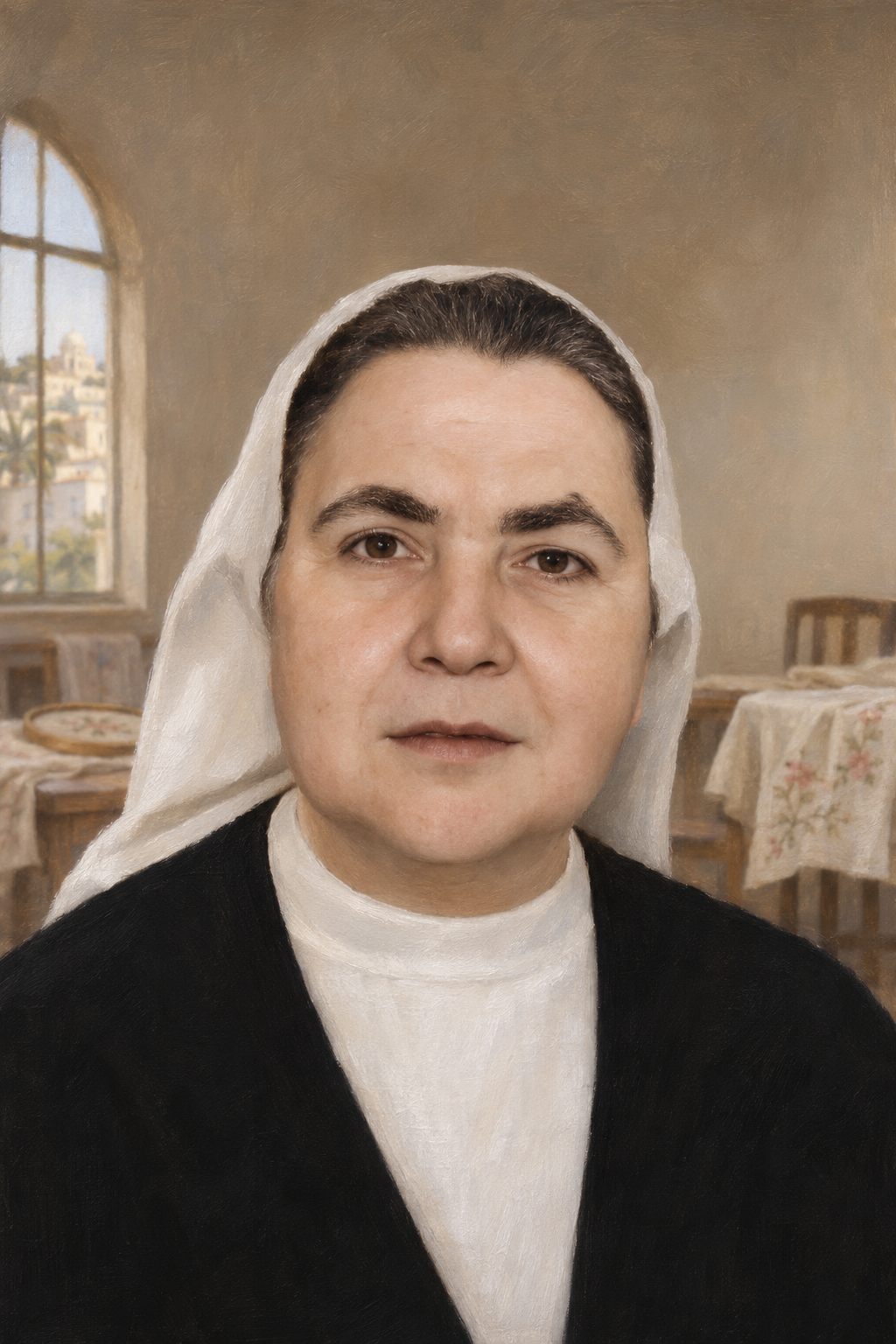
About Angèle-Marie Littlejohn
Angèle-Marie Littlejohn spent much of her religious life teaching girls in Algiers. Embroidery and lace were the crafts through which she worked alongside them. Her congregation remembers a patient teacher who wanted her pupils to value careful workmanship and the beauty they could make with their own hands. She belonged to the Missionary Sisters of Our Lady of the Apostles.
She was born Jeanne Littlejohn on 22 November 1933 in the Tunis area. Her family connected several Mediterranean places. In January 2019, Maltese church and archival officials presented records concerning her father, William, also called Guillaume. The parish priest of Għargħur reported that William had been born there in August 1900 and baptized in the parish that month. A marriage annotation recorded his marriage to Marie Viola in December 1932. Jeanne was their daughter. National Archives manager Joe Xerri also described William’s 1921 passport application for travel to Tunisia. These findings helped explain the Maltese connection of a woman whose own missionary life unfolded in North Africa.
The passport application supplied a particularly concrete link with Malta. William applied on 5 February 1921, and the report places his migration to Tunis in that year. The priest Giuseppe Mamo signed as his recommender. By then William was living in Ħamrun rather than Għargħur. The application and parish register thus preserve different stages of the family’s movements. They are records discussed by Maltese officials in 2019, rather than memories reconstructed solely from the later accounts of Jeanne’s religious life.
Jeanne lost her father when she was eight. While her mother worked, the children were placed in religious communities’ care. Her brother went to the Sisters of Saint Vincent de Paul. Jeanne and two sisters were entrusted to Our Lady of the Apostles. The congregation that helped bring her up later became the congregation she wished to join. She entered its postulate at Vénissieux on 1 March 1957. She made her first vows on 8 September 1959 and was sent to Algeria that year.
Her preparation had included a year at Lourdes in 1956. Archbishop Charles Scicluna recalled that part of her formation when he preached at a thanksgiving Mass in her father’s Maltese parish. He also distinguished her first profession from the perpetual vows she made on 8 September 1965. The later commitment came after she had already begun working in Algeria. Her religious name was Angèle-Marie, while Jeanne remained the name by which her early life and family records were known.
Formation was difficult for her. Hoffner’s account identifies dyslexia as a serious obstacle to her studies and emphasizes the persistence with which she completed religious training. The same account describes her skill in embroidery and artistic lace. Those abilities became a way of teaching young women and forming friendships with their families in Belcourt.
Her first Algerian assignment was at Bouzarea, in an orphanage and boarding school for girls. She cared for children and taught crafts there between 1959 and 1964. In 1964 she moved to the School of Industrial and Decorative Arts in Belcourt. She continued teaching there until 1995.
The cause’s account also remembers her pleasure in community life and her willingness to meet its demands. Prayer was part of that daily commitment. She continued participating in the life of the surrounding neighborhood as the security situation worsened. Her attachment was to the people and the place where she had been teaching for years.
Scicluna recalled a woman who entered neighborhood life with enthusiasm. She visited families and joined their celebrations, including dancing and the distinctive vocal expression of women’s joy in the Maghreb. His account also allowed room for her stubbornness. When leaving for Tunisia was proposed amid the danger, she wanted to remain where she was known. He described reciprocal family language between the sisters, older women and younger people: their friendships had developed the affection of mothers and daughters.
Her congregation’s regional superior, Sister Marie-Noël, later remembered both Angèle-Marie and Bibiane Leclercq as women who encouraged the young people around them. Their presence, she said, included compassionate attention and a community life sustained by prayer and joy.
On Sunday 3 September 1995, Angèle-Marie and Bibiane attended Mass and were killed while walking home in Algiers. They were killed in Belouizdad, also known as Belcourt. The women who had worked together in that neighborhood died on the same day.
The two sisters were beatified at Oran on 8 December 2018 among the nineteen martyrs of Algeria. Catholic recognition names Angèle-Marie a blessed martyr.
In January 2019, her father’s parish celebrated that recognition. Scicluna presented her as a witness whose limitations did not prevent a life of faith. His homily invited the congregation to see holiness in someone close to ordinary human experience.
The French bishops’ Nominis calendar lists the two sisters together on 3 September. Their shared remembrance preserves the connection between two lives of teaching and the neighborhood where they served.
Wondering how to weigh the stories and sources? Learn how to read a saint biography.