Biography
Angilbert
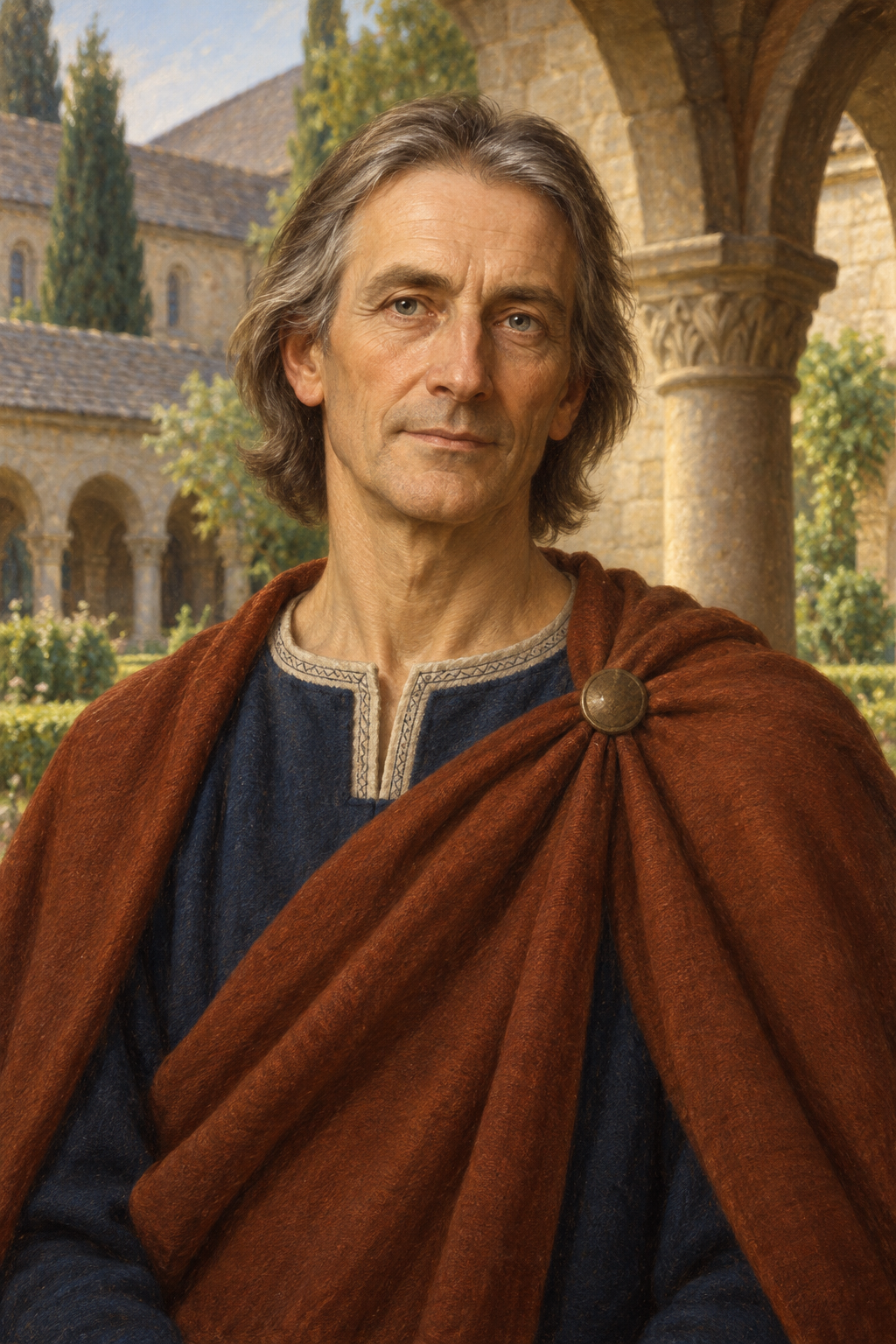
About Angilbert
Angilbert belonged to Charlemagne’s circle as a poet, diplomat and lay abbot of Centula, later called Saint-Riquier. Known at court as Homer, he was connected with Alcuin and undertook missions to the pope. His abbacy, placed around 790, joined religious patronage to continued life at the royal court.
His family is known from unusually direct testimony. The historian Nithard identifies Angilbert and Charlemagne’s daughter Bertha as the parents of himself and his brother Hartnid. He praises his father’s building at Centula and his government of its household. This testimony makes the relationship part of Angilbert’s history, rather than an episode to omit from his remembrance. It does not itself describe a marriage ceremony or subsequent penance.
The liturgical plan transmitted under his name gives a more practical view of his religious work. After decorating the churches, its author turns to their worship, teaching and singing. It provides for 300 monks and 100 schoolboys, supported with food and clothing, in three choirs. It also allows rotations for bodily needs and other duties. These are the arrangements described by the text, rather than independently verified headcounts.
The same plan directs processions between the churches and daily Masses at their altars, with prayer for Charlemagne and his family. In this account, the monastery’s wealth serves an ordered life of communal praise. The surviving text reaches us through later transmission; the scholarly catalogue distinguishes the version incorporated into Hariulf’s chronicle from another version with a festival order.
Architecture also helped shape that worship. Carol Heitz’s study relates the arrangement of the abbey’s sanctuaries to its liturgy and discusses excavations that clarified the cloister and eastern transept. The surviving descriptions and later drawings require interpretation; they are not a photograph of the buildings Angilbert knew.
Angilbert died on 18 February 814. His reputation for holiness developed alongside a complicated memory of court life. Nithard reports that his father’s body was found intact after burial, a received claim of incorruption rather than modern physical proof. Thurston notes that the story of severe penance comes from a twelfth-century biographer, while his priestly status is uncertain. Nominis retains his local commemoration on 18 February.
Wondering how to weigh the stories and sources? Learn how to read a saint biography.