Biography
Anna Julia Cooper
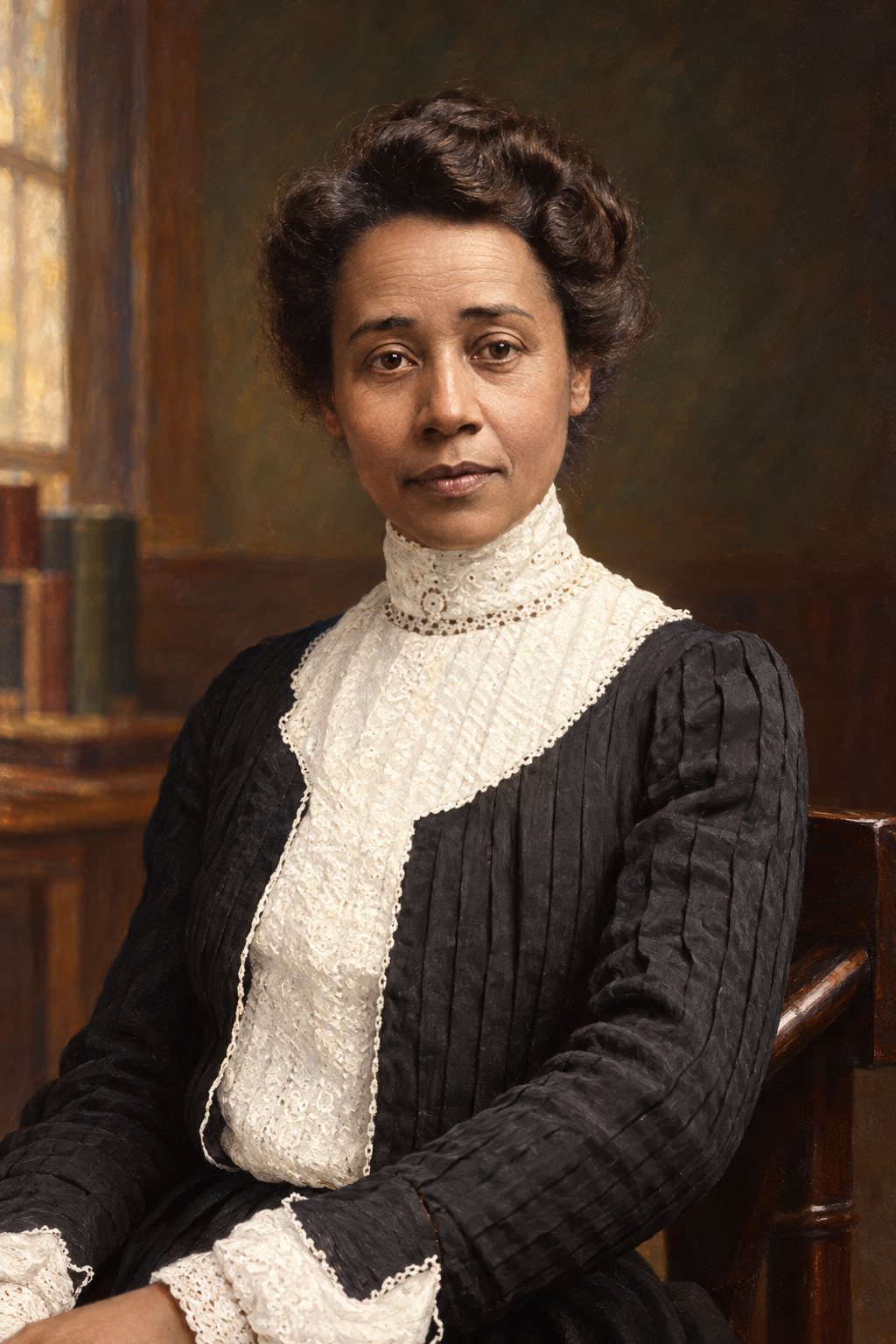
About Anna Julia Cooper
Anna Julia Cooper devoted her long life to education and to the freedom of Black women to speak for themselves. Born enslaved in Raleigh, North Carolina, she was raised by her mother, Hannah Stanley Haywood. After emancipation, she studied at St. Augustine’s school and helped teach other pupils. She married George Cooper in 1877; he died two years later. She continued teaching and entered Oberlin College in 1881, earning her bachelor’s degree in 1884. At St. Augustine’s, she successfully sought access to courses previously reserved for boys, challenging limits placed on girls’ education within the school.
Cooper remembered her student years with affection, but also as a time when she had to earn money wherever she could. Writing to Alfred Churchill in 1941, she recalled reading aloud to a student whose eyesight was failing, tutoring, and teaching algebra during her senior year. She also remembered delivering her commencement address as a speech rather than reading an essay, despite disapproval of that manner of speaking by a woman. Her recollection links her own education with the work that made it possible.
In Washington, D.C., Cooper taught at the school known as M Street High School and later became its principal. She defended a demanding education in classical and liberal arts subjects for Black students, helping them prepare for leading colleges. Her removal as principal in 1906 took place amid bitter disputes over education and racial politics. She subsequently returned to its teaching staff. Her public work also included helping organize Black women through the Colored Women’s League and the National Association of Colored Women’s Clubs.
Her 1892 book, A Voice from the South, addressed education, race, gender, and the responsibilities of religious institutions. Within it, Cooper challenged the Episcopal Church’s limited commitment to Black communities. She objected to church leaders making plans for Black people without inviting their participation. She argued that Black workers should be respected as people with judgments and purposes of their own. She also insisted that the education and development of Black women belonged at the center of the Church’s work. Her criticism came from within a Christian commitment: she questioned how a church claiming universal love could fail to make room for those it professed to serve.
In another passage, Cooper described faith through its consequences in ordinary life. She understood Jesus’ regard for the possibilities of each person as a call to lift people into fuller living. Correct opinions and religious formulas were insufficient if they left prejudice or suffering untouched. For Cooper, belief required action, growth, and attention to the lives within one’s reach.
Her own scholarly ambitions continued alongside teaching and family responsibilities. She undertook graduate work at Columbia while caring for five great-nieces and great-nephews, but could not meet the university’s residence requirement. She transferred her credits to Paris and pursued research while retaining her teaching position in Washington. Evenings and weekends at the Library of Congress helped her continue the work. She completed her doctorate at the Sorbonne in 1925.
The practical difficulties continued even after she arranged to study in Paris. Following an illness in late 1923, she requested leave from teaching. While developing her thesis, she learned that she had only sixty days to return to her Washington post or risk losing it. She returned within the deadline and continued the research around her teaching duties. Her eventual doctorate depended on sustaining that employment as well as completing the academic requirements.
Her dissertation examined France’s response to slavery during the Revolution, placing French political change in relation to the transatlantic slave trade and the Haitian Revolution.
Recognition did not remove every obstacle. In 1926 she offered Oberlin the proceeds from her published edition of a medieval French text. She had paid its production and shipping costs herself and wanted help finding an American publisher to distribute it. In her letter, she explained her concern that racial prejudice would prevent the work from being judged on its merits.
Her 1941 letter to Churchill describes another scholarly undertaking: preserving the life and writings of her friend Charlotte Forten Grimké. Cooper drew attention to Grimké’s diaries, correspondence with abolitionists, and published accounts of the South Carolina Sea Islands, bringing another Black woman’s intellectual work into view. She later privately printed a two-volume collection of writings by and about Grimké, extending this work of preserving another educator’s record.
In later life, Cooper led Frelinghuysen University, which served Black working adults in Washington. When it needed premises, she made her home available without charge. She also continued writing after her public-school teaching career ended. She died in Washington on February 27, 1964, and was buried in Raleigh beside her husband.
The Episcopal Church authorized a trial commemoration of Cooper as an educator on February 28 in 2006. The Diocese of Los Angeles included her on that date in its 2025 cycle of prayer.
Wondering how to weigh the stories and sources? Learn how to read a saint biography.