Biography
Anna Schäffer
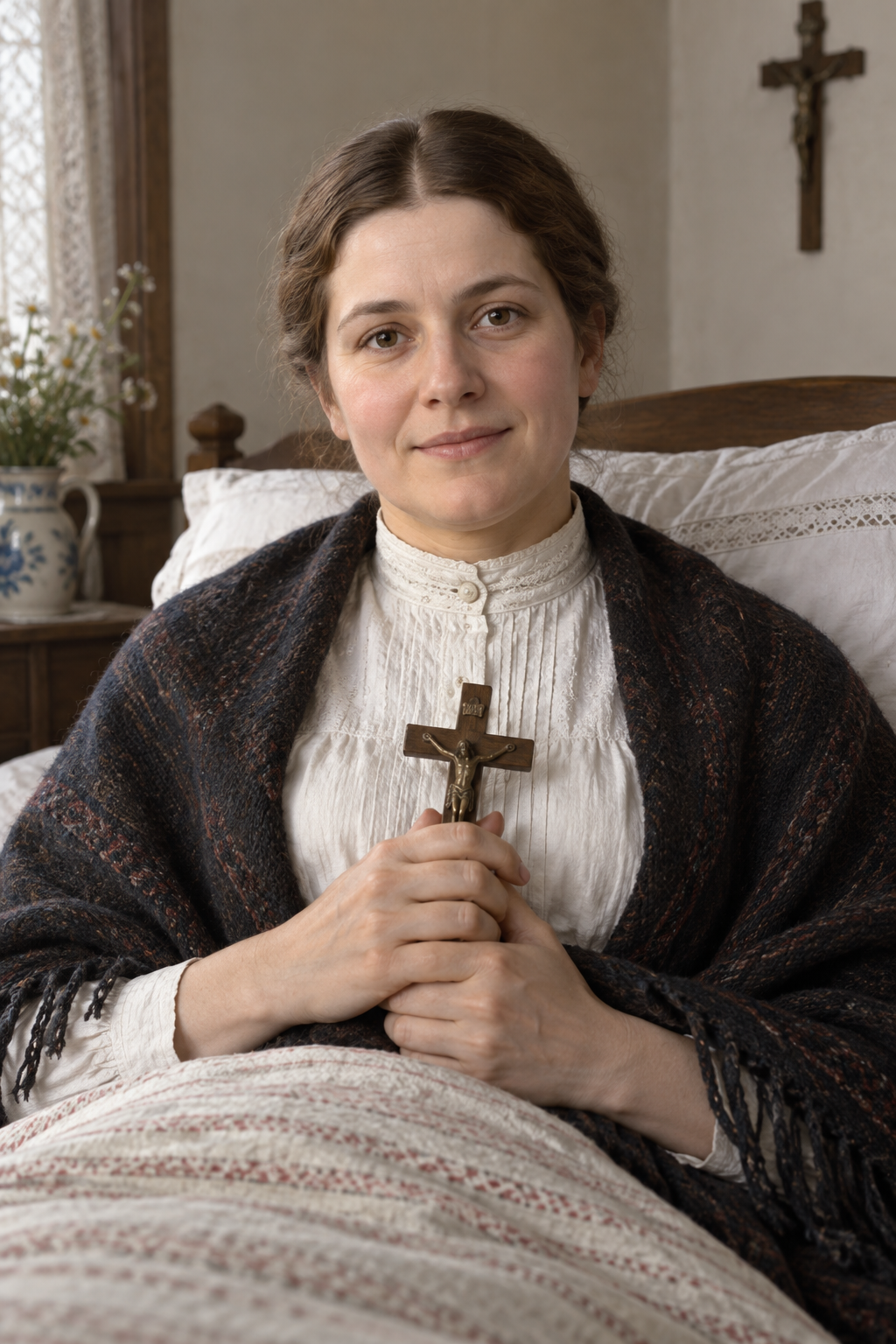
About Anna Schäffer
Anna Schäffer was born on February 18, 1882, in Mindelstetten, a Bavarian village in the Diocese of Regensburg. Her parents were Michael Schäffer, a carpenter, and Therese Forster, who came from a farming family. Church accounts disagree over the number of children, so no precise family count is retained.
She completed the village elementary school with strong reports. The Dicastery dates her First Communion to April 12, 1893; a diocesan leaflet gives 1894. The precise Dicastery date is retained, and the conflict is noted. Later accounts connect that occasion with her desire to dedicate her life to God. The surviving material does not establish every detail of how that vocation developed during childhood.
When her father died in 1896, the family's financial position worsened. Anna had already entered domestic service at thirteen, first working for a homeopath in Regensburg and later in Landshut and other households. She hoped to save the money required to enter a religious community and become a missionary sister. Employment, not formal religious life, therefore shaped her adolescence. Her work also brought her into direct care of sick people during her first placement in Regensburg.
On February 4, 1901, while employed at the forester's house in Stammham, Anna worked in the laundry with another servant. She climbed onto the rim of a boiler to repair a loose stove pipe. Snow on her clogs contributed to her losing her balance, and both legs went into the boiling laundry lye. The burns were grave and did not heal despite prolonged treatment. This accident ended her plan to earn a convent dowry and changed the practical course of her life.
Anna spent about ninety days in the hospital at Kösching before returning to her mother in Mindelstetten. Doctors used incisions, cauterization, skin grafts, ointments, and repeated operations in attempts to close the wounds. The treatments did not restore the use of her legs. A diocesan account says she was discharged as an invalid in May 1902 and that her condition continued to worsen. Anna and her mother then lived with very little income, making chronic illness and poverty inseparable parts of their household life.
Official devotional biographies do not portray her acceptance as immediate. The Mindelstetten shrine's account says that she struggled for roughly two years to understand what had happened and still hoped to recover. Her response gradually took the form of prayer and regular Communion brought by the parish priest Karl Rieger. Rieger and other villagers also provided material help. This record of dependence matters: her sickroom activity was sustained by caregivers and neighbors as well as by her own resolve.
From bed, Anna continued to work with the abilities available to her. She sewed and embroidered items for churches, wrote letters, received visitors, and listened to people who brought personal concerns. A 2025 diocesan account emphasizes that she answered many letters and promised to pray for those who sought her help. Requests reached her from beyond Bavaria, including Austria, Switzerland, and the United States. These concrete acts gave her life a social reach that the abandoned missionary plan had not achieved.
Anna's writings also preserve reports of extraordinary religious experiences. She called them dreams and wrote accounts of visions, including an experience dated October 4, 1910. Church biographies further report that she bore the stigmata, wounds associated with Christ's crucifixion. These statements record Anna's testimony and the devotional tradition received by her cause; they are not presented as independently observable medical findings. The cause reports twelve notebooks and 183 letters or notes.
Her short sayings show how she described the limited tools still open to her. The shrine preserves her image of three keys: suffering, a needle, and a penholder. Needlework and writing were not decorative additions to her story; they were activities through which she remained connected with churches and people. The quotation record retains her short reference to the needle and pen in the Holy See's English translation. Because the homily does not identify the manuscript or letter, the quotation remains probable rather than fully documented to an edition.
Her health declined further after 1923. Anna died in Mindelstetten on October 5, 1925, at the age of forty-three. She was buried there three days later. Visitors continued to come to her grave, and in 1972 Bishop Rudolf Graber permitted her remains to be transferred to the parish church. The history of that local devotion is documented; reports of favors or healings attributed to her intercession remain claims of the people and church processes that recorded them.
A diocesan cause opened in Regensburg in 1973. John Paul II beatified Anna on March 7, 1999. Benedict XVI canonized her in Saint Peter's Square on October 21, 2012, after the Catholic Church completed its prescribed review. The canonization letter records the Church's judgment and the procedure concerning a healing attributed to her intercession; it does not turn that healing into a general historical or medical claim here. The Diocese of Regensburg observes her on October 5 as a memorial and names her a virgin. Her enduring significance lies especially in the correspondence, handwork, listening, and prayer through which a disabled laywoman remained engaged with other people.
Wondering how to weigh the stories and sources? Learn how to read a saint biography.
Prayers for Anna Schäffer
Anna Schäffer: collect excerpt
Zeugnis von der Hoffnung des Evangeliums geben.