Biography
Anne Hutchinson
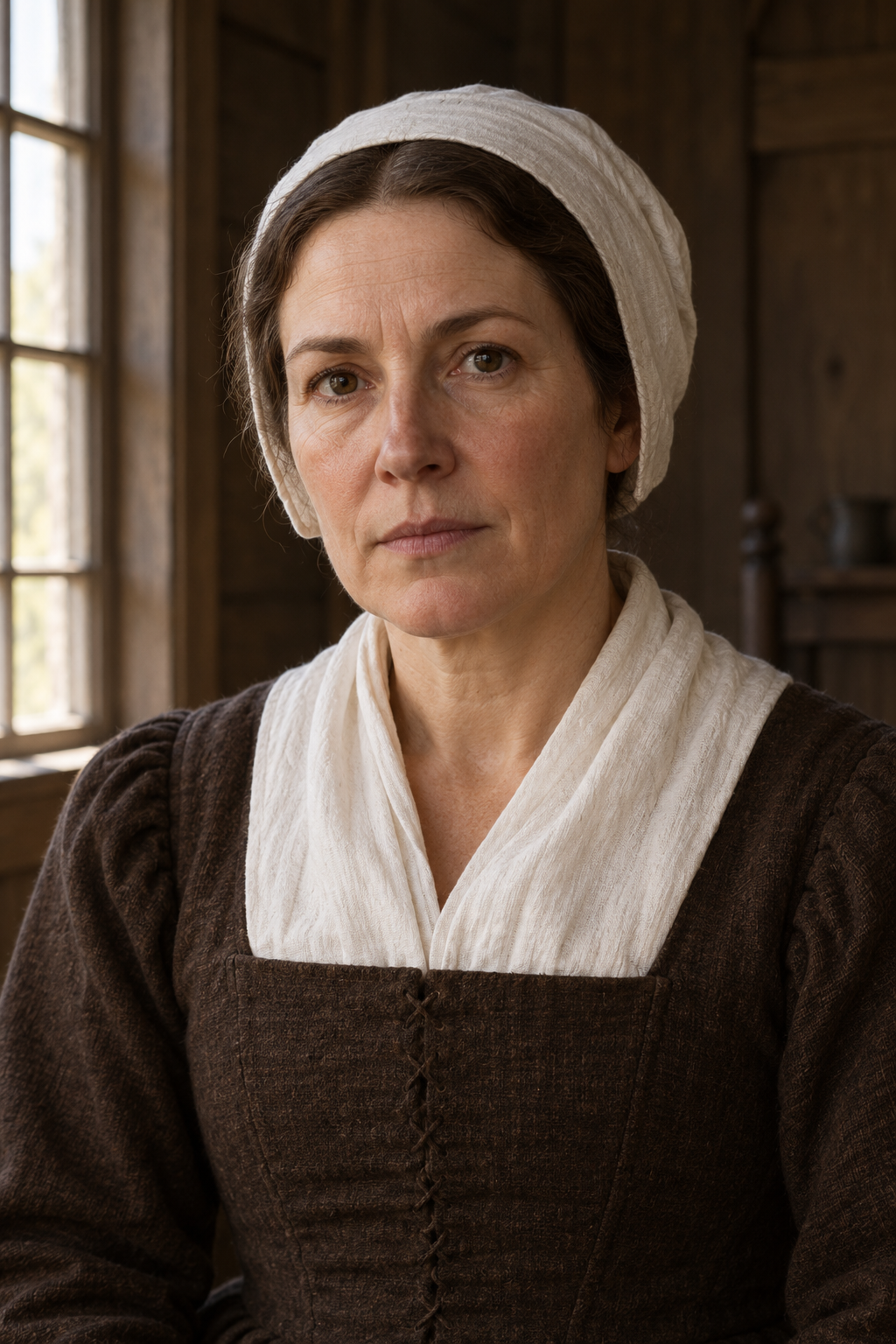
About Anne Hutchinson
Anne Hutchinson became a religious teacher through conversations held in her own home. Born Anne Marbury around 1591, she grew up in Alford, Lincolnshire, in a household shaped by her father’s religious dissent. Francis Marbury taught his daughter scripture. Although she received no formal education, she became a committed reader and an able interpreter of religious teaching. The preaching of John Cotton drew her into a Puritan circle whose members hoped to reform the church and live according to their understanding of God’s grace.
The surviving family records place her within a substantial household before the controversy that made her famous. An Alford parish entry records her baptism on July 20, 1591; that date should not be mistaken for a documented birthday. A London register records her marriage to William Hutchinson, a mercer from Alford, on August 9, 1612. The record identifies her as the daughter of Francis Marbury, a minister. Marriage, children, and the connections formed through their Lincolnshire religious community preceded the family’s migration to Massachusetts in 1634.
In Boston, Hutchinson’s work as a midwife brought her into close contact with other women. She began gathering women at home to discuss Cotton’s sermons. The meetings grew, and men also attended. Her explanations became criticisms of teachings she believed confused salvation through grace with the outward signs of a respectable life. The attention she received troubled colonial leaders, who regarded her authority over mixed gatherings as a challenge to the place assigned to women as well as to the ministers.
The dispute was not simply between religious faith and freedom from religion. Hutchinson argued from within a deeply Christian understanding of salvation. As historian William G. McLoughlin explains, she doubted that moral behavior, industry, or prosperity could establish that someone had received saving grace. God’s action could not be made the promised reward for human preparation. Her opponents thought her claims undermined the authority needed to govern a church and a colony. The name Antinomian Controversy preserves their accusation of hostility to law; it should not replace an account of the particular beliefs being debated.
At her civil examination in 1637, Governor John Winthrop accused her of disturbing the commonwealth and maintaining improper meetings. The surviving abridged transcript records her repeatedly asking what law she had broken. When challenged about teaching women, she appealed to the passage in Titus directing older women to instruct younger women. She also disputed the wording attributed to her by witnesses. John Cotton’s testimony initially supported part of her account, distinguishing criticism of how clearly ministers preached grace from the more sweeping charges against her. The proceedings brought together disputed testimony, biblical interpretation, and the magistrates’ concern for obedience.
The confrontation sharpened when Hutchinson described an immediate revelation from God. She insisted that her conscience and understanding of scripture could not simply be set aside at the court’s command. Winthrop called her revelation a delusion. The court voted to banish her and keep her confined until she could be sent away. When she asked the reason for the sentence, the governor closed the exchange rather than offering another explanation.
A church proceeding followed the civil judgment. In 1638 she was excommunicated, and Cotton publicly repudiated her meetings. Hutchinson and her family then joined other exiles on Aquidneck Island, where she became associated with the founding of Portsmouth. The movement from Massachusetts preserved a community of supporters, but it did not end the arguments about religious authority that had divided them.
McLoughlin cautions against assuming that the Hutchinsonians had developed a modern program of equal rights or universal religious toleration. The surviving records of their settlement are limited, and there is no record of Anne leading an established church there. Her own theology must largely be recovered from trial proceedings and reports by opponents, rather than writings she left in her own voice. Those limits make both dismissive judgments and uncomplicated heroic accounts difficult to sustain.
After William’s death, she moved in 1642 to New Netherland with members of her household. They settled near the waterway later called the Hutchinson River, in a region contested by Dutch colonists and Lenape people. Her experience of persecution did not place her outside that colonial conflict. The National Park Service’s account describes a settlement made under Dutch authority without obtaining Lenape consent. In 1643 an attack killed Hutchinson and most of the household. Her daughter Susanna survived and was taken to live among the Native community. The precise circumstances of the attack remain uncertain; it should not be presented as a documented execution for her religious beliefs.
Later generations made Hutchinson a symbol of women’s religious independence. A memorial received by Massachusetts in 1922 honored her as a defender of civil liberty and religious toleration. That remembrance belongs to her legacy, alongside the more particular theological conflict in which she lived.
All Saints Episcopal Church in Fort Lauderdale commemorates her with Roger Williams on February 5.
Wondering how to weigh the stories and sources? Learn how to read a saint biography.