Biography
Ansgar
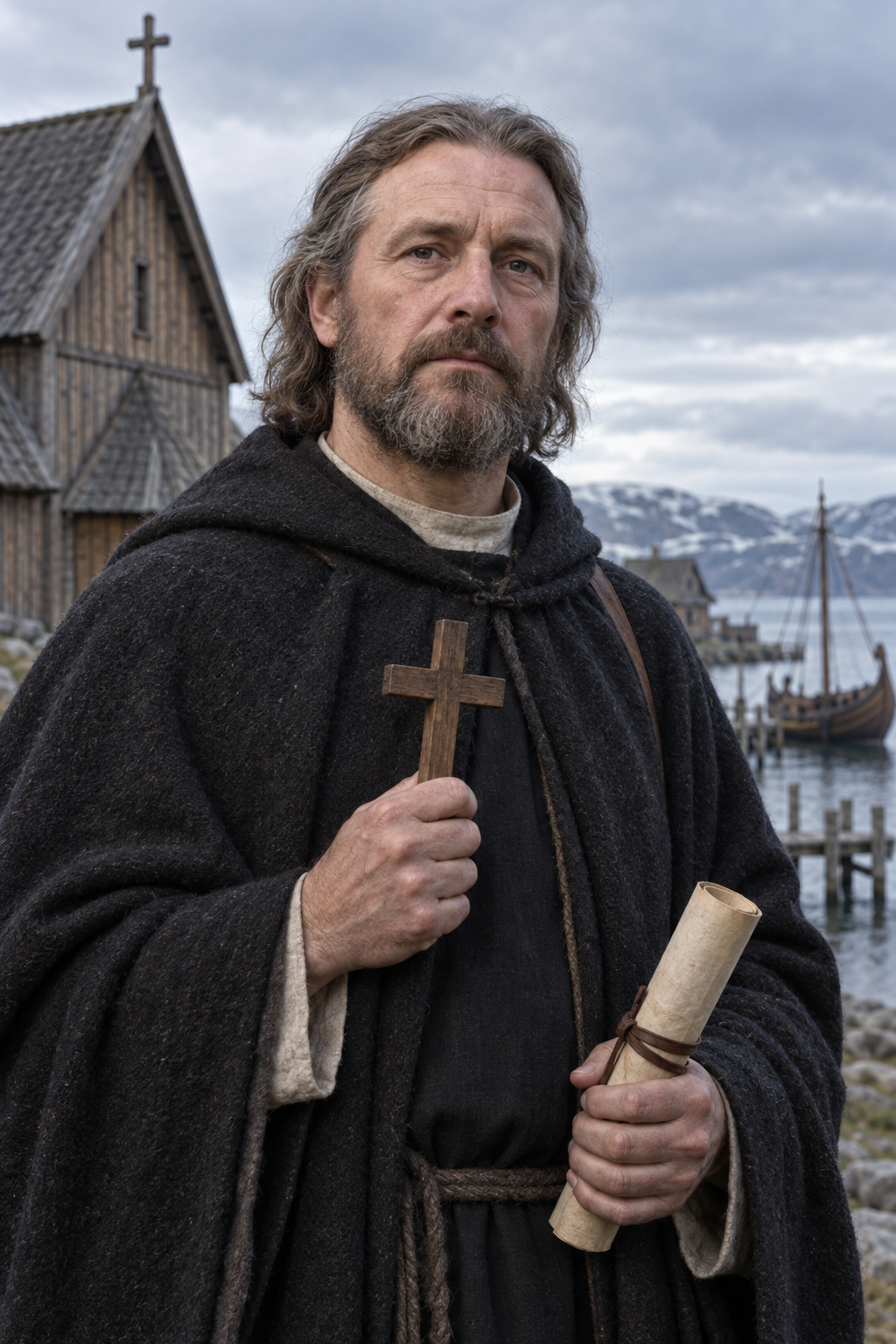
About Ansgar
Ansgar belongs to the early medieval story of Christian mission around the North Sea and Baltic. The title often given to him—Apostle of the North—signals how later Christians received that story, but a responsible account begins with the limited claims that official Church sources actually make. Paul VI, speaking to the Danish royal family in 1964, recalled Ansgar’s journey to Rome in 831–832, the pallium he received, and his appointment as apostolic legate. Those facts place his work within a mission consciously connected to Rome rather than in a legend of isolated adventure.
That commission concerned peoples and communities for whom Christian practice was neither socially secure nor uniformly established. Mission in this setting involved preaching, worship, relationships with local rulers, and the slow formation of communities able to continue when a missionary was absent. It is tempting to summarize such a process as a single conversion of a nation. The evidence instead supports a more patient picture: beginnings could be real and still vulnerable; a Christian presence could be planted without becoming immediately widespread or permanent.
The 2026 Holy See commemoration of the twelfth centenary of the beginning of Ansgar’s mission in Denmark shows the continuing importance attached to that beginning. A centenary observance is not itself proof of every biographical detail, but it confirms that the Danish mission is central to the Church’s memory of him. It also gives a clear chronological anchor for the beginning of that mission without requiring a catalogue of unverified journeys or encounters.
Ansgar’s significance can therefore be described through service rather than triumphalism. He worked in a region where Christian communities needed pastoral care and where the language of mission could easily be entangled with political ambition. The sources remembered by the Holy See emphasize apostolic responsibility: a mission is directed toward announcing Christ, forming believers, and sustaining communion. They do not warrant presenting northern peoples as passive recipients without their own history and agency.
Later tradition associates Ansgar with Denmark and Sweden and honors him as a missionary bishop. This dossier retains that broad association, but it treats the familiar honorific as devotional reception. It does not manufacture exact dates of birth or death, childhood scenes, miracle stories, or numerical claims about converts from sources that do not establish them. In this way, the account can preserve both reverence and historical discipline.
For a modern reader, Ansgar’s life suggests the ordinary, prolonged character of mission. Beginnings are often smaller than later memory makes them appear: a commission accepted, travel undertaken, worship begun, friendships formed, setbacks endured, and communities entrusted to God. The Church’s later commemoration of his Danish mission does not erase those uncertainties. It invites gratitude for a missionary legacy while leaving unproven details unclaimed.
The mission remembered in Ansgar’s name was also a work of translation in the broadest sense. Christian teaching had to be communicated across languages, customs, political boundaries, and different expectations about authority. The source record available here does not describe every method or local response. It does, however, prevent an account that imagines mission as a one-way act in which northern communities had no agency. Communities receive, question, adapt, resist, and carry forward what they have heard.
The connection with Rome gave Ansgar’s work a visible ecclesial horizon. A pallium and apostolic legation were not private honors; they expressed a responsibility exercised in communion with the wider Church. That framework can be acknowledged without importing modern assumptions about institutions into the ninth century. It helps explain why later Catholic remembrance returns to his Roman commission when it speaks about the Danish mission.
The commemoration of the mission’s twelfth centenary also shows that Christian memory is not simply a record of the past. It asks what a mission’s beginning means for people now. A centenary observance can encourage gratitude, but it can also invite examination: does Christian witness still show charity, humility, and respect for those among whom it is lived? These are interpretive questions, not claims about Ansgar’s private thoughts. They are an appropriate response to the legacy his name carries.
For this reason, Ansgar’s title as Apostle of the North should be used carefully. It is a reverent recognition of a missionary legacy, not a claim that all northern Christian history began with one person or that the subsequent history was simple. His witness is better understood as a beginning that needed many other people, many years, and the patient work of communities. That perspective preserves historical humility while still honoring the courage required to begin.
The surviving official recollections therefore invite neither triumphalism nor vagueness. They identify a real missionary commission and a real legacy, while asking later readers to resist claims that reach beyond the evidence available for his life.
Wondering how to weigh the stories and sources? Learn how to read a saint biography.