Biography
Aphrahat
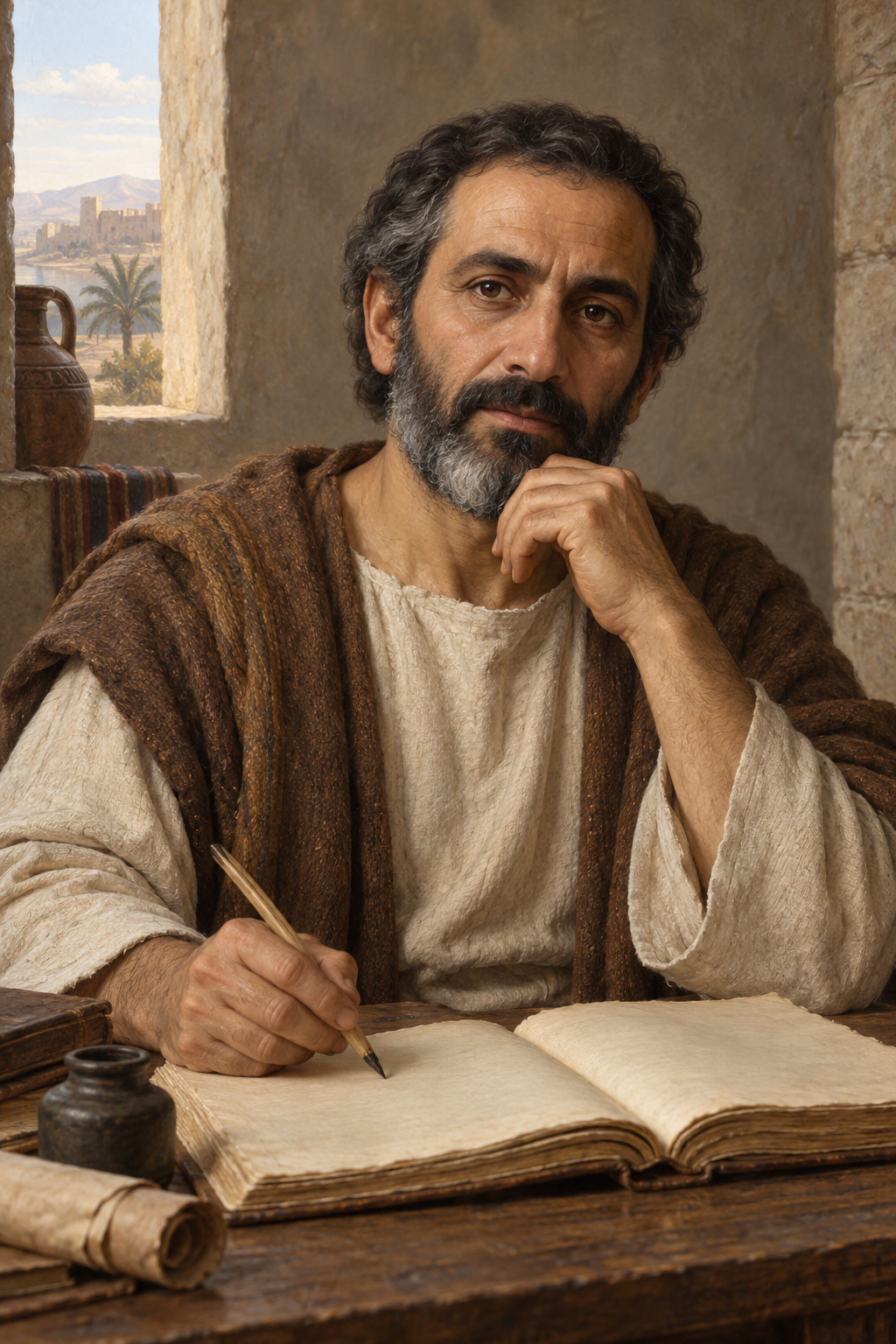
About Aphrahat
Aphrahat, known as the Persian Sage, wrote in Syriac for Christians living in the Persian Empire during the fourth century. His surviving work is the collection called the Demonstrations. Sebastian Brock identifies it as the first major literary work in Syriac, with carefully balanced prose as well as religious instruction. The dated collections place his writing in 336–337 and 343–344, with a final work in 345. These dates establish when he was active; they do not establish the year of his death.
Little can be securely recovered about his childhood or the course of his life. The Catholic Encyclopedia explicitly says that his date of death is unknown. A biography therefore cannot end his life in 345 simply because that is the date of his last surviving work. The distinction matters for a writer whose books provide much firmer evidence than later accounts of his personal history.
John Gwynn challenged the often repeated birth date of about 280. It depended on assuming Aphrahat was elderly when he wrote, an assumption without proof. Comparisons with Ephrem’s literary chronology could not repair that gap. The evidence allows the writers to be treated as contemporaries without assigning Aphrahat a precise age.
His ecclesiastical position is uncertain as well. Brock finds some authority behind the writings, but rejects the late identification of Aphrahat as bishop of the monastery of Mar Matay. He places the discussions of ascetic life within the early Syriac tradition of the sons of the covenant and solitary Christians. This setting helps explain the writings without supplying an authenticated monastery, ordination record or episcopal office for their author.
The first Demonstration answers an inquirer who asks for instruction about faith. Aphrahat uses the image of a building whose foundation is Christ. Faith must take shape in deeds: prayer, fasting, generosity, hospitality, patience and care in speech. He moves through biblical examples rather than telling the story of his own life. The account preserves a teacher’s voice, but it does not provide evidence that he personally performed the miracles he recounts from Scripture.
The same work contains sharp claims against the people of Israel, presenting their rejection of Christ through images of darkness and loss. These are Aphrahat’s polemical religious judgments, rather than neutral descriptions of Jewish life. They belong to the historical setting of the writing and should be acknowledged alongside its practical teaching about good deeds.
Gwynn’s study of Aphrahat’s biblical citations also counsels care. He found agreements with several Syriac forms of Scripture, but not uniform dependence on a single surviving version. Some gospel passages seemed closer to the Diatessaron, while others suggested separate Gospels. His analysis makes the Demonstrations important witnesses to the history of reading Scripture, while leaving particular textual relationships open to investigation.
A different aspect of the author emerges in Hervé Inglebert’s study of Syriac historical thought. Inglebert argues that Aphrahat should be understood within an early attempt to bring biblical interpretation into conversation with historical knowledge from the Greek and Roman world. This challenges the idea that his Syriac language placed him outside every wider intellectual exchange. The argument concerns the sources and methods visible in his writings, rather than proving journeys or personal encounters that his biography does not record.
Inglebert reaches that conclusion through comparisons of royal and imperial lists. He proposes that Aphrahat drew on an older list of Roman rulers, related to traditions also used by Christian chronographers. He does not claim that Aphrahat simply copied Eusebius’s complete history. The distinctions between shared sources and direct borrowing help explain both the resources available to the Persian writer and the limits of reconstructing his reading.
The recovery of his work has its own history. Gwynn explains that the Armenian version was printed at Rome in 1756 under an incorrect attribution to Jacob of Nisibis. The Syriac text was later recovered from manuscripts in the British Museum and published by William Wright in 1869. The misattribution brought the writings to scholarly attention before their author was properly identified. It also shows why a familiar saint’s name on a manuscript cannot by itself settle authorship.
Aphrahat remains present in modern church teaching. In his 2007 audience, Benedict XVI used the Persian Sage to emphasize the place of Scripture within Christian spiritual formation. He presented reading, humility and prayer as connected practices, and asked his listeners to consider the closeness of prayer and charity. The address treated Aphrahat as a voice that could still shape everyday Christian life, rather than merely as an entry in the history of theology.
Benedict also drew attention to the early Syriac setting of that voice. His catechesis described a religious culture with Semitic roots and a strong connection to the biblical world. The emphasis gives modern readers a reason to encounter Aphrahat on his own linguistic and spiritual terms, without expecting every ancient Christian writer to use the same vocabulary or method.
The Syriac Orthodox Patriarchate’s Department of Syriac Studies lists him as Saint Aphrahat. Its linked author page presents translations of the Demonstrations and studies of the Persian Sage.
Theodoret describes an Aphraates who left his cell to support Christians at Antioch under Valens. That monk’s story should not be transferred to this writer’s record.
The linked catalog records Arabic translations and a study by Boulos al Feghali. These publications show a continuing effort to make the author’s writings available to another readership. Aphrahat’s lasting significance lies chiefly in that surviving voice: an early witness to Syriac Christianity whose work can still be read, questioned and interpreted across centuries.
Wondering how to weigh the stories and sources? Learn how to read a saint biography.