Biography
Baruch
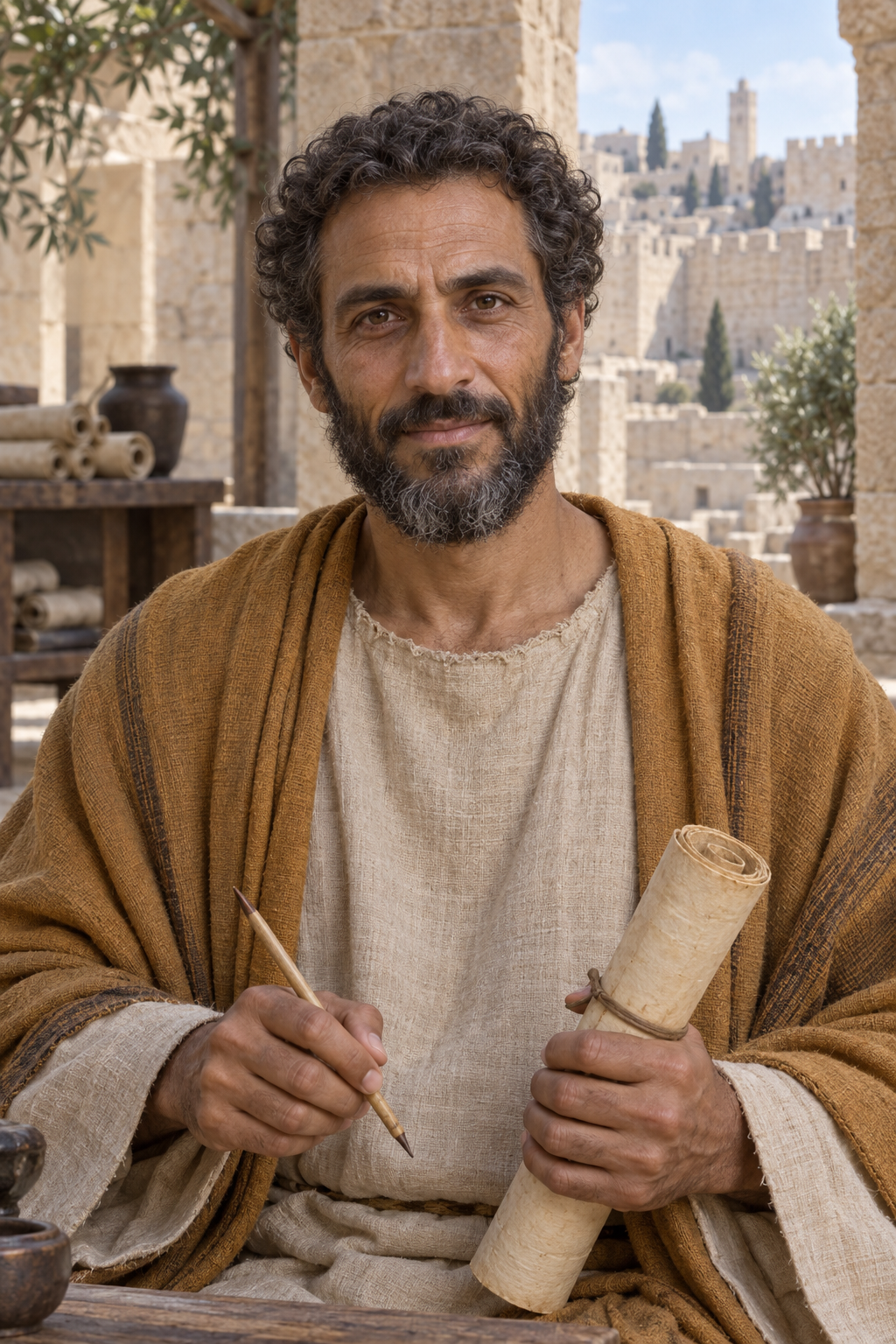
About Baruch
Baruch son of Neriah appears in the Book of Jeremiah as Jeremiah's scribe, trusted agent, and companion during Judah's final crisis before and after Jerusalem's fall. That identity separates him from several other biblical men named Baruch. The reviewed texts do not provide his birth, childhood, mother, marriage, or death. They place his activity within the reigns of Judah's last kings, but those narrative settings do not support the catalog's inherited endpoints of 650 and 582 BC. Those dates are therefore removed. A careful life must stay with the actions Jeremiah attributes to Baruch and distinguish them from later traditions attached to his name.
Jeremiah 32 introduces Baruch during the Babylonian siege of Jerusalem. Jeremiah is confined in the court of the guard when he buys family land at Anathoth as a sign that property will again be held in Judah. After the deed is signed, sealed, witnessed, and weighed, Jeremiah gives both the sealed document and its open copy to Baruch. He directs Baruch to place them in an earthen jar so they may last a long time. Baruch's role is practical and legally careful: he receives records in front of witnesses and preserves them amid war. The chapter does not say where the jar was stored or whether it survived.
A longer episode begins in the fourth year of King Jehoiakim. Jeremiah dictates his messages, and Baruch writes them on a scroll. Because Jeremiah is barred from entering the temple, he sends Baruch to read the scroll there on a fast day. Baruch does what he is asked and reads from a room overlooking the temple court, within hearing of the gathered people. The narrative gives him more than quiet clerical work. He carries contested words into a public setting when their author cannot go. The text does not report Baruch's exact handwriting, training, or official rank, so scribe is retained without inventing a court office.
Officials hear of the reading and summon Baruch. He reads the scroll to them and explains that Jeremiah dictated while he wrote with ink. Alarmed, they say the king must be informed and advise Jeremiah and Baruch to hide without revealing their location. The king has the scroll read aloud, cuts off sections with a scribe's knife, and burns them in a brazier. He then orders the arrest of both men, but the narrative says they remain hidden. Baruch is not described as imprisoned in this chapter. Later accounts that add imprisonment should therefore be labeled tradition rather than folded into Jeremiah's report.
The destruction of the first scroll does not end the work. Jeremiah takes another scroll, and Baruch writes again at his dictation all the words that had been burned, with additional material. This repeated labor is one of the clearest actions associated with him. It shows diligence under political pressure: the record is reconstructed after an attempt to erase it. The narrative credits Jeremiah as the prophetic speaker and Baruch as the scribe. It does not make Baruch the author of every oracle or allow modern readers to identify the exact boundaries of his editorial contribution to the finished Book of Jeremiah.
Jeremiah 45 preserves a personal word addressed to Baruch from the same regnal year. Baruch laments that grief has been added to pain and that he is exhausted. The response does not shame the weariness or promise public success. It tells him not to seek great things for himself and promises that his life will be granted wherever he goes. The passage reveals strain within Baruch's service and prevents a portrait of effortless courage. His faithfulness occurs alongside grief, fatigue, and an uncertain future. The promise belongs to Jeremiah's prophetic narrative; it is not evidence for the later circumstances or date of Baruch's death.
After Jerusalem's fall, opponents accuse Jeremiah of lying about the command to remain in Judah and accuse Baruch of inciting him to hand the remnant over to Babylon. The leaders reject the warning and take the survivors, Jeremiah, and Baruch into Egypt, arriving at Tahpanhes. The text presents Baruch as taken with the group, not as choosing or directing the migration. It says nothing further about his personal fate. Jerusalem and Tahpanhes are therefore valid settlement-level settings for mapped narrative events, but no route, stopping points, or exact residence can be supplied. Later stories of his return to Babylon are not established by this chapter.
A separate work called the Book of Baruch opens by attributing a scroll to Baruch and setting him among exiles in Babylon. The USCCB introduction explains that the book is a collection of different compositions, that only Greek and other versions survive, that its Babylonian setting is fictional, and that its final form may belong to the last two centuries BC. This is much later than the world narrated in Jeremiah. The book is received as Scripture in Catholic and Orthodox traditions, but its literary attribution cannot be used as direct biographical evidence that Jeremiah's scribe composed the whole collection or lived in Babylon in the scene it presents.
The Orthodox Church in America commemorates the Prophet Baruch on September 28 and presents him as Jeremiah's devoted follower and secretary. Its life also preserves later claims about imprisonment, travel, Jeremiah's death, and Baruch's return to Babylon. Those details are valuable evidence of Orthodox reception, not equal evidence for sixth-century events. The feast is recorded as a documented present observance while the catalog avoids adopting unverified death traditions. The title prophet belongs to that ecclesial reception and to the Book of Baruch's attribution; Jeremiah itself most clearly depicts Baruch as scribe, custodian of records, public reader, and endangered companion.
Baruch's enduring significance rests on concrete acts of preservation and accompaniment. He safeguards a deed during siege, writes Jeremiah's words, reads them publicly, hides when arrest is ordered, and recreates a destroyed scroll. He remains with Jeremiah when both are carried into Egypt, while his own lament records the cost of that fidelity. His story gives scribal work moral weight without romanticizing it. Written testimony can be fragile, power can try to destroy it, and the person preserving it may be tired and afraid. Baruch is remembered not because the evidence supplies a complete life, but because these bounded scenes show responsible service under sustained pressure.
Wondering how to weigh the stories and sources? Learn how to read a saint biography.