Biography
Benigna Cardoso da Silva
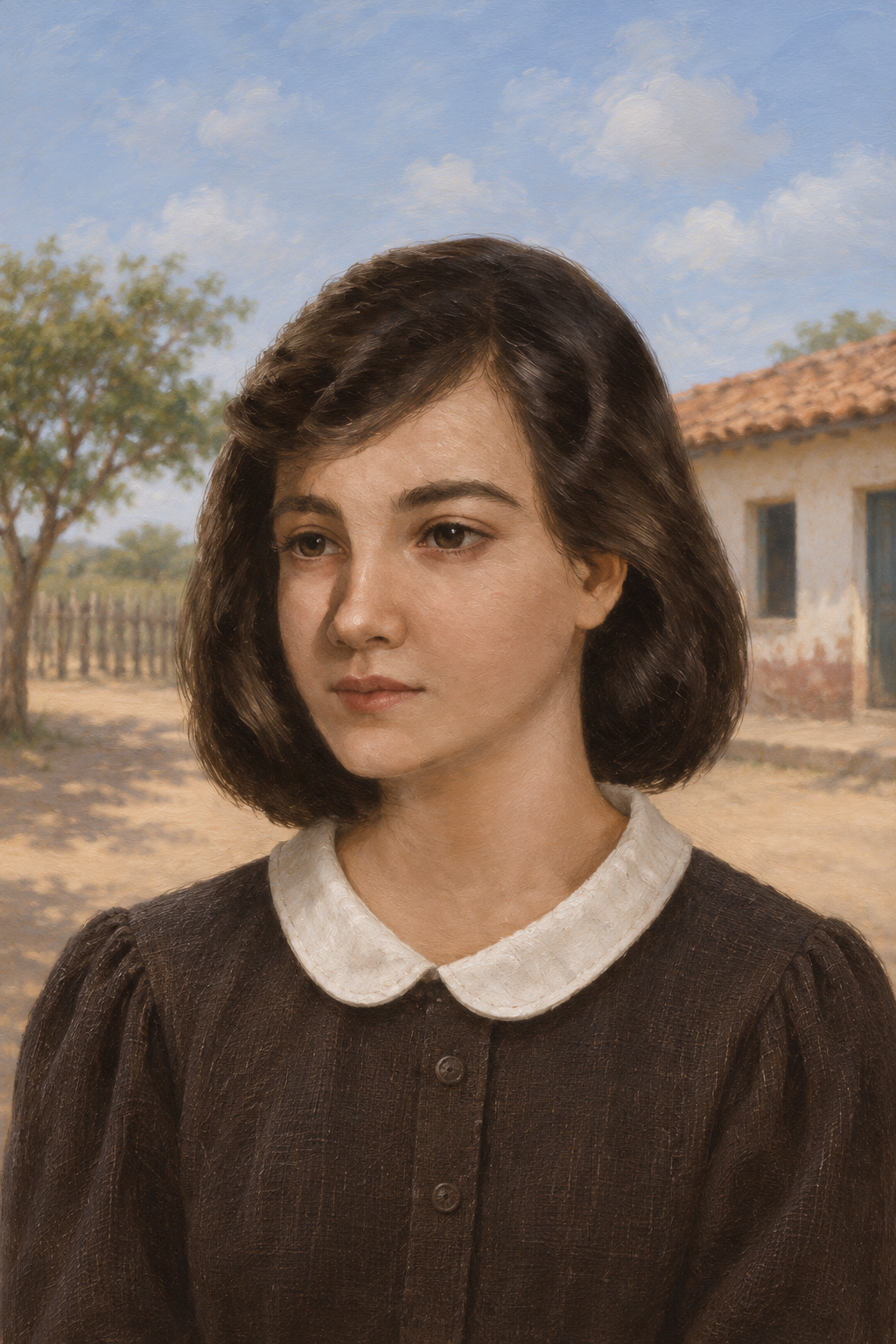
About Benigna Cardoso da Silva
Benigna Cardoso da Silva grew up in the countryside around Santana do Cariri, Ceará. Born at Sítio Oiti on 15 October 1928, she lost both parents while very young and was taken into the Sisnando Leite household with her siblings. The diocesan account remembers a childhood with foster sisters, games, dolls, songs and outings. These memories give a glimpse of a child’s ordinary life before later devotion concentrated so strongly on the circumstances of her death.
She helped with domestic tasks and attended school and church. The Catholic account describes her as reserved and willing to assist the household that had taken her in. Communion and participation in parish life were important to her. Her faith belonged to a rural community and to the people who cared for her; she was a lay girl, rather than a member of a religious congregation.
The diocese’s earlier biography recalls that she accompanied women of the household to worship and participated in devotion to the Sacred Heart. It also describes her as generous and well liked by people who knew her. The account is retrospective testimony about childhood, not a detailed record of her thoughts. The material it preserves concerns school, household work, relationships and prayer, the limited but important settings of a life that ended at thirteen.
During the last part of her life, a local boy repeatedly harassed her despite her rejection of his advances. She sought guidance from her confessor. On 24 October 1941, when she went to collect water, he attacked and killed her.
A note attributed to the parish priest, reproduced by the Diocese of Crato, records her death at Sítio Oiti that afternoon. The published annotation also shows how quickly her death was understood locally in religious terms. The original baptism register has not been inspected here.
The church’s formal investigation took place much later. The original martyrdom decree records a diocesan inquiry in 2013 and subsequent review in Rome. Pope Francis authorized the recognition of her martyrdom in 2019. This was a formal Catholic judgment, distinct from the popular devotion that had developed around her.
Her beatification followed at Crato on 24 October 2022, in a celebration led by Cardinal Leonardo Steiner as the pope’s representative.
The ceremony included people connected with her family story. Her foster sisters carried a relic in the rite, and the diocesan bishop spoke of the familiar printed cotton clothing in which her image was presented. The community remembered a girl from its own rural culture, rather than a remote figure detached from that place.
Her familiar face is itself a modern reconstruction. In 2022 the diocese presented a facial approximation prepared by Cícero Morais using photographs of relatives and recollections from people close to her. It should not be confused with a photograph taken during her life.
Bishop Fernando Panico’s earlier foreword to her biography also gave remembrance a practical purpose: affirming human dignity and rejecting violence against women. Those concerns remain part of the church’s interpretation of her short life.
Wondering how to weigh the stories and sources? Learn how to read a saint biography.