Biography
Blaise
About Blaise
Blaise is remembered as a bishop and martyr of Sebaste in Armenia Minor, a city represented today by Sivas in Türkiye. The Roman Martyrology places his suffering under Emperor Licinius, whose reign overlapped the early fourth century. A historical reference published in the Catholic Encyclopedia likewise regards his episcopate and martyrdom near the beginning of that century as the limited core that may be accepted. No contemporary life survives, however. His birth, family, education, occupation, exact death date, and the circumstances of his ministry cannot be securely reconstructed, so this account leaves those details unset.
The surviving narrative belongs to later hagiography. It presents Blaise as a physician before his election as bishop, but the historical reference does not treat that profession as established. It also notes that the Acts preserved in several languages are legendary and that their details cannot serve as a contemporary record. That distinction matters because modern retellings often blend the small historical core with a long sequence of miracles and tortures. Blaise may responsibly be called bishop and martyr in received Christian memory; calling every scene in his passion documented would claim more than the evidence allows.
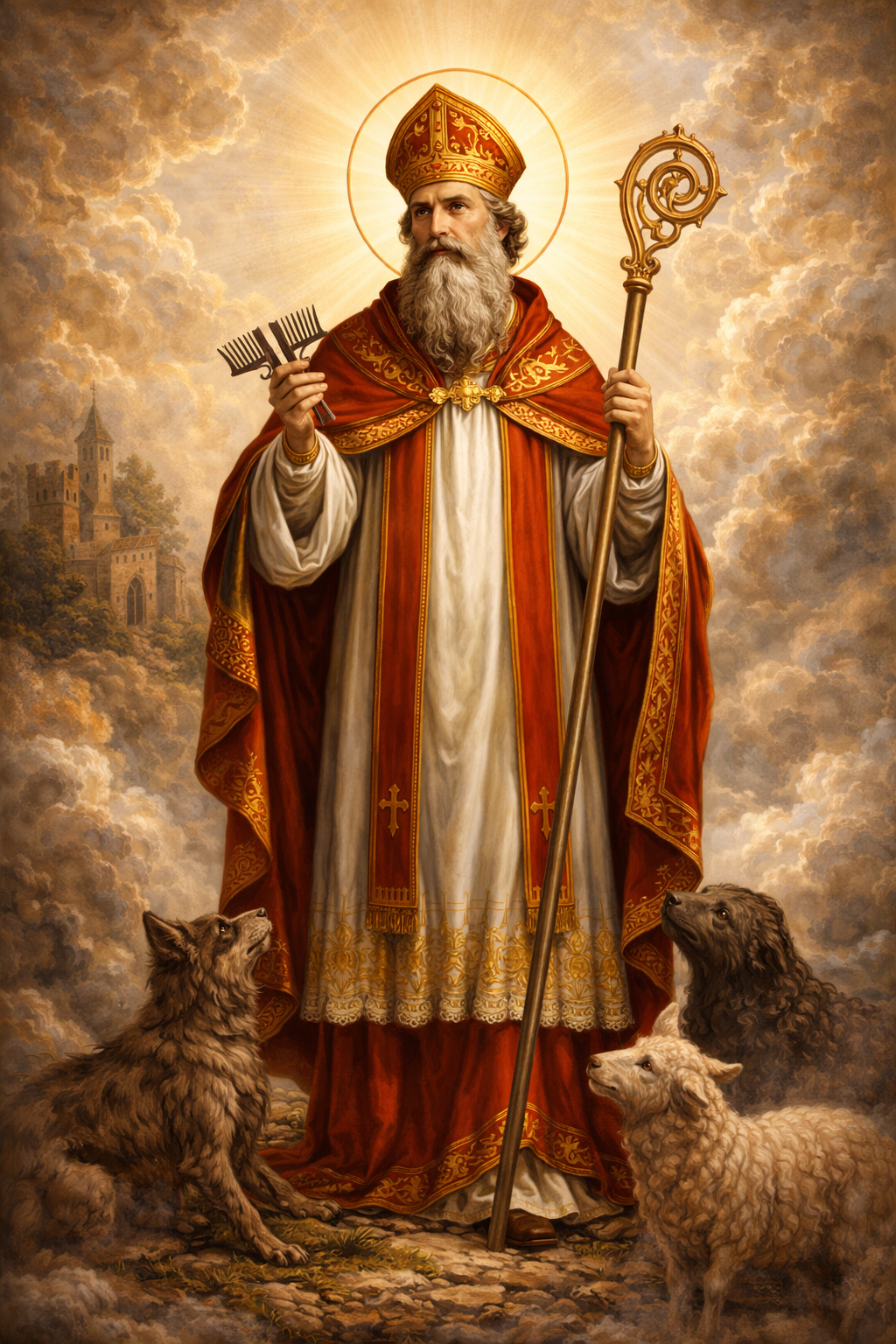
The Orthodox Church in America preserves the fuller Eastern account. In it, Blaise is chosen bishop of Sebaste during persecution, encourages Christians, visits prisoners, and supports martyrs. He later withdraws to a cave on a mountain, where wild animals wait peacefully while he prays and sick animals receive healing. Hunters searching for beasts discover him and report him to the governor. These scenes communicate a received image of pastoral care extending to vulnerable people and animals. They are valuable evidence for how Orthodox tradition remembers Blaise, but the cave, the animals, and the healings remain traditional or legendary rather than independently verified episodes.
According to the same life, Blaise goes with the soldiers rather than resisting arrest. On the way, a poor widow reports that a wolf has taken her pig, her only possession; the animal then returns it unharmed. The governor presses Blaise to honor the gods, has him beaten, and imprisons him when he refuses. The account later describes severe torture with iron implements. Western art connected those instruments with wool combs, helping to make Blaise a patron of wool workers. The violence should not be hidden, but neither its precise instruments nor the miraculous return of the animal can be presented as established history.
The passion also remembers seven women who gather Blaise's blood, reject the governor's demand to worship idols, and are tortured and beheaded. One entrusts her two sons to Blaise. He is then taken to a lake; the narrative says that he stands upon the water while sixty-eight men who enter it drown. An angel calls him back to shore, and the governor orders Blaise and the two boys beheaded. This is an uncompromising story of state coercion and lethal religious violence. The women and children should not disappear from its retelling, even though their names and independent historical identities are not established.
Another legend became more influential in Western devotion: while Blaise was being led to prison, he saved a child who was choking on a fish bone. The Catholic Encyclopedia connects this story with the long-standing practice of invoking him for diseases of the throat. It also records an older Western sacramental custom in which two candles, consecrated around his feast, are held in a crossed position near the throat while a blessing is spoken. The legend does not prove a medical event in Blaise's life. It does explain why care for people facing frightening illness became the most recognizable part of his later cult.
The throat blessing remains a living practice rather than merely a medieval survival. After Mass at the Vatican on February 3, 2014, two priests gave Pope Francis and the congregation the traditional blessing by placing two crossed candles at the throat. The gesture uses Blaise's received intercession; it is not a reenactment or proof of the fish-bone story. Its modern setting also shows how a sparse ancient biography can sustain a concrete pastoral custom. The best interpretation keeps compassion for bodily vulnerability at the center without promising a cure or treating devotional ritual as a substitute for medical care.
Blaise's calendars developed differently across Christian traditions. The United States Catholic lectionary marks February 3 as his optional memorial and identifies him as bishop and martyr. The Orthodox Church in America commemorates the hieromartyr on February 11 and preserves the traditional date of about 316. Those observances document present liturgical reception; they do not establish the day or year of his death. The Western cult was already represented in ninth-century historical martyrologies, according to the Catholic Encyclopedia, showing that devotion traveled far beyond Sebaste even while the biographical evidence remained limited.
Blaise therefore stands at the meeting point of a probable early-fourth-century martyrdom and a richly elaborated devotional memory. The historically cautious portrait is modest: a Christian remembered as bishop of Sebaste who died under imperial pressure. Tradition adds pastoral visits, care for animals, endurance under torture, concern for a widow and child, and solidarity with other victims. Later communities made those themes tangible through feasts, images, guild patronage, and the blessing of throats. His continuing significance lies not in proving every marvel, but in the durable association of religious courage with attentive care for people in pain.
Wondering how to weigh the stories and sources? Learn how to read a saint biography.