Biography
Caleb
About Caleb
Caleb in this profile is Caleb son of Jephunneh, the Kenizzite leader associated with Judah in Numbers and Joshua. That exact identification matters because the Hebrew Bible contains other people and family lines called Caleb, especially in 1 Chronicles. Their parents, descendants, settlements, and chronology cannot be transferred to son of Jephunneh merely because English translations spell their names alike. The available account is scriptural narrative rather than contemporary administrative documentation. It preserves a coherent literary portrait of courage and fidelity, but it does not establish Caleb's birth year, birthplace, private childhood, or manner of death.
Numbers first names Caleb among twelve leaders sent from the wilderness of Paran to reconnoiter Canaan. He represents the tribe of Judah and is explicitly called son of Jephunneh. The scouts travel through the land, inspect its settlements and produce, and return after forty days. Their report agrees that the land is fruitful, but fear rises around fortified cities and their inhabitants. Caleb quiets the people before Moses and urges immediate action. The chapter gives him a distinctive public role at a moment when a group entrusted with observation becomes divided over what its evidence means and what response faithfulness requires.
The crisis deepens in Numbers 14. The community weeps, complains against Moses and Aaron, and proposes returning to Egypt. Caleb and Joshua tear their garments and answer together that the land is good and that Israel should not rebel or fear. Their appeal does not prevail; the assembly threatens to stone them. The narrative then distinguishes Caleb and Joshua from the generation that refused to enter. Caleb is promised entry because he followed wholeheartedly. This is not a story of optimism detached from danger. The text says the cities were fortified. Caleb's courage consists in speaking a minority judgment openly while acknowledging the difficulty.
Numbers later revisits the failure when tribes request land east of the Jordan. Moses recalls that men sent from Kadesh-barnea discouraged Israel and says that Caleb son of Jephunneh the Kenizzite and Joshua son of Nun were excepted because they followed the Lord wholeheartedly. Deuteronomy offers another retrospective: the people would not go up, Caleb would see the land, and his descendants would receive territory on which he had walked. These retellings confirm Caleb's stable role in the received narrative while also showing that biblical books shape the episode for later communities. They do not provide a modern date for the reconnaissance.
Joshua 14 returns to Caleb at the apportionment of Canaan. At Gilgal he reminds Joshua of the mission from Kadesh-barnea and says that he was forty when Moses sent him. He reports that forty-five years have passed and calls himself eighty-five. These ages belong within the story's chronology; they do not justify calculating exact BCE birth and death years. Caleb asks for the mountain region containing Hebron despite the Anakim and fortified cities. Joshua blesses him and grants the territory. The chapter identifies him both as son of Jephunneh and as Kenizzite, while placing his household's inheritance among Judah.
Joshua 15 describes the Hebron tradition in action. Caleb drives out three Anakim named Sheshai, Ahiman, and Talmai, then sets a challenge concerning Debir. Othniel captures it and receives Caleb's daughter Achsah in marriage. Achsah later asks her father for springs because her allotted land is dry, and Caleb grants upper and lower springs. The passage presents a household embedded in conquest and land distribution. Modern readers should neither erase the violence nor transform an ancient war narrative into uncomplicated moral instruction. The virtues retained here concern Caleb's earlier truthful report, solidarity with Joshua, and willingness to accept a difficult responsibility—not violence as such.
Caleb's relationships are unusually clear within the narrative. Jephunneh is named as his father. Joshua is first his fellow scout and public ally, then the leader who blesses him and grants Hebron. Moses sends the scouts and transmits the promise concerning Caleb. Achsah is named as Caleb's daughter, and Othniel becomes his son-in-law after the Debir episode. These are literary and genealogical relationships in Scripture, not independently verified civil records. The Kenizzite designation has generated scholarly discussion, but the text itself associates Caleb with Judah without explaining every stage of that affiliation.
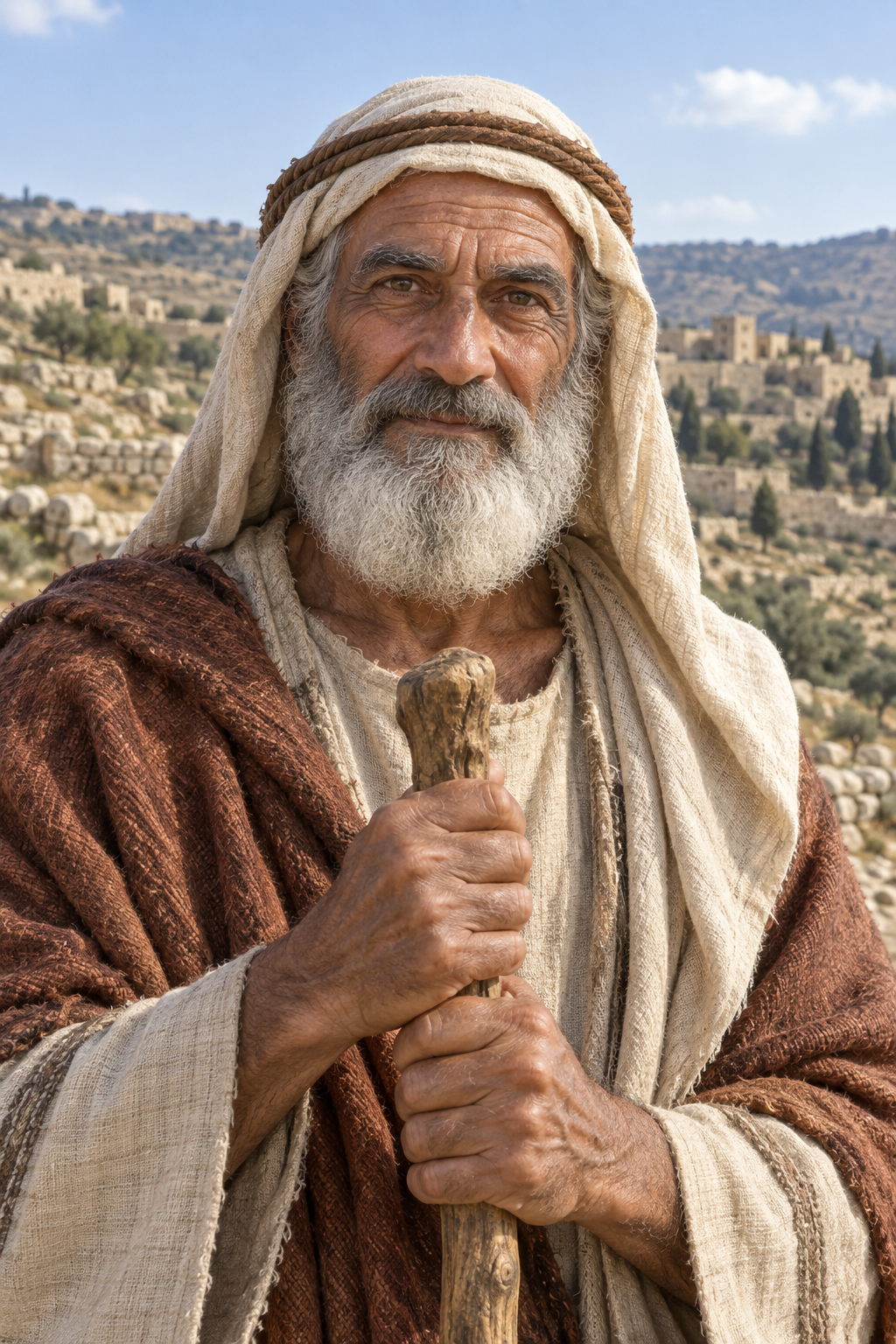
No precise feast observance or prayer for Caleb son of Jephunneh was established in the sources reviewed for this packet. He is classified as a lay leader and confessor in the broad catalog sense: he holds no priestly or royal office, and he publicly maintains his conviction under threat. His short quotation, asking Joshua for the mountain region promised to him, is attributed by the Book of Joshua and is not presented as a transcript confirmed outside Scripture. The artwork is modern AI-generated devotional imagery. It may symbolize age, travel, or courage, but it cannot establish Caleb's appearance, clothing, weapons, or surroundings.
Caleb's enduring contribution is a pattern of responsible dissent. He observes the same difficult landscape as the other scouts but refuses to let danger become an excuse for collective abandonment. He stands with Joshua when the crowd threatens them, remembers a long-delayed promise, and accepts a challenging inheritance rather than requesting ease. At the same time, careful reading limits what can be claimed: Scripture gives no defensible civil dates, no birthplace or death account, and no permission to merge him with Chronicles' Caleb lineages. His story can encourage courage, patience, and truthfulness without converting sacred narrative into invented modern biography.
Wondering how to weigh the stories and sources? Learn how to read a saint biography.