Biography
Carmen Rendiles Martínez
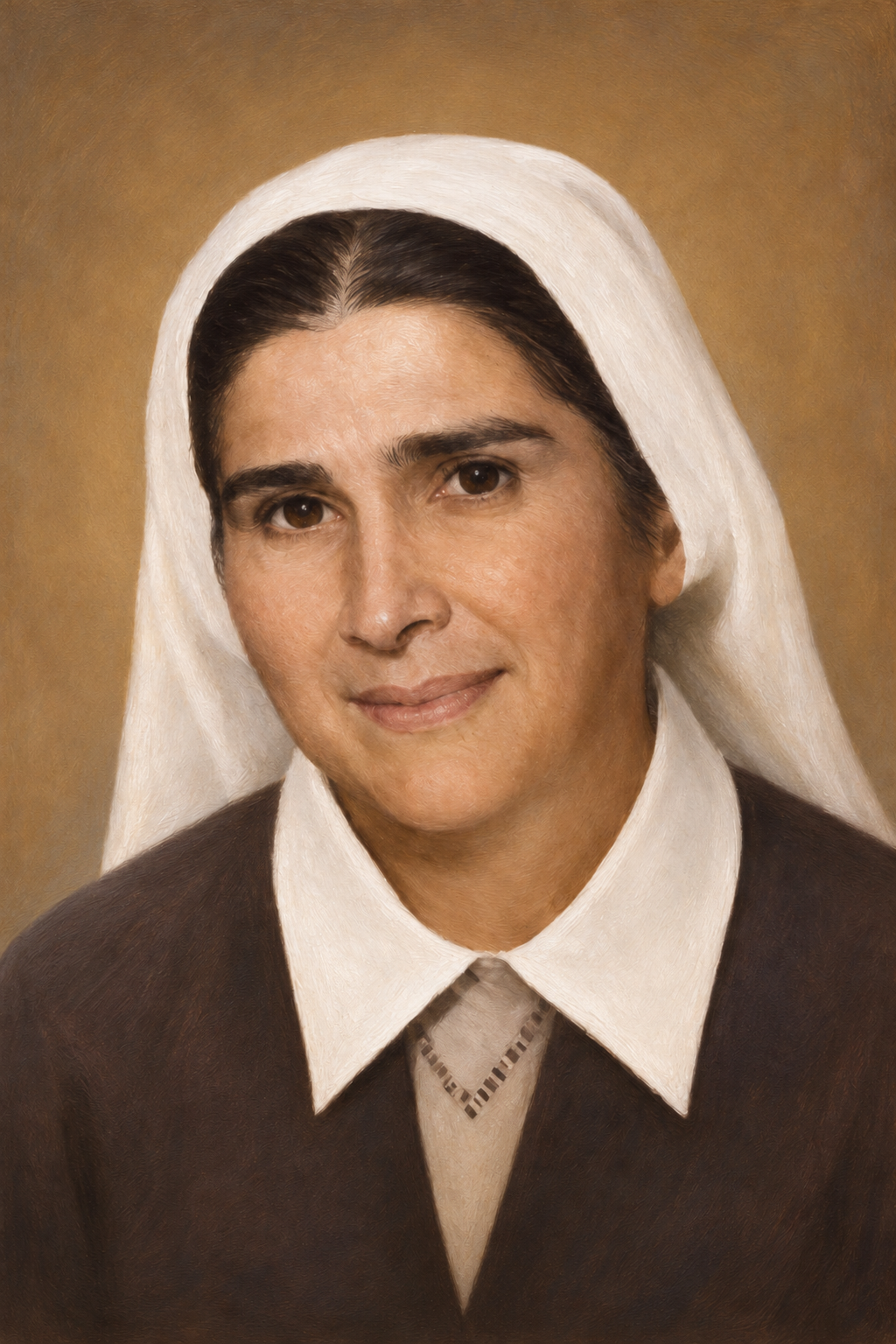
About Carmen Rendiles Martínez
Carmen Rendiles Martínez was a Venezuelan religious founder whose work joined education, Eucharistic prayer and practical support for priests. She was born at Caracas on August 11, 1903, to Ramiro Rendiles and Ana Antonia Martínez. Born without her left arm, she used a prosthesis throughout her life. After the deaths of a younger brother in 1921 and her father in 1924, she helped her mother and younger siblings. Parish catechesis and charitable work accompanied her growing interest in religious life. A community founded in Toulouse opened a house in Caracas in 1926. Carmen joined it the following year and made her perpetual profession on September 8, 1932. From 1935 to 1943 she served as novice mistress in Caracas. Tuberculosis in 1942 and arthritis in 1945 brought further lasting health difficulties. As the sisters developed their work in Venezuela and Colombia, she helped guide communities serving in schools, parishes, seminaries and diocesan offices.
Her relationship with France began before she entered the congregation. At the El Paraíso school, run by the Sisters of Saint Joseph of Tarbes, she learned French. She also studied art, including painting and woodworking. François Bonfils's account for the Diocese of Toulouse describes repeated refusals by religious communities concerned about her disability and fragile health. The sisters from Toulouse eventually received her, and her knowledge of their language helped her communicate with the newly arrived French community. After perpetual profession she went to Toulouse for further formation. She returned to Caracas in 1934. Through these years she became deeply attached to the Eucharistic spirituality of the French founder, Jeanne-Onésime Guibret. Her later disagreement with the French institute did not erase that attachment. Bonfils describes the separation as painful, involving a woman determined to preserve what she believed she had received from her religious family while continuing dialogue with its members.
When the original congregation sought to become a secular institute, the Venezuelan sisters wished to remain religious. In 1965 a new diocesan congregation, the Servants of Jesus, was established. Carmen continued visiting its houses despite increasing disability. She died at Caracas on May 9, 1977. The institute received pontifical approval in 1985.
The work remembered at her beatification included schools for girls in need, notably institutions associated with Santa Ana in Caracas and other Venezuelan towns. The sisters' educational mission developed alongside assistance to priests. In a 2018 interview, Cardinal Angelo Amato remembered Carmen as an adviser who offered priests personal and maternal support. He also emphasized her attention to sick sisters: visiting, encouraging and helping them rather than treating illness as a withdrawal from community life. Her religious ideal linked Eucharistic adoration with the daily responsibilities of service. The spirituality was therefore expressed in institutions, relationships and practical assistance as well as in prayer. Amato described her concern for people who caused her suffering through respect, restraint and forgiveness. His account also recalled the appeal in her final circular for prayer on behalf of people returning to the Eucharist. The circular's concern reflected the place of sacramental life in the mission she hoped her sisters would continue.
The vice-postulator of her cause, Rosa María Ríos, later described a leader formed within family life. In an interview with journalist Fabiana Ortega, she stressed that Carmen's disability did not prevent leadership either at home or in the congregation. Ríos placed the emphasis of the canonization cause on the sustained practice of Christian virtues. The reported healings were considered within that process as confirmation, rather than as a substitute for examining her life. The interview recalled the collection of her writings and testimonies after her death and the opening of the study of her life and virtues in 1995. Its account of her legacy centered on the Eucharist and priestly ministry. Ríos invited readers to consider the ordinary work of each day when thinking about Carmen's holiness. This interpretation comes from a representative of the cause and expresses how her religious community understands the founder's continuing significance. Among the virtues Ríos highlighted were humility, prudence, fortitude and generosity toward others. She described prayer as friendship with God and related that friendship to Carmen's decisions in community life. The interview thus explained the spiritual meaning her sisters attached to ordinary responsibilities.
In 2025 Archbishop Raúl Biord Castillo of Caracas likewise connected Carmen's recognition with the lives of Venezuelan women. He remembered the difficulty she faced in being admitted to religious life and the educational purpose of the community she founded. For him, her recognition also honored mothers and grandmothers who transmitted faith, and religious women working in schools, hospitals and neighborhoods. He presented Carmen and José Gregorio Hernández as figures capable of bringing together people divided by social, economic and political differences.
Pope Leo XIV canonized Carmen Rendiles Martínez in Rome on October 19, 2025. Catholics now honor her as Saint Carmen Rendiles.
Wondering how to weigh the stories and sources? Learn how to read a saint biography.